. 2016 Nov;41(12):2830-2838.
doi: 10.1038/npp.2016.81. Epub 2016 May 31.

Nucleus Accumbens Acetylcholine Receptors Modulate Dopamine and Motivation

Affiliations

Nucleus Accumbens Acetylcholine Receptors Modulate Dopamine and Motivation

Anne L Collins et al. Neuropsychopharmacology. 2016 Nov.

Abstract

Environmental reward-predictive cues can motivate reward-seeking behaviors. Although this influence is normally adaptive, it can become maladaptive in disordered states, such as addiction. Dopamine release in the nucleus accumbens core (NAc) is known to mediate the motivational impact of reward-predictive cues, but little is known about how other neuromodulatory systems contribute to cue-motivated behavior. Here, we examined the role of the NAc cholinergic receptor system in cue-motivated behavior using a Pavlovian-to-instrumental transfer task designed to assess the motivating influence of a reward-predictive cue over an independently-trained instrumental action. Disruption of NAc muscarinic acetylcholine receptor activity attenuated, whereas blockade of nicotinic receptors augmented cue-induced invigoration of reward seeking. We next examined a potential dopaminergic mechanism for this behavioral effect by combining fast-scan cyclic voltammetry with local pharmacological acetylcholine receptor manipulation. The data show evidence of opposing modulation of cue-evoked dopamine release, with muscarinic and nicotinic receptor antagonists causing suppression and augmentation, respectively, consistent with the behavioral effects of these manipulations. In addition to demonstrating cholinergic modulation of naturally-evoked and behaviorally-relevant dopamine signaling, these data suggest that NAc cholinergic receptors may gate the expression of cue-motivated behavior through modulation of phasic dopamine release.


Figures
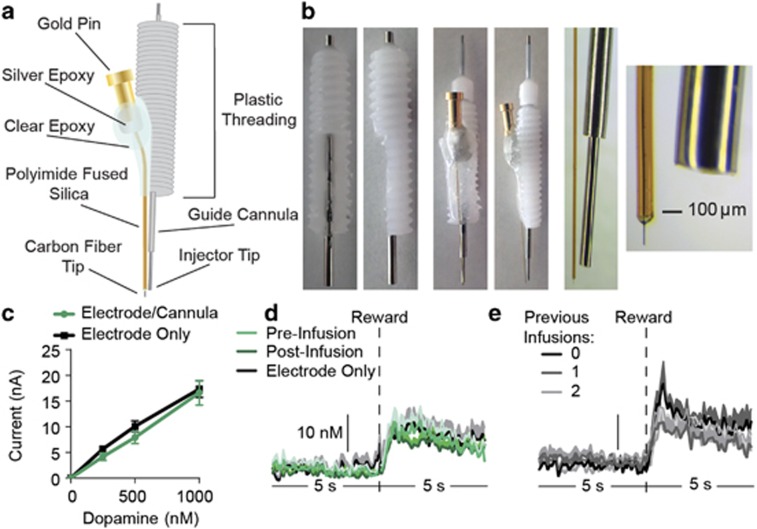
Figure 1
Figure 1
Design and characterization of carbon-fiber microelectrode/cannula probes. (a) Schematic of carbon-fiber microelectrode combined with a guide cannula for microinfusion in the extracellular recording space. (b) Images of guide cannulae with portion of plastic threading shaved down on one side (left) and assembled electrode/cannula probe with injector inserted through the guide cannula (middle). Right-most images show magnification of the electrode tip with the injector inserted through the guide cannula. (c) Average current response of either electrode/cannula probes or individual electrodes to known concentrations of dopamine in vitro in a flow-cell calibration unit. (d) Averaged (across trials and across subjects) dopamine concentration vs time traces 5 s before and after delivery of an unexpected food-pellet reward detected at either carbon-fiber microelectrodes alone, or electrode/cannula probes either before (pre-infusion) or after (post-infusion) infusion of ACSF vehicle. (e) Averaged dopamine concentration vs time around pellet delivery detected at electrode/cannula probes either before any infusion had ever been made or after rats had, on previous days, received either one or two infusions.
Figure 2
Figure 2
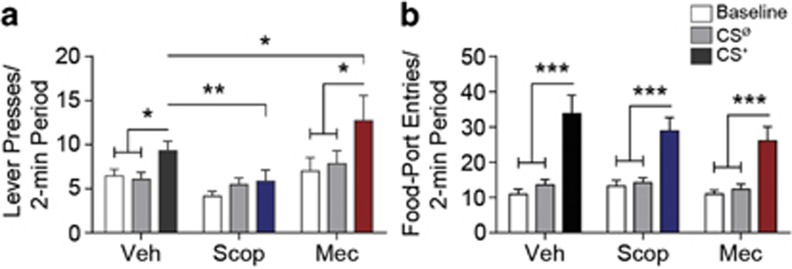
Effect of nucleus accumbens muscarinic and nicotinic acetylcholine receptor blockade on Pavlovian-to-instrumental transfer. Prior to each PIT test (see the ‘Materials and Methods' section), rats were bilaterally infused with either scopolamine (Scop; 10 μg), mecamylamine (Mec; 10 μg), or ACSF vehicle (Veh) into the NAc. (a) The PIT effect. Number of lever presses during each 2-min period, averaged across trials compared between the CS-free (baseline), neutral stimulus (CSØ), and reward-predictive cue (CS+) periods. (b) Conditioned food-port approach responding. Number of entries into the food-delivery port during each 2-min period, averaged across trials compared between the baseline, CSØ, and CS+ periods. n=24. Error bars represent±1 SEM. *p<0.05, **p<0.01, ***p<0.001.
Figure 3
Figure 3
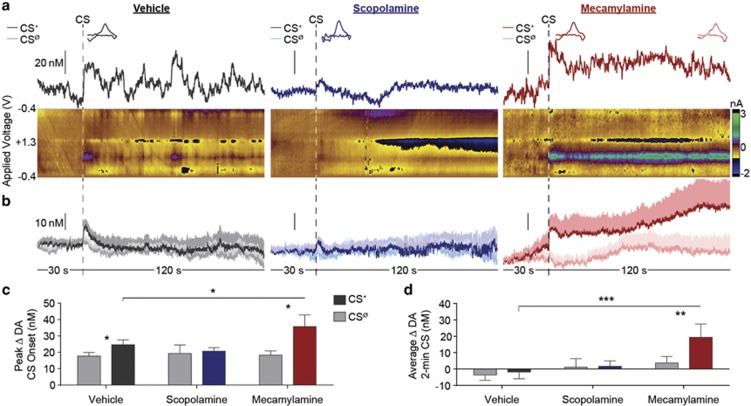
Effect of nucleus accumbens muscarinic and nicotinic acetylcholine receptor blockade on cue-evoked dopamine signaling during Pavlovian-to-instrumental transfer. (a) Representative example, single-trial, FSCV data 30 s before and during the entire 2-min CS+, during the PIT test following the unilateral infusion of ASCF-vehicle (left), scopolamine (10 μg); (middle), or mecamylamine (10 μg); (right) into the NAc recording zone. Upper plot depicts the dopamine concentration vs time trace. Inset, cyclic voltammograms identifying the detected current as dopamine, taken from within the first 30 s following CS+ onset. Right inset of mecamylamine condition, average of CVs taken at 1-s intervals for the duration of the CS+ (shading shows SEM), confirming detection of sustained dopamine throughout the CS+. Color plots in the lower panels show corresponding background-subtracted cyclic voltammograms as a function of the applied voltage vs time. (b) Average (across trials of the same type and across subjects) dopamine concentration vs time trace change 30 s prior to and during the entire 2-min CS+ or CSØ period. Shading reflects +1 between-subjects SEM. (c) Peak dopamine concentration change in the 30-s period following CS+ or CSØ onset, averaged across trials. (d) Average dopamine concentration change during 2-min CS+ or CSØ period. n=10. Error bars represent±1 SEM. *p<0.05, **p<0.01, ***p<0.001.
Figure 4
Figure 4
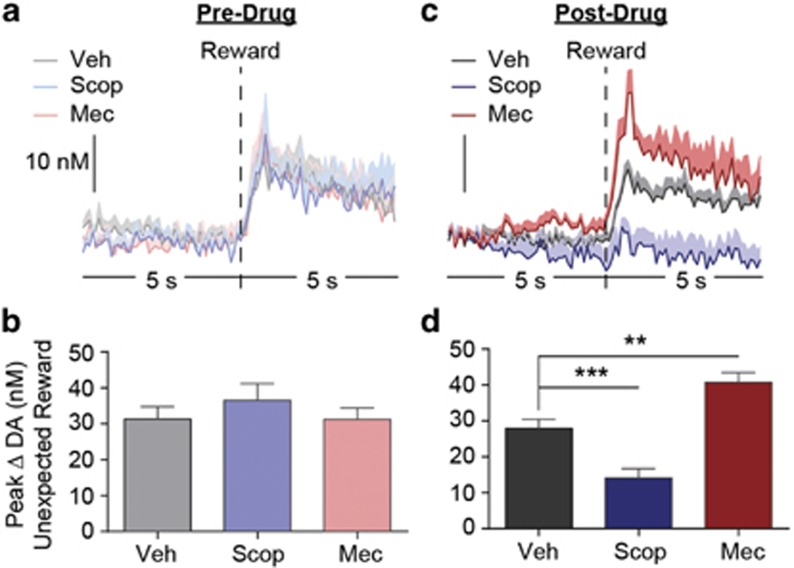
Effect of nucleus accumbens muscarinic and nicotinic acetylcholine receptor blockade on unexpected reward-evoked dopamine. (a and c) Averaged (across trials and across subjects) dopamine concentration vs time traces 5 s before and after delivery of an unexpected food pellet reward off drug (a) or following the unilateral infusion of either scopolamine (Scop; 10 μg), mecamylamine (Mec; 10 μg), or ACSF vehicle (Veh) into the NAc FSCV recording zone (c). Shading reflects +1 between-subjects SEM. (b and d) Peak dopamine concentration change within 3 s following unexpected food reward delivery off drug (b) or following unilateral intra-NAc infusion (d) n=7. Error bars represent±1 SEM. **p<0.01, ***p<0.001.

References

    1. Aitken TJ, Greenfield VY, Wassum KM (2016). Nucleus accumbens core dopamine signaling tracks the need-based motivational value of food-paired cues. J Neurochem 136: 1026–1036. - PMC - PubMed
    1. Berridge KC (2007). The debate over dopamine's role in reward: the case for incentive salience. Psychopharmacology (Berl) 191: 391–431. - PubMed
    1. Bolam JP, Wainer BH, Smith AD (1984). Characterization of cholinergic neurons in the rat neostriatum. A combination of choline acetyltransferase immunocytochemistry, golgi-impregnation and electron microscopy. Neuroscience 12: 711–718. - PubMed
    1. Cachope R, Cheer JF (2014). Local control of striatal dopamine release. Front Behav Neurosci 8: 188. - PMC - PubMed
    1. Cachope R, Mateo Y, Mathur BN, Irving J, Wang HL, Morales M et al (2012). Selective activation of cholinergic interneurons enhances accumbal phasic dopamine release: setting the tone for reward processing. Cell Rep 2: 33–41. - PMC - PubMed

MeSH terms