


Protective efficacy and safety of liver stage attenuated malaria parasites
- PMID: 27241521
- PMCID: PMC4886212
- DOI: 10.1038/srep26824
Protective efficacy and safety of liver stage attenuated malaria parasites
Abstract
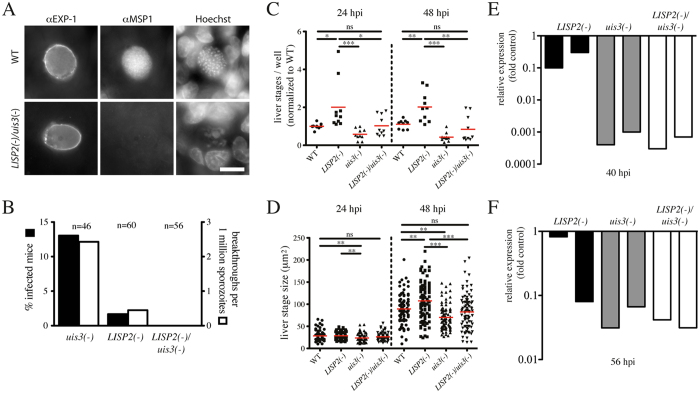
During the clinically silent liver stage of a Plasmodium infection the parasite replicates from a single sporozoite into thousands of merozoites. Infection of humans and rodents with large numbers of sporozoites that arrest their development within the liver can cause sterile protection from subsequent infections. Disruption of genes essential for liver stage development of rodent malaria parasites has yielded a number of attenuated parasite strains. A key question to this end is how increased attenuation relates to vaccine efficacy. Here, we generated rodent malaria parasite lines that arrest during liver stage development and probed the impact of multiple gene deletions on attenuation and protective efficacy. In contrast to P. berghei strain ANKA LISP2(-) or uis3(-) single knockout parasites, which occasionally caused breakthrough infections, the double mutant lacking both genes was completely attenuated even when high numbers of sporozoites were administered. However, different vaccination protocols showed that LISP2(-) parasites protected better than uis3(-) and double mutants. Hence, deletion of several genes can yield increased safety but might come at the cost of protective efficacy.
Figures
References
-
- Nussenzweig R. S., Vanderberg J., Most H. & Orton C. Protective immunity produced by the injection of x-irradiated sporozoites of Plasmodium berghei. Nature 216, 160–162 (1967). - PubMed
-
- Silvie O. et al.. Effects of irradiation on Plasmodium falciparum sporozoite hepatic development: implications for the design of pre-erythrocytic malaria vaccines. Parasite Immunol. 24, 221–223 (2002). - PubMed
-
- Seder R. A. et al.. Protection against malaria by intravenous immunization with a nonreplicating sporozoite vaccine. Science 341, 1359–1365 (2013). - PubMed
-
- Hoffman S. L. et al.. Protection of humans against malaria by immunization with radiation-attenuated Plasmodium falciparum sporozoites. J. Infect. Dis. 185, 1155–1164 (2002). - PubMed
-
- Beaudouin R. L., Strome C. P. A., Mitchell F. & Tubergen T. A. Plasmodium berghei: Immunization of mice against the ANKA strain using the unaltered sporozoite as an antigen. Exp. Parasitol. 42, 1–5 (1977). - PubMed
Publication types
MeSH terms
Substances
LinkOut - more resources
Full Text Sources
Other Literature Sources
Medical
