Review
. 2016 Sep;87(5):1505-19.
doi: 10.1111/cdev.12549. Epub 2016 May 31.

Eureka!: What Is Innovation, How Does It Develop, and Who Does It?

Affiliations
Review

Eureka!: What Is Innovation, How Does It Develop, and Who Does It?

Kayleigh Carr et al. Child Dev. 2016 Sep.

Abstract

Innovation is not only central to changes in traditional practice but arguably responsible for humanity's remarkable success at colonizing the earth and diversifying the products, technologies, and systems within it. Surprisingly little is known of how this integral component of behavioral flexibility develops and the factors that are responsible for individual differences therein. This review highlights two primary ways in which the process and development of innovation may be better understood: By emulating the critical advances of animal behavior researchers in examining innovation in nonhuman species and establishing a clearer conceptualization of what is "innovation". A pathway to innovation is suggested and an innovation classification system offered to aid recognition of its appearance and potential cultural contributions.


Figures

Figure 1
Figure 1
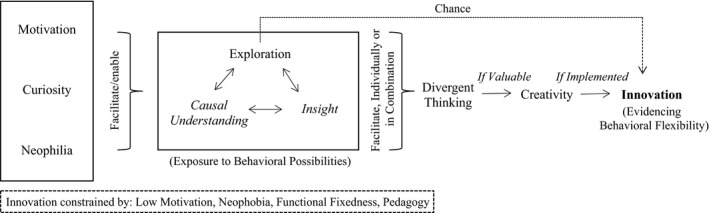
A hypothetical individual‐level pathway to innovation. Arrows denote which construct leads to another construct. From left to right, any of the processes within the first block can lead to those within the second block. The constructs in italic text within the second block play more contested, or less direct, roles in this pathway (see Point 2). Neophilia, and its opposing construct neophobia, are discussed in Point 3. Context and prior learning (social and/or asocial) are acknowledged to potentially contribute to each construct portrayed and to differentially promote behavioral change. Innovation is generally regarded as a component of behavioral flexibility by allowing “individuals to react to environmental changes… [by] changing established behavior” (Toelch et al., 2011, p. 1). It should be noted that, rather than necessarily prompting divergent thinking and creativity, exploration may allow an individual to stumble upon an innovation by chance, captured by the connecting arrow.

References

    1. Beck, S. R. , Apperly, I. A. , Chappell, J. , Guthrie, C. , & Cutting, N. (2011). Making tools isn't child's play. Cognition, 119, 301–306. doi: - DOI - PubMed
    1. Benson‐Amram, S. , & Holekamp, K. E. (2012). Innovative problem solving by wild spotted hyenas. Proceedings of the Royal Society B, 279, 4087–4095. doi: - DOI - PMC - PubMed
    1. Bijvoet‐van den Berg, S. , & Hoicka, E. (2014). Individual differences and age‐related changes in divergent thinking in toddlers and preschoolers. Developmental Psychology, 50, 1629–1639. doi: - DOI - PubMed
    1. Bonawitz, E. , Shafto, P. , Gweon, H. , Goodman, N. D. , Spelke, E. , & Schulz, L. (2011). The double‐edged sword of pedagogy: Instruction limits spontaneous exploration and discovery. Cognition, 120, 322–330. doi: - DOI - PMC - PubMed
    1. Boyd, R. , & Richerson, P. J. (1985). Culture and the evolutionary process. Chicago, IL: University of Chicago Press.

Publication types

LinkOut - more resources