


A study on pre-XDR & XDR tuberculosis & their prevalent genotypes in clinical isolates of Mycobacterium tuberculosis in north India
- PMID: 27241648
- PMCID: PMC4892081
- DOI: 10.4103/0971-5916.182625
A study on pre-XDR & XDR tuberculosis & their prevalent genotypes in clinical isolates of Mycobacterium tuberculosis in north India
Abstract
Background & objectives: Pre-extensively drug resistant (pre-XDR) and extensively drug resistant tuberculosis (XDR-TB) have been areas of growing concern, and are posing threat to global efforts of TB control. The present study was planned to study the presence of pre-XDR and XDR Mycobacterium tuberculosis and their genotypes in clinical isolates obtained from previously treated cases of pulmonary TB.
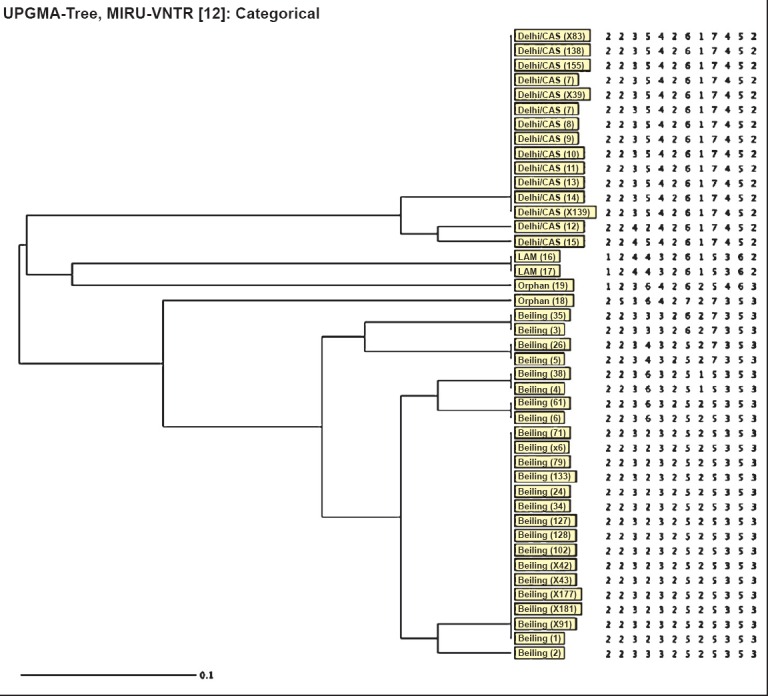
Methods: A total of 219 isolates obtained from previously treated cases of pulmonary TB were subjected to first-line (streptomycin, isoniazid, rifampicin and ethambutol) and second-line (ofloxacin, kanamycin, capreomycin and amikacin) drug susceptibility testing on solid Lowenstein-Jensen medium by proportion method. Genotyping was done for pre-XDR and XDR-TB isolates using 12 loci Mycobacterial Interspersed Repetitive Units-Variable Number Tandem Repeats (MIRU-VNTR).
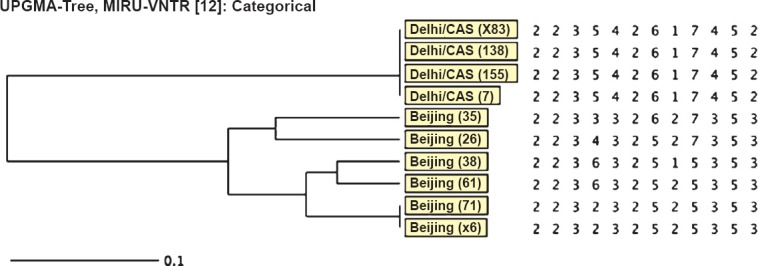
Results: Multi-drug resistance was observed in 39.7 per cent (87/219) isolates. pre-XDR and XDR M. tuberculosis isolates amongst 87 multi-drug resistant (MDR) TB isolates were 43 (49.4%) and 10 (11.4%), respectively. Two most dominant genotypes among pre-XDR and XDR M. tuberculosis isolates were Beijing and Delhi/CAS types.
Interpretation & conclusions: Resistance to second-line anti-tubercular drugs should be routinely assessed in areas endemic for TB. Similar genotype patterns were seen in pre-XDR and XDR-TB isolates. Beijing and Delhi/CAS were predominant genotypes.
Conflict of interest statement
Figures
References
-
- Report of the meeting of the WHO Global Task Force on XDR-TB. Geneva, Switzerland: WHO; 2009. [accessed on February 2, 2013]. World Health Organization. Geneva, Switzerland, 9-10 October, 2006 WHO/HTM/TB/2007.375. Available from: http://whqlibdoc.who.int/hq/2007/who_htm_tb_2007375_eng.pdf .
-
- World Health Organization. Global Tuberculosis Report 2013. [accessed on February 5, 2014]. Available from: www.who.int/iris/bitstream/10665/91355/1/9789241564656_eng.pdf .
MeSH terms
Substances
LinkOut - more resources
Full Text Sources
Other Literature Sources