Review
. 2016 May 20:7:706.
doi: 10.3389/fmicb.2016.00706. eCollection 2016.

Bacterial Cell-Cell Communication in the Host via RRNPP Peptide-Binding Regulators

Affiliations
Review

Bacterial Cell-Cell Communication in the Host via RRNPP Peptide-Binding Regulators

David Perez-Pascual et al. Front Microbiol. .

Abstract

Human microbiomes are composed of complex and dense bacterial consortia. In these environments, bacteria are able to react quickly to change by coordinating their gene expression at the population level via small signaling molecules. In Gram-positive bacteria, cell-cell communication is mostly mediated by peptides that are released into the extracellular environment. Cell-cell communication based on these peptides is especially widespread in the group Firmicutes, in which they regulate a wide array of biological processes, including functions related to host-microbe interactions. Among the different agents of communication, the RRNPP family of cytoplasmic transcriptional regulators, together with their cognate re-internalized signaling peptides, represents a group of emerging importance. RRNPP members that have been studied so far are found mainly in species of bacilli, streptococci, and enterococci. These bacteria are characterized as both human commensal and pathogenic, and share different niches in the human body with other microorganisms. The goal of this mini-review is to present the current state of research on the biological relevance of RRNPP mechanisms in the context of the host, highlighting their specific roles in commensalism or virulence.

Keywords: cell–cell communication; commensalism; firmicutes; quorum sensing; virulence.


Figures
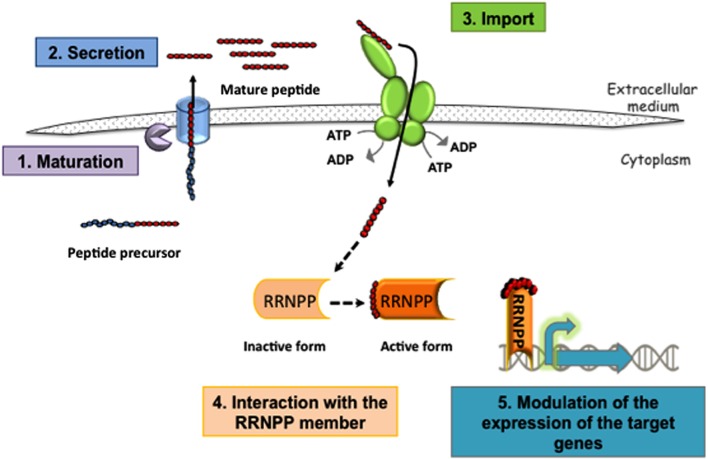
FIGURE 1
FIGURE 1
Schematic representation of the RRNPP mechanism involving transcriptional regulators. (1) Maturation of a peptide precursor (or protein in E. faecalis) and (2) secretion of the mature peptide releases a signaling peptide outside the bacterium. These two processes involve various exporters and proteases, depending on the bacteria, and some have yet to be identified. The order in which these steps occur is also largely unknown. (3) Next, the signaling peptide is imported into the cell by Opp, a transporter from the ATP-binding cassette (ABC) family. (4) Finally, the signaling peptides interact with their specific sensors (Rgg, NprR, PlcR, or PrgX), and (5) modulate the expression of their target genes. For NprR, PlcR, or the Rgg which function as activators binding to their cognate peptide allows them to positively control the expression of their target genes. For TprA or the Rgg3 that function as repressor binding to their cognate peptide alleviates the repressor effect. The repressing function of PrgX is either strengthened by the binding of an inhibitory peptide or weakened by the binding of an activating peptide.

References

    1. Agaisse H., Gominet M., Okstad O. A., Kolsto A. B., Lereclus D. (1999). PlcR is a pleiotropic regulator of extracellular virulence factor gene expression in Bacillus thuringiensis. Mol. Microbiol. 32 1043–1053. 10.1046/j.1365-2958.1999.01419.x - DOI - PubMed
    1. Antunes L. C., Ferreira R. B. (2009). Intercellular communication in bacteria. Crit. Rev. Microbiol. 35 69–80. 10.1080/10408410902733946 - DOI - PubMed
    1. Atkinson S., Williams P. (2009). Quorum sensing and social networking in the microbial world. J. R. Soc. Interface 6 959–978. 10.1098/rsif.2009.0203 - DOI - PMC - PubMed
    1. Bergman N. H., Anderson E. C., Swenson E. E., Janes B. K., Fisher N., Niemeyer M. M., et al. (2007). Transcriptional profiling of Bacillus anthracis during infection of host macrophages. Infect. Immun. 75 3434–3444. 10.1128/IAI.01345-06 - DOI - PMC - PubMed
    1. Bottone E. J. (2010). Bacillus cereus, a volatile human pathogen. Clin. Microbiol. Rev. 23 382–398. 10.1128/CMR.00073-09 - DOI - PMC - PubMed
