. 2016 May 11:7:644.
doi: 10.3389/fpls.2016.00644. eCollection 2016.

Regulation of Plant Growth, Photosynthesis, Antioxidation and Osmosis by an Arbuscular Mycorrhizal Fungus in Watermelon Seedlings under Well-Watered and Drought Conditions

Affiliations

Regulation of Plant Growth, Photosynthesis, Antioxidation and Osmosis by an Arbuscular Mycorrhizal Fungus in Watermelon Seedlings under Well-Watered and Drought Conditions

Yanling Mo et al. Front Plant Sci. .

Abstract

Drought stress has become an increasingly serious environmental issue that influences the growth and production of watermelon. Previous studies found that arbuscular mycorrhizal (AM) colonization improved the fruit yield and water use efficiency (WUE) of watermelon grown under water stress; however, the exact mechanisms remain unknown. In this study, the effects of Glomus versiforme symbiosis on the growth, physio-biochemical attributes, and stress-responsive gene expressions of watermelon seedlings grown under well-watered and drought conditions were investigated. The results showed that AM colonization did not significantly influence the shoot growth of watermelon seedlings under well-watered conditions but did promote root development irrespective of water treatment. Drought stress decreased the leaf relative water content and chlorophyll concentration, but to a lesser extent in the AM plants. Compared with the non-mycorrhizal seedlings, mycorrhizal plants had higher non-photochemical quenching values, which reduced the chloroplast ultrastructural damage in the mesophyll cells and thus maintained higher photosynthetic efficiency. Moreover, AM inoculation led to significant enhancements in the enzyme activities and gene expressions of superoxide dismutase, catalase, ascorbate peroxidase, glutathione reductase, and monodehydroascorbate reductase in watermelon leaves upon drought imposition. Consequently, AM plants exhibited lower accumulation of MDA, H2O2 and [Formula: see text] compared with non-mycorrhizal plants. Under drought stress, the soluble sugar and proline contents were significantly increased, and further enhancements were observed by pre-treating the drought-stressed plants with AM. Taken together, our findings indicate that mycorrhizal colonization enhances watermelon drought tolerance through a stronger root system, greater protection of photosynthetic apparatus, a more efficient antioxidant system and improved osmoregulation. This study contributes to advances in the knowledge of AM-induced drought tolerance.

Keywords: antioxidant system; arbuscular mycorrhizal fungus; drought stress; osmotic adjustment; photosynthesis; plant growth; watermelon.


Figures

FIGURE 1
FIGURE 1
The development of the arbuscular mycorrhizal (AM) fungus in watermelon roots (as revealed by trypan blue staining) and the morphological characteristics of the mycorrhizal (+M) and non-mycorrhizal (-NM) watermelon seedlings grown under well-watered (WW) and drought-stressed (DS) conditions. (A) Root cells without AM inoculation (bars 500 μm). (B) Root cells with AM inoculation (bars 200 μm). (C) Photographs showing the hypha (bars 100 μm). (D) Photographs showing the vesicle and arbuscules (bars 100 μm). (E) Well-watered plants with and without AM inoculation (bars 2 cm). (F) Drought-stressed plants with and without AM inoculation (bars 2 cm).
FIGURE 2
FIGURE 2
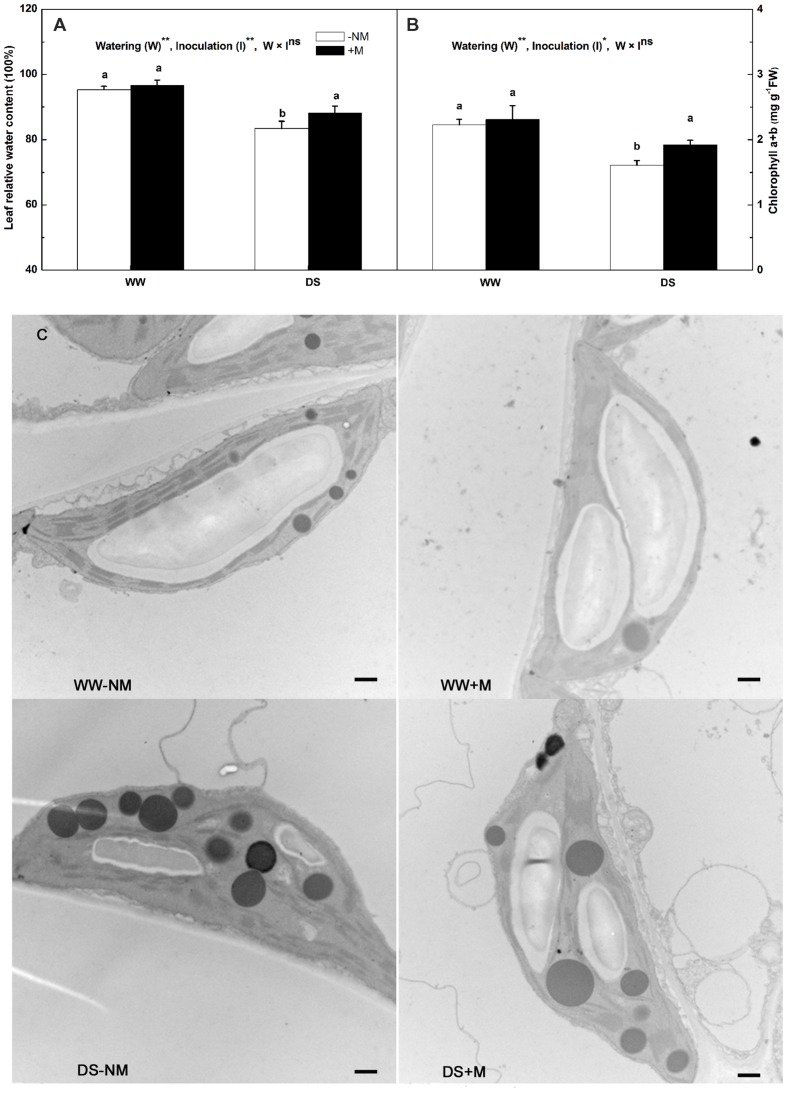
Leaf relative water content (RWC; A), chlorophyll concentration (B) and chloroplast ultrastructure (C) of mesophyll cells in mycorrhizal (+M) and non-mycorrhizal (-NM) watermelon seedlings grown under WW and DS conditions. Scale bars: (C) 500 nm. T-test was performed to compare differences between inoculation treatments under the same water treatment. Different letters following the values indicate significant differences between treatments at P < 0.05. Two-way ANOVA output: ns, not significant; P < 0.05, ∗∗P < 0.01. Data represent the means ± SD of six replicates.
FIGURE 3
FIGURE 3
Malondialdehyde (MDA) content (A), superoxide anion radical (O2) content (B), hydrogen peroxide (H2O2) content (C), and histochemical staining (D) of O2 and H2O2 in the leaves of mycorrhizal (+M) and non-mycorrhizal (-NM) watermelon seedlings grown under WW and DS conditions. T-test was performed to compare differences between inoculation treatments under the same water treatment. Different letters following the values indicate significant differences between treatments at P < 0.05. Two-way ANOVA output: ns, not significant; P < 0.05, ∗∗P < 0.01. Data represent the means ± SD of three replicates.
FIGURE 4
FIGURE 4
Antioxidant enzymes activities and antioxidant contents in mycorrhizal (+M) and non-mycorrhizal (-NM) watermelon seedlings grown under WW and DS conditions. (A) superoxide dismutase (SOD), (B) catalase (CAT), (C) ascorbate peroxidase (APX), (D) glutathione reductase (GR), (E) monodehydroascorbate reductase (MDHAR), (F) dehydroascorbate reductase (DHAR), (G) reduced ascorbate (ASA), (H) dehydroascorbate (DHA), (I) the ratio of reduced and oxidized ascorbate (ASA/DHA), (J) reduced glutathione (GSH), (K) oxidized glutathione (GSSG), (L) the ratio of reduced and oxidized glutathione (GSH/GSSG). T-test was performed to compare differences between inoculation treatments under the same water treatment. Different letters following the values indicate significant differences between treatments at P < 0.05. Two-way ANOVA output: ns, not significant; P < 0.05, ∗∗P < 0.01. Data represent the means ± SD of three replicates.
FIGURE 5
FIGURE 5
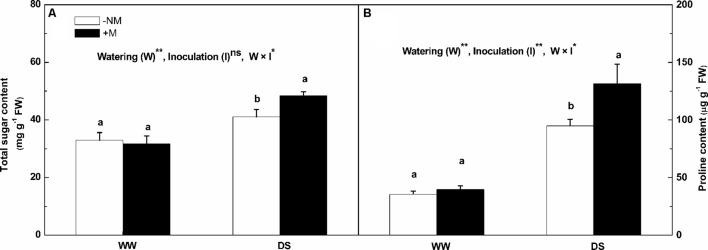
Total soluble sugar content (A), and proline content (B) in leaves of mycorrhizal (+M) and non-mycorrhizal (-NM) watermelon seedlings grown under WW and DS conditions. T-test was performed to compare differences between inoculation treatments under the same water treatment. Different letters following the values indicate significant differences between treatments at P < 0.05. Two-way ANOVA output: ns, not significant; P < 0.05, ∗∗P < 0.01. Data represent the means ± SD of three replicates.
FIGURE 6
FIGURE 6
Relative expression levels of the RBCS(A), RBCL(B), PAO(C), PPH(D), Cu-Zn SOD(E), CAT(F), APX(G), GR(H), MDHAR(I), and DHAR(J) genes in mycorrhizal (+M) and non-mycorrhizal (-NM) watermelon seedlings grown under WW and DS conditions. The expression level of the genes in the non-mycorrhizal seedlings grown under WW conditions was used as the control with a nominal value of 1. T-test was performed to compare differences between inoculation treatments under the same water treatment. Different letters following the values indicate significant differences between treatments at P < 0.05. Two-way ANOVA output: ns, not significant; P < 0.05, ∗∗P < 0.01. Data represent the means ± SD of three replicates.

References

    1. Bai T., Li C., Ma F., Feng F., Shu H. (2010). Responses of growth and antioxidant system to root-zone hypoxia stress in two Malus species. Plant Soil 327 95–105. 10.1007/s11104-009-0034-x - DOI
    1. Barrs H., Weatherley P. (1962). A re-examination of the relative turgidity technique for estimating water deficits in leaves. Aust. J. Biol. Sci. 15 413–428.
    1. Boaretto L. F., Carvalho G., Borgo L., Creste S., Landell M. G., Mazzafera P., et al. (2014). Water stress reveals differential antioxidant responses of tolerant and non-tolerant sugarcane genotypes. Plant Physiol. Biochem. 74 165–175. 10.1016/j.plaphy.2013.11.016 - DOI - PubMed
    1. Cartmill D. L., Alarcón A., Volder A., Valdez-Aguilar L. A., Arnold M. A., Cartmill A. D. (2012). Arbuscular mycorrhizal fungi alleviate growth of Ulmus parvifolia Jacq at suboptimal planting depths. Sci. Hortic. (Amsterdam) 144 74–80. 10.1016/j.scienta.2012.06.043 - DOI
    1. Chen S., Jin W., Liu A., Zhang S., Liu D., Wang F., et al. (2013). Arbuscular mycorrhizal fungi (AMF) increase growth and secondary metabolism in cucumber subjected to low temperature stress. Sci. Horticult. (Amsterdam) 160 222–229. 10.1016/j.scienta.2013.05.039 - DOI