. 2016 May 6:6:51.
doi: 10.3389/fcimb.2016.00051. eCollection 2016.

Identification of Secreted Exoproteome Fingerprints of Highly-Virulent and Non-Virulent Staphylococcus aureus Strains

Affiliations

Identification of Secreted Exoproteome Fingerprints of Highly-Virulent and Non-Virulent Staphylococcus aureus Strains

Emilia Bonar et al. Front Cell Infect Microbiol. .

Abstract

Staphylococcus aureus is a commensal inhabitant of skin and mucous membranes in nose vestibule but also an important opportunistic pathogen of humans and livestock. The extracellular proteome as a whole constitutes its major virulence determinant; however, the involvement of particular proteins is still relatively poorly understood. In this study, we compared the extracellular proteomes of poultry-derived S. aureus strains exhibiting a virulent (VIR) and non-virulent (NVIR) phenotype in a chicken embryo experimental infection model with the aim to identify proteomic signatures associated with the particular phenotypes. Despite significant heterogeneity within the analyzed proteomes, we identified alpha-haemolysin and bifunctional autolysin as indicators of virulence, whereas glutamylendopeptidase production was characteristic for non-virulent strains. Staphopain C (StpC) was identified in both the VIR and NVIR proteomes and the latter fact contradicted previous findings suggesting its involvement in virulence. By supplementing NVIR, StpC-negative strains with StpC, and comparing the virulence of parental and supplemented strains, we demonstrated that staphopain C alone does not affect staphylococcal virulence in a chicken embryo model.

Keywords: Staphylococcus; chicken embryo model; pathogen; protein; proteomics; virulence.


Conflict of interest statement

The authors declare that the research was conducted in the absence of any commercial or financial relationships that could be construed as a potential conflict of interest.

Figures
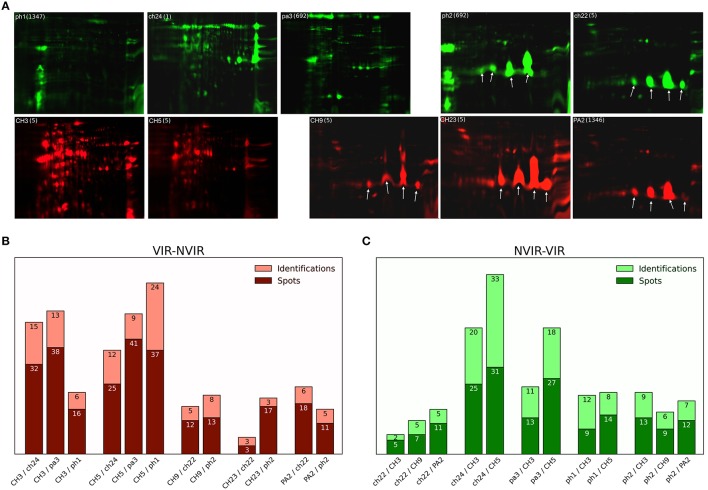
Figure 1
Figure 1
Staphylococcal exoproteome profiles analyzed by 2D gel electrophoresis and mass spectrometry (MS). (A) The exoproteomes of poultry-derived S. aureus strains exhibit two major types of profiles: (right) dominated by staphopain C (StpC; arrows) expression or (left) lacking the expression of staphopain C. The profile type does not correlate with virulence in the chicken embryo model—virulent strains CH3, CH5, CH9, CH23, PA2 (red); non-virulent strains ph1, ch22, pa3, ch24, ph2 (green). Molecular weight range is 6–116 kDa, pI range is 3–10 for gels without staphopain C (CH3, CH5, ph1, ch24, and pa3) and from 4 to 7 in case of gels with StpC (CH9, CH23, PA2, ph2, and ch22). Sequence type (ST) is provided next to the strain tag in a bracket. (B,C) respectively, summary of 2D DIGE and MS identification analyses of the staphylococcal exoproteomes of the virulent and non-virulent strains (dark color bar—number of differentiating spots cut out from the gel, light color bar—number of proteins identified by MS analysis; the differences in the above referenced numbers arise mainly from the fact that in many cases multiple spots originated from a single protein).
Figure 2
Figure 2
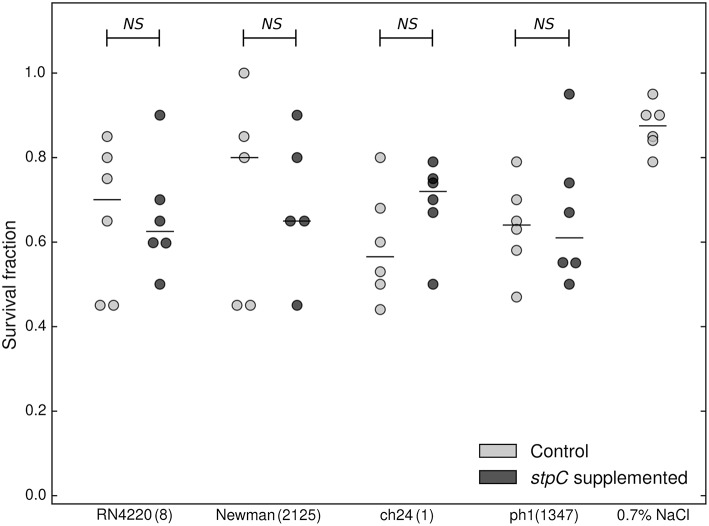
Comparison of virulence of WT (stpC, supplemented with a control plasmid) and staphopain C-supplemented staphylococcal strains in the chicken embryo model. Cumulative survival of chicken embryos 7 days following inoculation with staphylococcal strains supplemented with staphopain C expressing plasmid (dark gray circles), and control plasmid (light gray circles). The median is marked with a horizontal line. Each circle corresponds to an independent data point. No statistically significant differences were recorded (Mann-Whitney test). ST is provided next to the strain tag in a bracket.
Figure 3
Figure 3
Analysis of glutamylendopeptidase (SSPA) and staphopain B (SSPB) posttranslational processing. SSPA and SSPB were identified only in the non-virulent strains. (A) Strain pa3 contained only zymogen (Z in the superscript) forms of both proteases (as evidenced by approximate molecular weight and tryptic peptide coverage), indicating a disrupted activation pathway. Strains ph2 (B) and ph1 (C) contained the zymogen, the mature (M in the superscript) forms, and the degradation (D in the superscript) products of the proteases.
Figure 4
Figure 4
Non-overlapping spots with identical identifications. Spots originating from the same protein do not overlap on 2D gels due to genetic variation and differential posttranslational processing. (A) CH3/ch24, (B) CH3/pa3, (C) CH3/ph1, (D) CH5/ch24, (E) CH5/pa3, (F) CH5/ph1. Red (yellow circles)—VIR strain; green (blue circles)—NVIR strain; orange (yellow circles)—overlapping spots.

References

    1. Alban A., David S. O., Bjorkesten L., Andersson C., Sloge E., Lewis S., et al. . (2003). A novel experimental design for comparative two-dimensional gel analysis: two-dimensional difference gel electrophoresis incorporating a pooled internal standard. Proteomics 3, 36–44. 10.1002/pmic.200390006 - DOI - PubMed
    1. Barbier F., Lebeaux D., Hernandez D., Delannoy A. S., Caro V., Francois P., et al. . (2010). High prevalence of the arginine catabolic mobile element in carriage isolates of methicillin-resistant Staphylococcus epidermidis. J. Antimicrob. Chemother. 66, 29–36. 10.1093/jac/dkq410 - DOI - PubMed
    1. Becker R. E., Bubeck Wardenburg J. (2015). Staphylococcus aureus and the skin: a longstanding and complex interaction. Skinmed 13, 111–119. Avaliable online at: http://www.skinmedjournal.com/ - PubMed
    1. Berube B. J., Bubeck Wardenburg J. (2013). Staphylococcus aureus α-Toxin: nearly a century of intrigue. Toxins (Basel) 5, 1140–1166. 10.3390/toxins5061140 - DOI - PMC - PubMed
    1. Bohach G. A., Fast D. J., Nelson R. D., Schlievert P. M. (1990). Staphylococcal and streptococcal pyrogenic toxins involved in toxic shock syndrome and related illnesses. Crit. Rev. Microbiol. 17, 251–272. 10.3109/10408419009105728 - DOI - PubMed

MeSH terms

LinkOut - more resources