


Primary Care-Based Interventions to Promote Positive Parenting Behaviors: A Meta-analysis
- PMID: 27244800
- PMCID: PMC4845871
- DOI: 10.1542/peds.2015-3393
Primary Care-Based Interventions to Promote Positive Parenting Behaviors: A Meta-analysis
Abstract
Context: Utilization of primary care settings offers a promising approach to enhance parenting practices that are critical for promoting early childhood development. Determining the impact of existing primary care interventions on key parenting behaviors will aid providers and policy makers as they seek strategies to improve early child outcomes.
Objective: To evaluate the efficacy of primary care-based interventions on parenting practices that promote early child development among children younger than 36 months.
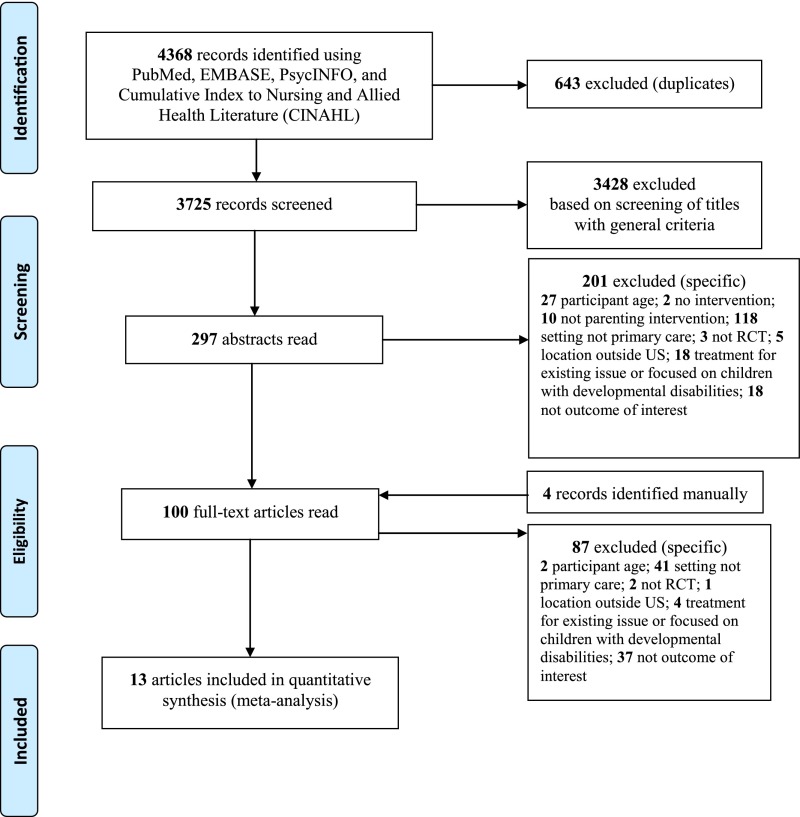
Data sources: PubMed, Excerpta Medica dataBASE, PsycINFO, and Cumulative Index to Nursing and Allied Health Literature databases were searched electronically.
Study selection: English-language articles that were quasi-randomized or randomized controlled trials, included parents of children <36 months of age, and reported outcomes related to parenting behaviors that promote early child development.
Data extraction: Two reviewers independently extracted data regarding participants, interventions, and outcomes. Quantitative meta-analyses were conducted with random effects for study and fitted with restricted maximum likelihood methods.
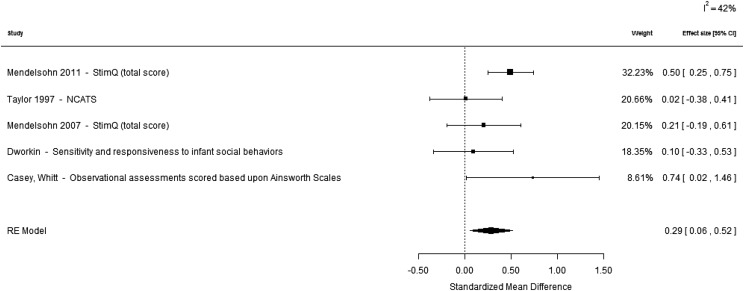
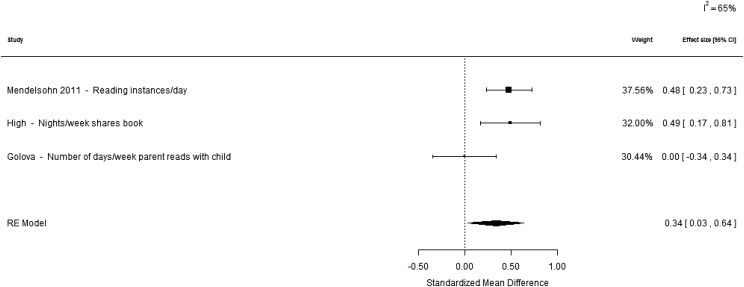
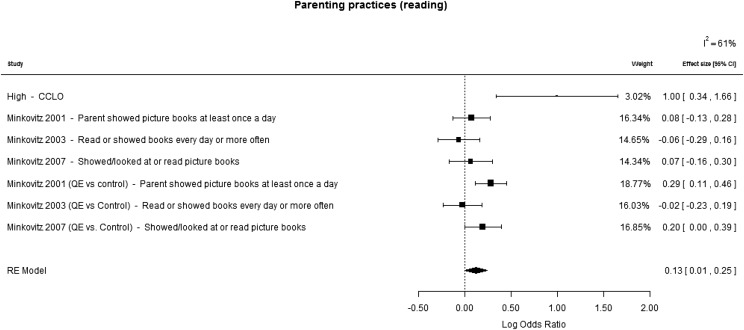
Results: The review included 13 studies reporting parenting outcomes in 2 categories: participation in cognitively stimulating activities and positive parent-child interactions. We found a statistically significant positive effect of primary care-delivered interventions and parent-child interactions (summary standardized mean difference 0.29, 95% confidence interval [CI] 0.06-0.52, P < .0001) and participation in cognitively stimulating activities (summary standardized mean difference 0.34, 95% CI 0.03-0.54; summary odds ratio 0.13, 95% CI 0.01-0.25, P < .0001).
Limitations: Limitations included heterogeneity in measures used, outcomes, and timing of assessments.
Conclusions: Primary care-based interventions modestly affect positive parenting behaviors important for early childhood development. Randomized controlled trials with comparable outcome measures using standardized assessments are needed to assess further beneficial impacts.
Copyright © 2016 by the American Academy of Pediatrics.
Conflict of interest statement
Figures
References
-
- High PC; American Academy of Pediatrics Committee on Early Childhood, Adoption, and Dependent Care and Council on School Health . School readiness. Pediatrics. 2008;121(4). Available at: www.pediatrics.org/cgi/content/full/121/4/e1008 - PubMed
-
- Hart B, Risley TR. Meaningful Differences in the Everyday Experience of Young American Children. Baltimore, MD: Paul H. Brookes Pub Co; 1995
-
- Engle PL, Black MM. The effect of poverty on child development and educational outcomes. Ann N Y Acad Sci. 2008;1136:243–256 - PubMed
-
- Duncan GJ, Brooks-Gunn J. Family poverty, welfare reform, and child development. Child Dev. 2000;71(1):188–196 - PubMed
Publication types
MeSH terms
Grants and funding
LinkOut - more resources
Full Text Sources
Other Literature Sources
Medical
