


Outpatient Rehabilitation for Medicaid-Insured Children Hospitalized With Traumatic Brain Injury
- PMID: 27244850
- PMCID: PMC4891290
- DOI: 10.1542/peds.2015-3500
Outpatient Rehabilitation for Medicaid-Insured Children Hospitalized With Traumatic Brain Injury
Abstract
Objectives: To describe the prevalence of postdischarge outpatient rehabilitation among Medicaid-insured children hospitalized with a traumatic brain injury (TBI) and to identify factors associated with receipt of services.
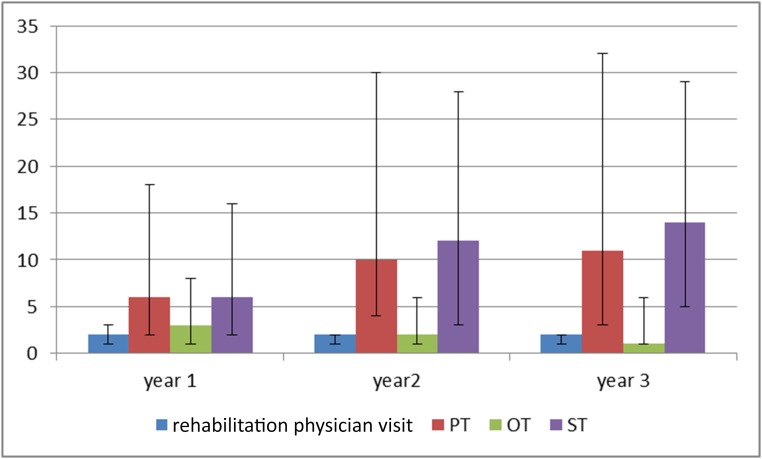
Methods: Retrospective cohort of children <21 years, hospitalized for a TBI between 2007 and 2012, from a national Medicaid claims database. Outcome measures were receipt of outpatient rehabilitation (physical, occupational, or speech therapies or physician visits to a rehabilitation provider) 1 and 3 years after discharge. Multivariable regression analyses determined the association of demographic variables, injury severity, and receipt of inpatient services with receipt of outpatient rehabilitation at 1 and 3 years. The mean number of services was compared between racial/ethnic groups.
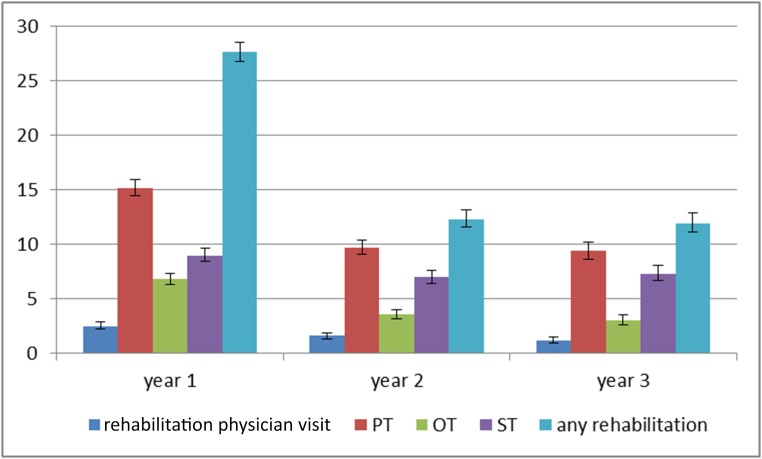
Results: Among 9361 children, only 29% received any type of outpatient rehabilitation therapy during the first year after injury, although 62% sustained a moderate to severe TBI. The proportion of children receiving outpatient therapies declined to 12% in the second and third years. The most important predictor of receipt of outpatient rehabilitation was receipt of inpatient therapies or consultation with a rehabilitation physician during acute care. Compared with children of other racial/ethnic groups, Hispanic children had lower rates of receipt of outpatient speech therapy.
Conclusions: Hospitalized children who received inpatient assessment of rehabilitation needs were more likely to continue outpatient rehabilitation care. Hispanic children with TBI were less likely than non-Hispanics to receive speech therapy. Interventions to increase inpatient rehabilitation during acute care might increase outpatient rehabilitation and improve outcomes for all children.
Copyright © 2016 by the American Academy of Pediatrics.
Conflict of interest statement
Figures
References
-
- Centers for Disease Control and Prevention Report to Congress on Traumatic Brain Injury in the United States: Epidemiology and Rehabilitation. Atlanta, GA: National Center for Injury Prevention and Control, Division of Unintentional Injury Prevention; 2014
-
- Cicerone KD, Dahlberg C, Kalmar K, et al. Evidence-based cognitive rehabilitation: recommendations for clinical practice. Arch Phys Med Rehabil. 2000;81(12):1596–1615 - PubMed
-
- Cicerone KD, Dahlberg C, Malec JF, et al. Evidence-based cognitive rehabilitation: updated review of the literature from 1998 through 2002. Arch Phys Med Rehabil. 2005;86(8):1681–1692 - PubMed
-
- Cicerone KD, Langenbahn DM, Braden C, et al. Evidence-based cognitive rehabilitation: updated review of the literature from 2003 through 2008. Arch Phys Med Rehabil. 2011;92(4):519–530 - PubMed
MeSH terms
Grants and funding
LinkOut - more resources
Full Text Sources
Other Literature Sources
Medical
