


Cholesterol Depletion from a Ceramide/Cholesterol Mixed Monolayer: A Brewster Angle Microscope Study
- PMID: 27245215
- PMCID: PMC4887913
- DOI: 10.1038/srep26907
Cholesterol Depletion from a Ceramide/Cholesterol Mixed Monolayer: A Brewster Angle Microscope Study
Abstract
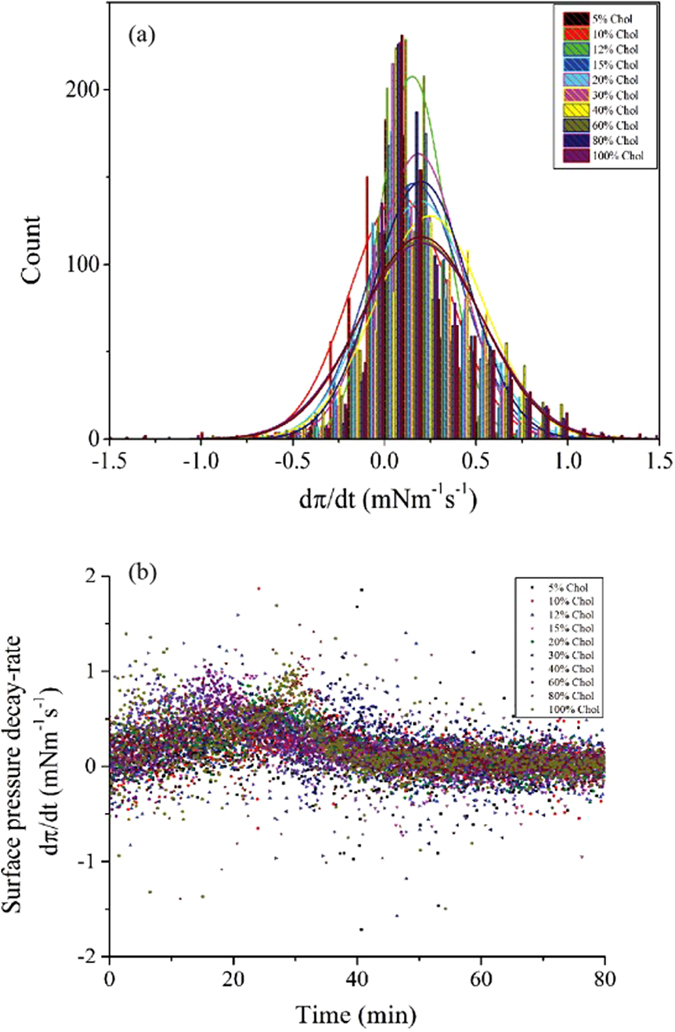
Cholesterol is crucial to the mechanical properties of cell membranes that are important to cells' behavior. Its depletion from the cell membranes could be dramatic. Among cyclodextrins (CDs), methyl beta cyclodextrin (MβCD) is the most efficient to deplete cholesterol (Chol) from biomembranes. Here, we focus on the depletion of cholesterol from a C16 ceramide/cholesterol (C16-Cer/Chol) mixed monolayer using MβCD. While the removal of cholesterol by MβCD depends on the cholesterol concentration in most mixed lipid monolayers, it does not depend very much on the concentration of cholesterol in C16-Cer/Chol monolayers. The surface pressure decay during depletion were described by a stretched exponential that suggested that the cholesterol molecules are unable to diffuse laterally and behave like static traps for the MβCD molecules. Cholesterol depletion causes morphology changes of domains but these disrupted monolayers domains seem to reform even when cholesterol level was low.
Figures


References
-
- Arora A. & Damodaran S. beta-Cyclodextrin-Mediated Removal of Soy Phospholipids from the Air-Water Interface. J Am Oil Chem Soc 88, 213–222, doi: 10.1007/S11746-010-1664-0 (2011). - DOI
-
- Collot M. et al. Bis antennae amphiphilic cyclodextrins: the first examples. Tetrahedron Lett 48, 8566–8569, doi: 10.1016/J.Tetlet.2007.09.020 (2007). - DOI
Publication types
MeSH terms
Substances
LinkOut - more resources
Full Text Sources
Other Literature Sources
Medical
