Refractive Errors in Koreans: The Korea National Health and Nutrition Examination Survey 2008-2012
- PMID: 27247521
- PMCID: PMC4878982
- DOI: 10.3341/kjo.2016.30.3.214
Refractive Errors in Koreans: The Korea National Health and Nutrition Examination Survey 2008-2012
Abstract
Purpose: Our study provides epidemiologic data on the prevalence of refractive errors in all age group ≥5 years in Korea.
Methods: In 2008 to 2012, a total of 33,355 participants aged ≥5 years underwent ophthalmologic examinations. Using the right eye, myopia was defined as a spherical equivalent (SE) less than -0.5 or -1.0 diopters (D) in subjects aged 19 years and older or as an SE less than -0.75 or -1.25 D in subjects aged 5 to 18 years according to non-cycloplegic refraction. Other refractive errors were defined as follows: high myopia as an SE less than -6.0 D; hyperopia as an SE larger than +0.5 D; and astigmatism as a cylindrical error less than -1.0 D. The prevalence and risk factors of myopia were evaluated.
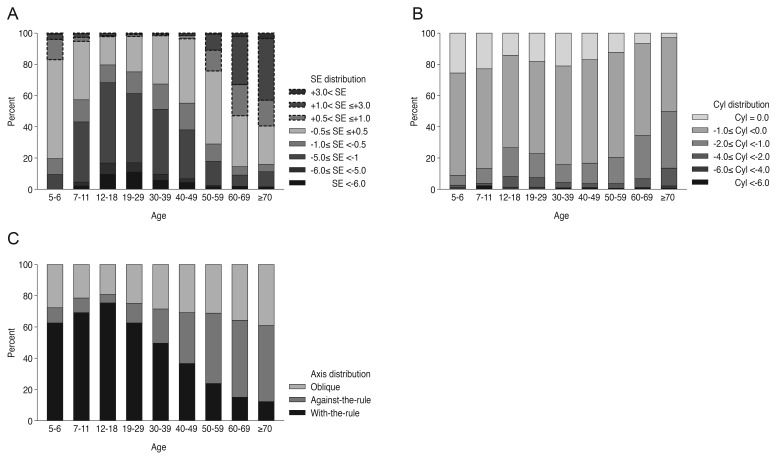
Results: Prevalence rates with a 95% confidence interval were determined for myopia (SE <-0.5 D, 51.9% [51.2 to 52.7]; SE <-1.0 D, 39.6% [38.8 to 40.3]), high myopia (5.0% [4.7 to 5.3]), hyperopia (13.4% [12.9 to 13.9]), and astigmatism (31.2% [30.5 to 32.0]). The prevalence of myopia demonstrated a nonlinear distribution with the highest peak between the ages of 19 and 29 years. The prevalence of hyperopia decreased with age in subjects aged 39 years or younger and then increased with age in subjects aged 40 years or older. The prevalence of astigmatism gradually increased with age. Education was associated with all refractive errors; myopia was more prevalent and hyperopia and astigmatism were less prevalent in the highly educated groups.
Conclusions: In young generations, the prevalence of myopia in Korea was much higher compared to the white or black populations in Western countries and is consistent with the high prevalence found in most other Asian countries. The overall prevalence of hyperopia was much lower compared to that of the white Western population. Age and education level were significant predictive factors associated with all kinds of refractive errors.
Keywords: Astigmatism; Hyperopia; Myopia; Refractive errors.
Conflict of interest statement
Figures
References
-
- Wang Q, Klein BE, Klein R, Moss SE. Refractive status in the Beaver Dam Eye Study. Invest Ophthalmol Vis Sci. 1994;35:4344–4347. - PubMed
-
- Attebo K, Ivers RQ, Mitchell P. Refractive errors in an older population: the Blue Mountains Eye Study. Ophthalmology. 1999;106:1066–1072. - PubMed
-
- Wu SY, Nemesure B, Leske MC. Refractive errors in a black adult population: the Barbados Eye Study. Invest Ophthalmol Vis Sci. 1999;40:2179–2184. - PubMed
-
- Wong TY, Foster PJ, Hee J, et al. Prevalence and risk factors for refractive errors in adult Chinese in Singapore. Invest Ophthalmol Vis Sci. 2000;41:2486–2494. - PubMed
MeSH terms
LinkOut - more resources
Full Text Sources
Other Literature Sources
Medical