


Trehalose pathway as an antifungal target
- PMID: 27248439
- PMCID: PMC5383216
- DOI: 10.1080/21505594.2016.1195529
Trehalose pathway as an antifungal target
Abstract
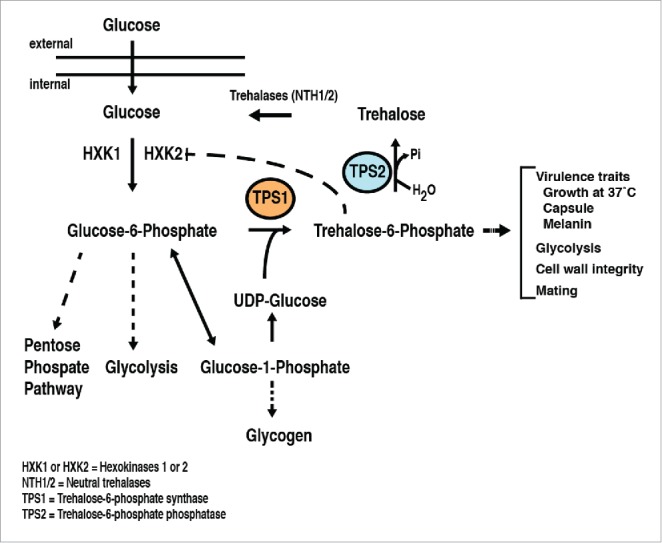
With an increasing immunocompromised population which is linked to invasive fungal infections, it is clear that our present 3 classes of antifungal agents may not be sufficient to provide optimal management to these fragile patients. Furthermore, with widespread use of antifungal agents, drug-resistant fungal infections are on the rise. Therefore, there is some urgency to develop the antifungal pipeline with the goal of new antifungal agent discovery. In this review, a simple metabolic pathway, which forms the disaccharide, trehalose, will be characterized and its potential as a focus for antifungal target(s) explained. It possesses several important features for development of antifungal agents. First, it appears to have fungicidal characteristics and second, it is broad spectrum with importance across both ascomycete and basidiomycete species. Finally, this pathway is not found in mammals so theoretically specific inhibitors of the trehalose pathway and its enzymes in fungi should be relatively non-toxic for mammals. The trehalose pathway and its critical enzymes are now in a position to have directed antifungal discovery initiated in order to find a new class of antifungal drugs.
Keywords: antifungal; drug development; trehalose.
Figures
Comment in
-
Trehalose as antifungal target: The picture is still incomplete.Virulence. 2017 Feb 17;8(2):237-238. doi: 10.1080/21505594.2016.1215797. Epub 2016 Jul 26. Virulence. 2017. PMID: 27459134 Free PMC article. No abstract available.
-
Reply to Argüelles.Virulence. 2017 Feb 17;8(2):239. doi: 10.1080/21505594.2016.1221249. Epub 2016 Aug 5. Virulence. 2017. PMID: 27494147 Free PMC article. No abstract available.
References
-
- Butts A, Krysan DJ. Antifungal drug discovery: something old and something new. PLoS Pathog 2012; 8:e1002870; PMID:22969422; http://dx.doi.org/10.1371/journal.ppat.1002870 - DOI - PMC - PubMed
-
- Ostrosky-Zeichner L, Casadevall A, Galgiani JN, Odds FC, Rex JH. An insight into the antifungal pipeline: selected new molecules and beyond. Nat Rev Drug Discov 2010; 9:719-27; PMID:20725094; http://dx.doi.org/10.1038/nrd3074 - DOI - PubMed
-
- Brown GD, Denning DW, Gow NA, Levitz SM, Netea MG, White TC. Hidden killers: human fungal infections. Sci Transl Med 2012; 4:165rv13; PMID:23253612; http://dx.doi.org/10.1126/scitranslmed.3004404 - DOI - PubMed
-
- Zaoutis TE, Argon J, Chu J, Berlin JA, Walsh TJ, Feudtner C. The epidemiology and attributable outcomes of candidemia in adults and children hospitalized in the United States: a propensity analysis. Clin Infect Dis 2005; 41:1232-9; PMID:16206095; http://dx.doi.org/10.1086/496922 - DOI - PubMed
-
- Diekema D, Arbefeville S, Boyken L, Kroeger J, Pfaller M. The changing epidemiology of healthcare-associated candidemia over three decades. Diagn Microbiol Infect Dis 2012; 73:45-8; PMID:22578938; http://dx.doi.org/10.1016/j.diagmicrobio.2012.02.001 - DOI - PubMed
Publication types
MeSH terms
Substances
Grants and funding
LinkOut - more resources
Full Text Sources
Other Literature Sources
Medical
