


Published Erratum
doi: 10.1007/s00018-016-2279-x.
Erratum to: Controlling the response to DNA damage by the APC/C-Cdh1
Affiliations
- PMID: 27251328
- PMCID: PMC4969907
- DOI: 10.1007/s00018-016-2279-x
Item in Clipboard
Published Erratum
Erratum to: Controlling the response to DNA damage by the APC/C-Cdh1
Cell Mol Life Sci.
2016 Aug.
No abstract available
Figures

The molecular composition of the APC/C. The subunits of the mammalian APC/C are indicated. APC3, APC6, APC7 and APC8 contain tetracopeptide-repeat (TPR) domains, and together with APC12 form the TPR lobe. APC1, APC4 and APC5 form the ‘platform’ domain of the APC/C. The catalytic core is composed of APC11 (Ring) and APC2 (Cullin). APC10 together with one of the co-activators Cdc20/Cdh1 forms the degron-recognition domain
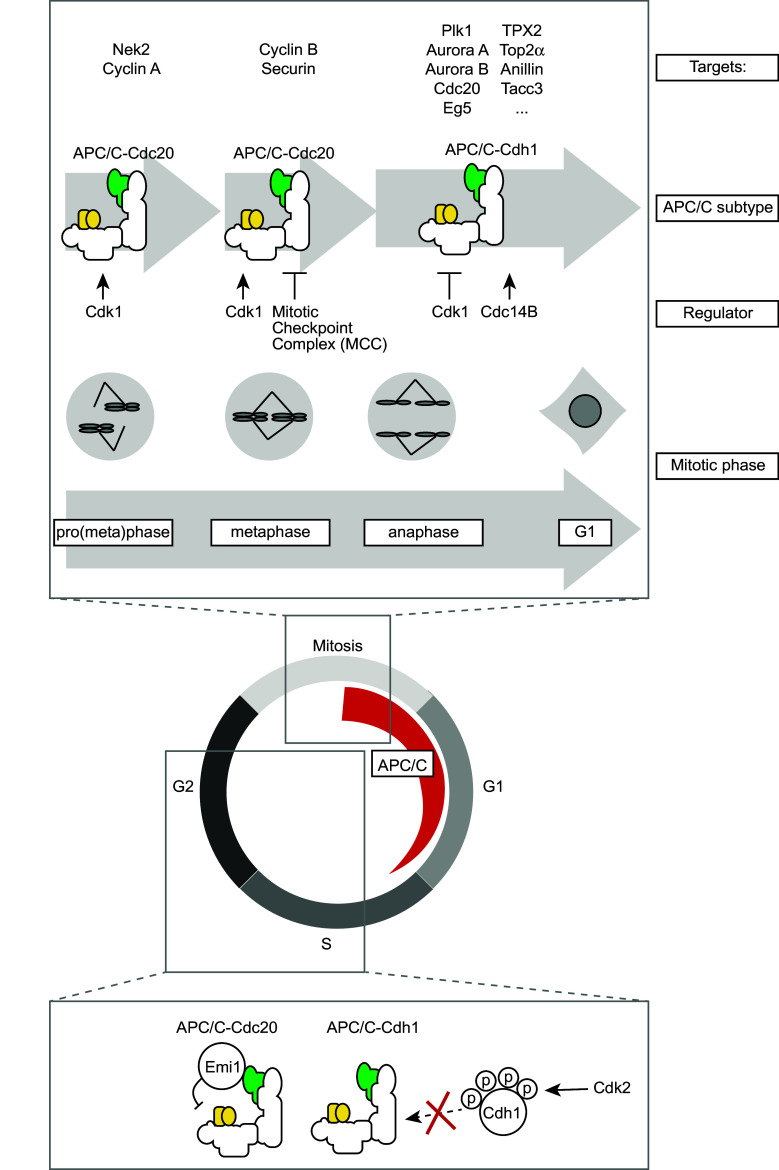
Three waves of APC/C activation during mitosis. The APC/C is activated during mitosis and remains active up until G1 phase. Three independent waves of APC/C activity can be distinguished. (1) APC/C-Cdc20 activity during prometaphase, which is unaffected by the spindle checkpoint, (2) APC/C-Cdc20 activity in metaphase, which is under control of the spindle checkpoint, (3) APC/C-Cdh1 activity, which commences during anaphase onset. Identified substrates of each of the APC/C entities are indicated. Interphase activation of the APC/C is precluded by Emi1 and Cdk2-mediated phosphorylation of Cdh1
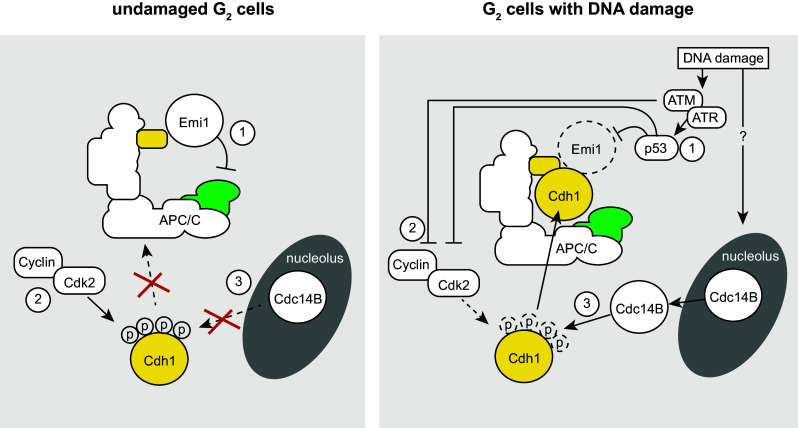
Roles of the APC/C-Cdh1 in response to DNA damage. During an unperturbed interphase, the APC/C is not active due to (1) binding of Emi1, (2) phosphorylation of Cdh1 by Cdk2, and (3) the inability of Cdc14B to dephosphorylate Cdh1. In response to DNA damage in G2 cells, (1) the DDR kinases ATM and ATR mediate activation of p53, which leads to Emi1 down-regulation. (2) ATM/ATR and p53 inactivate Cdk2 activity, and 3 Cdc14B is released from the nucleolus through unknown mechanisms. Combined, these mechanisms lead to activation of the APC/C-Cdh1

Functions of the APC/C-Cdh1 in situations of DNA damage. Different function of the APC/C-Cdh1 and its targets are illustrated
Erratum for
-
Controlling the response to DNA damage by the APC/C-Cdh1.Cell Mol Life Sci. 2016 Mar;73(5):949-60. doi: 10.1007/s00018-015-2096-7. Epub 2015 Dec 9. Cell Mol Life Sci. 2016. PMID: 26650195 Free PMC article. Review.
References
Publication types
LinkOut - more resources
Full Text Sources
Other Literature Sources
Miscellaneous
