Weight Loss and Lowering Androgens Predict Improvements in Health-Related Quality of Life in Women With PCOS
- PMID: 27253669
- PMCID: PMC4971336
- DOI: 10.1210/jc.2016-1896
Weight Loss and Lowering Androgens Predict Improvements in Health-Related Quality of Life in Women With PCOS
Abstract
Context: Polycystic ovary syndrome (PCOS) is associated with reduced health-related quality of life (HRQOL) and increased prevalence of depressive and anxiety disorders. The impact of PCOS-specific treatments on these co-morbidities is unclear.
Objective: To assess the impact of weight loss and decreasing hyperandrogenism on HRQOL and mood and anxiety disorders in women with PCOS.
Design/setting/participants: A secondary analysis of a randomized controlled trial (OWL-PCOS) of preconception treatment conducted at two academic centers in women (age, 18-40 years; body mass index, 27-42 kg/m(2)) with PCOS defined by Rotterdam criteria.
Intervention: Continuous oral contraceptive pill (OCP) or intensive lifestyle intervention or the combination (Combined) for 16 weeks.
Main outcome measure(s): Changes in HRQOL assessed by PCOSQ and SF-36 and prevalence of depression and anxiety disorder assessed by PRIME-MD PHQ.
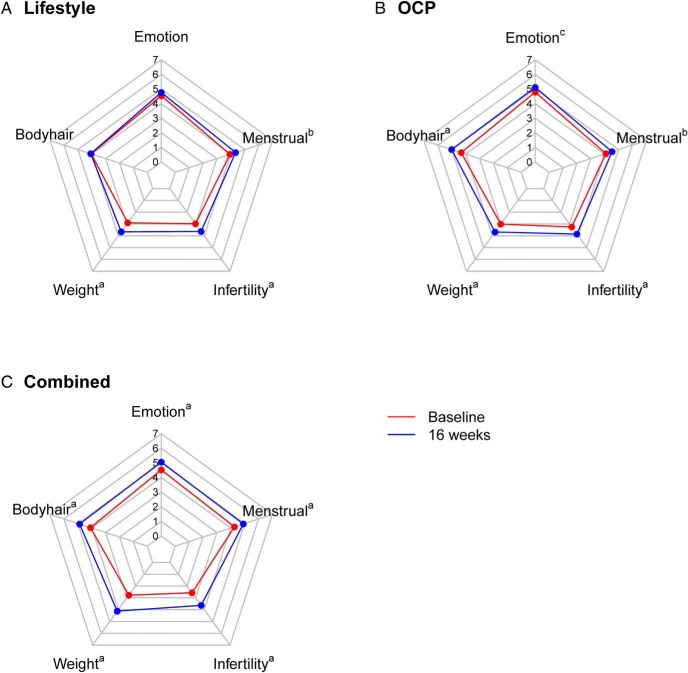
Results: The lowest scores were noted on the general health domain of the SF-36 and the weight and infertility domains on the PCOSQ. All three interventions resulted in significant improvement in the general health score on the SF-36. Both the OCP and Combined groups showed improvements in all domains of the PCOSQ (P < .01) compared to baseline scores. The Combined group had significant improvements in the weight, body hair, and infertility domains compared to a single treatment group (P < .05). In a linear regression model, change in weight correlated with improvements in the weight domain (P < .001) and physical well-being (P < .02), change in T correlated with improvements in the hair domain (P < .001), and change in both weight and T correlated with the infertility (P < .001) and menstrual domains (P < .05).
Conclusions: Both weight loss and OCP use result in significant improvements in several physical and mental domains related to quality of life, depressive symptoms, and anxiety disorders, and combined therapies offer further benefits in overweight/obese women with PCOS.
Trial registration: ClinicalTrials.gov NCT00704912.
Figures
References
-
- Azziz R, Marin C, Hoq L, Badamgarav E, Song P. Health care-related economic burden of the polycystic ovary syndrome during the reproductive life span. J Clin Endocrinol Metab. 2005;90(8):4650–4658. - PubMed
-
- Jones GL, Hall JM, Balen AH, Ledger WL. Health-related quality of life measurement in women with polycystic ovary syndrome: a systematic review. Hum Reprod Update. 2008;14(1):15–25. - PubMed
-
- Veltman-Verhulst SM, Boivin J, Eijkemans MJ, Fauser BJ. Emotional distress is a common risk in women with polycystic ovary syndrome: a systematic review and meta-analysis of 28 studies. Hum Reprod Update. 2012;18(6):638–651. - PubMed
-
- Dokras A, Clifton S, Futterweit W, Wild R. Increased risk for abnormal depression scores in women with polycystic ovary syndrome: a systematic review and meta-analysis. Obstet Gynecol. 2011;117(1):145–152. - PubMed
Publication types
MeSH terms
Substances
Associated data
Grants and funding
LinkOut - more resources
Full Text Sources
Other Literature Sources
Medical