. 2016 Jun 2;14(6):e1002472.
doi: 10.1371/journal.pbio.1002472. eCollection 2016 Jun.

NMNAT2:HSP90 Complex Mediates Proteostasis in Proteinopathies

Affiliations

NMNAT2:HSP90 Complex Mediates Proteostasis in Proteinopathies

Yousuf O Ali et al. PLoS Biol. .

Abstract

Nicotinamide mononucleotide adenylyl transferase 2 (NMNAT2) is neuroprotective in numerous preclinical models of neurodegeneration. Here, we show that brain nmnat2 mRNA levels correlate positively with global cognitive function and negatively with AD pathology. In AD brains, NMNAT2 mRNA and protein levels are reduced. NMNAT2 shifts its solubility and colocalizes with aggregated Tau in AD brains, similar to chaperones, which aid in the clearance or refolding of misfolded proteins. Investigating the mechanism of this observation, we discover a novel chaperone function of NMNAT2, independent from its enzymatic activity. NMNAT2 complexes with heat shock protein 90 (HSP90) to refold aggregated protein substrates. NMNAT2's refoldase activity requires a unique C-terminal ATP site, activated in the presence of HSP90. Furthermore, deleting NMNAT2 function increases the vulnerability of cortical neurons to proteotoxic stress and excitotoxicity. Interestingly, NMNAT2 acts as a chaperone to reduce proteotoxic stress, while its enzymatic activity protects neurons from excitotoxicity. Taken together, our data indicate that NMNAT2 exerts its chaperone or enzymatic function in a context-dependent manner to maintain neuronal health.


Conflict of interest statement

The authors have declared that no competing interests exist.

Figures
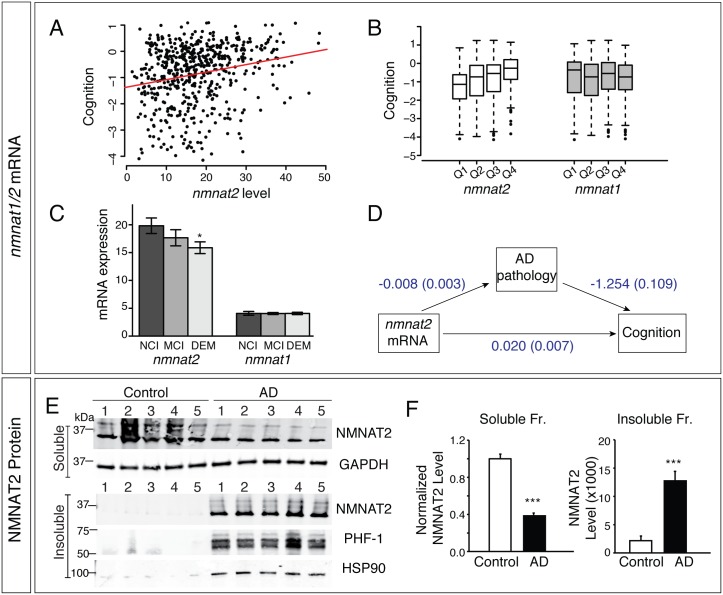
Fig 1
Fig 1. NMNAT2 expression in human brain positively correlates with global cognition scores.
(A) The scatter plot shows individual subject values for nmnat2 mRNA levels and global cognition scores proximate to death. The regression line shows the positive relationship between nmnat2 levels and cognitive scores. Units for both mRNA and cognitive scores are arbitrary (Materials and Methods for details). (B) Box plots show global cognition scores within each quartile of nmnat1/2 level. Each box is defined by the interquartile range, the line in the box is the median, and the whiskers are 1.5*interquartile range. (C) Bar graphs of nmnat2 and nmnat1 mRNA levels by clinical diagnosis. Abbreviations: NCI, no cognitive impairment; MCI, mild cognitive impairment; DEM, dementia. (D) Path analysis of hypothetical structural models linking nmnat2 levels with cognition, either indirectly via an effect on AD pathology (top) or directly (bottom). The arrows in the model represent the hypothetical causal directions of the effects being tested by the statistical modeling. Standardized path coefficient (standard error) is shown, revealing that 30% of the NMNAT2 effect on cognition is mediated by AD pathologic burden. (E–F) NMNAT2 protein levels were reduced in the soluble fractions of AD brains. The insoluble fraction contains aggregated proteins such as insoluble Tau (revealed by PHF-1 antibody, which detects p-S396/404 hTau). NMNAT2 and HSP90 shift solubility in AD brains, appearing in the insoluble fraction. *,*** indicate p < 0.05, p < 0.001. The authors confirm that all data underlying the findings are fully available without restriction. Data for Fig 1E and 1F can be found in S1 Data. Data for Fig 1A–1C are available upon request via an online request tool listed in http://www.rush.edu/radc.
Fig 2
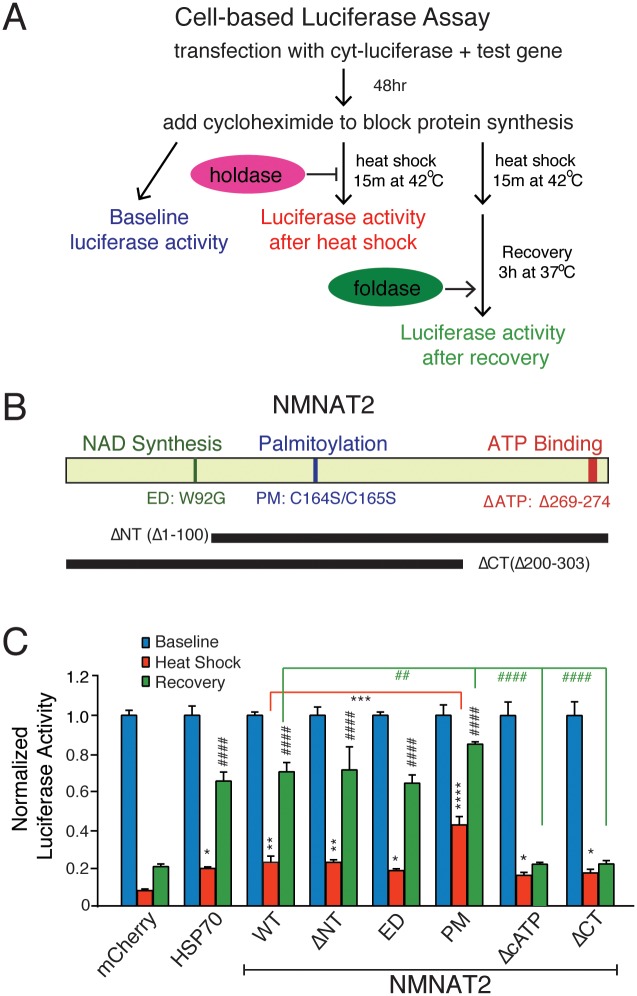
Fig 2. NMNAT2 exerts chaperone activity independently from its NAD-synthase function.
(A) Diagram illustrates simplified experimental procedure of cell-based luciferase denaturation and refolding assay. (B) Diagram showing human NMNAT2 and the mutants generated for this study. (C) Summary for the chaperone activity of mCherry, HSP70, and various NMNAT2 mutants. Blue bars show baseline luciferase activity. Red bars show luciferase activity immediately after heat shock, while blue bars show luciferase activity after recovery. * and # indicate significant differences from mCherry heat shock, and mCherry recovery, respectively (n = 3 with triplicates per experiment). Individual values for 2C are provided in S1 Data. */#,**/##,***/###,****/#### indicate p < 0.05, p < 0.01, or p < 0.001, p < 0.0001, respectively.
Fig 3
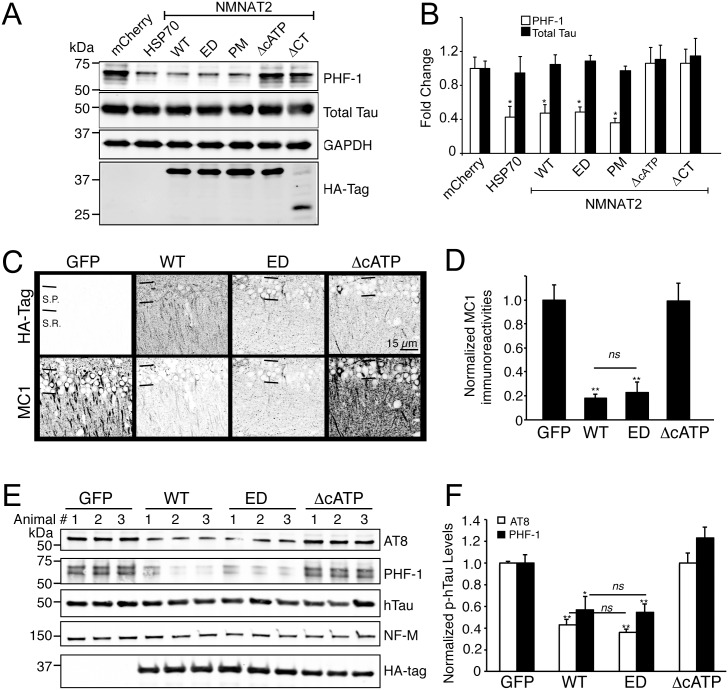
Fig 3. NMNAT2’s chaperone activity is required to reduce p-hTau levels both in vitro and in vivo.
(A–B) Example western blot shows an increase of p-hTau in an inducible hTau40 cell line after doxycycline treatment. The increase in p-hTau was prevented by HSP70, NMNAT2-WT, -ED, or -PM but not -ΔCT or -ΔcATP (n = 4 independent experiments). (C) Overexpression of NMNAT2-WT or -ED but not -ΔcATP, reduced the levels of p-hTau revealed by MC1 immunoreactivity in the CA1 region of the hippocampus (GFP, n = 8; WT, n = 6; ED, n = 5; ΔcATP, n = 6). (D) Summary of normalized MC1 immunoreactivity in the CA1 S.P. area. (E) Representative western blots show the levels of p-hTau species recognized by PHF-1 or AT8 antibodies, neurofilaments (NF-M), total hTau, and HA-tag (recognizes exogenous NMNAT2). (F) p-hTau levels were quantified and normalized to sample neurofilament levels. Individual values for 3B, 3D and 3E are provided in S1 Data. S.P, striatum pyramidale layer; S. R., striatum radiatum layer; ns, not significant.
Fig 4
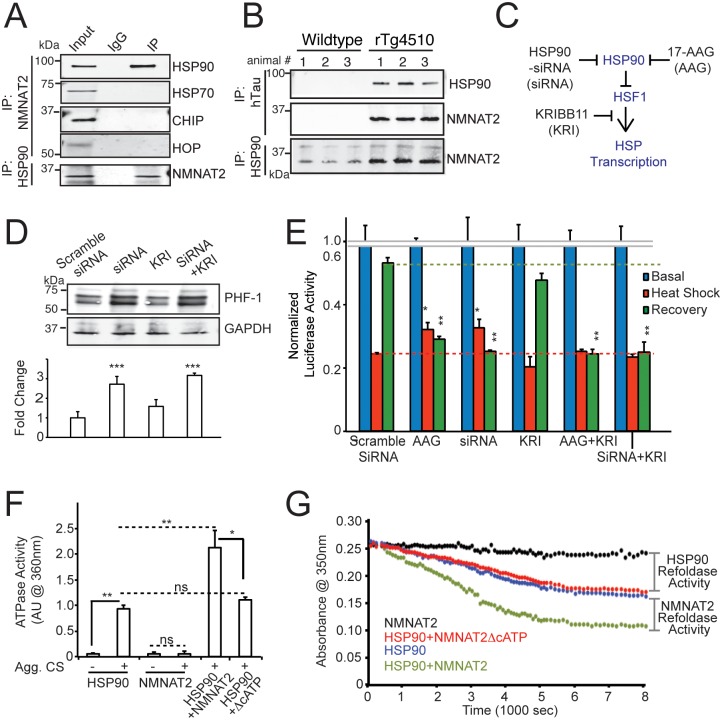
Fig 4. NMNAT2 complexes with HSP90 to refold aggregated proteins.
(A) Immunoprecipitation identifies an interaction between NMNAT2 and HSP90, but not between NMNAT2 and HSP70 or HOP or CHIP in the hTau40 cell line. (B) NMNAT2 complexes with hTau and HSP90 in insoluble fractions of 6-mo-old rTg4510 cortex. (C) A simple diagram illustrating how HSP90 regulates HSF1 activity. (D) Inhibition of HSP90 by siRNA prevents the NMNAT2-dependent clearance of p-hTau, while inhibition of HSF1 by KRI is ineffective. Bar graph shows the summary from three independent experiments. (E) Summary of luciferase assay in NMNAT2-expressing cells with various treatments (n = 4 with triplicate). (F) Summary of ATPase activity of HSP90 and NMNAT2 (WT/ΔcATP) in the absence or presence of aggregated CS. (G) WT, but not NMNAT2-ΔcATP, can refold aggregated CS in the presence of HSP90 and ATP. Individual values for 4D, 4E, 4F, and 4G are provided in S1 Data. ns, not significant, *p < 0.05, **p < 0.001, ***p < 0.0001.
Fig 5
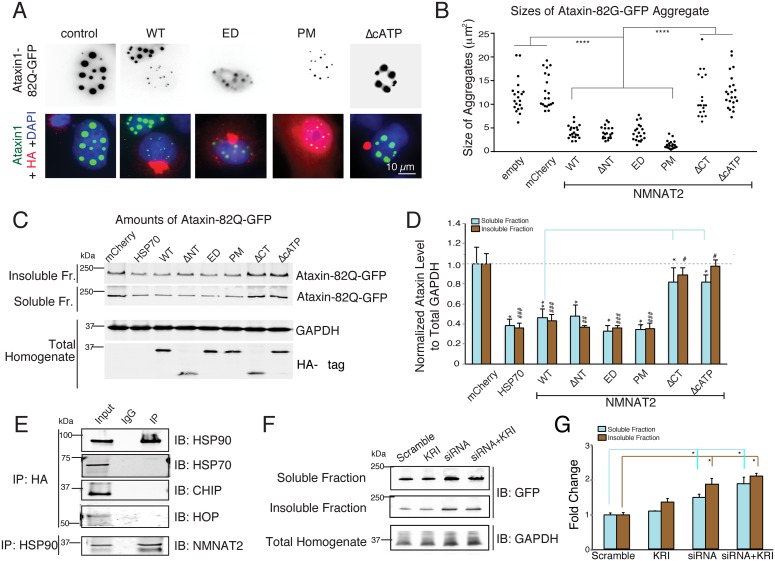
Fig 5. NMNAT2 reduces Ataxin1-82Q-GFP aggregates.
(A) Immunostaining images show that cells expressing NMNAT2-WT, -ED, and -PM have fewer Ataxin1-82Q-GFP aggregates compared to untransfected cells or cells expressing mCherry, NMNAT2-ΔCT, or NMNAT2-ΔcATP (n = 3 independent experiments). (B) Summary of the sizes of individual Ataxin1-82Q-GFP aggregates present in transfected cells (C) Example western blot showing that expression of HSP70 and NMNAT2-WT/ΔNT/ED/PM, but not NMNAT2-ΔCT/ΔcATP have reduced Ataxin1-82Q-GFP aggregates in both the soluble and RIPA-insoluble fractions. (D) Summary of normalized Ataxin1-82Q-GFP levels in both the soluble and insoluble fractions of cell lysates prepared from cells expressing the indicated cDNAs (n = 3 independent experiments). GAPDH in total lysate was used to normalize GFP signals in the soluble and insoluble fractions. *and # indicate significant differences in soluble or insoluble Ataxin1-82Q-GFP levels between mCherry control and transfected test protein, respectively. (E) Immunoprecipitation identifies an interaction between NMNAT2 and HSP90, but not between NMNAT2 and HSP70 or HOP or CHIP in the Ataxin1-82Q-GFP and HA-NMNAT2 overexpressing cell line. (F) Western blot shows the levels of Ataxin1-82Q-GFP in both soluble and insoluble fractions upon treatment with scrambled siRNA, HSP90-siRNA (siRNA), KRI, or the combination of siRNA and KRI (n = 3 independent experiments). (G) Inhibition of HSP90 expression, but not HSF1 activity, increases Ataxin1-82Q-GFP accumulation (n = 3 independent experiments). Individual values for 5B, 5D, and 5G are provided in S1 Data. ns, not significant, */#p < 0.05, **/##p < 0.001, ***/###p < 0.0001.
Fig 6
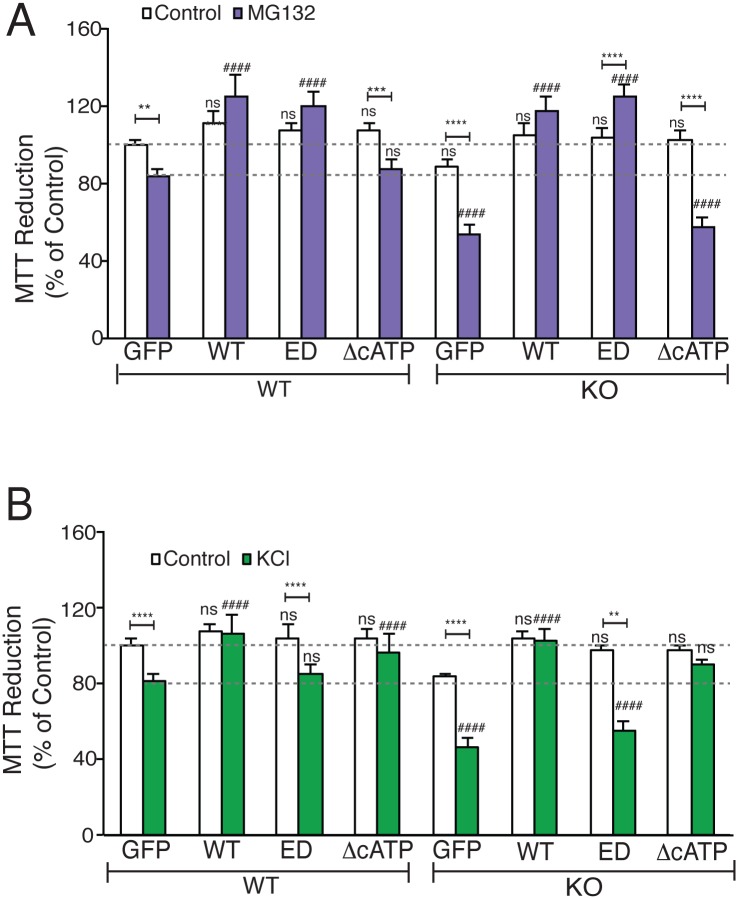
Fig 6. NMNAT2 is required to protect neurons against proteotoxicity and excitotoxicity.
Cell viability was evaluated by the MTT reduction assay. (A) MTT reductions of NMNAT2 WT and KO neurons overexpressing GFP or NMNAT2-WT, -ED, or -ΔcATP after DMSO or MG132 treatment. *and # indicate significant differences in DMSO or in MG132-treated cells between GFP control and transfected test NMNAT2 construct, respectively (n = 3 independent experiments). (B) MTT reduction by DIV14 NMNAT2 WT and KO neurons overexpressing GFP or NMNAT2-WT, -ED, or -ΔcATP after DMSO or KCl treatment (n = 3 independent experiments). *and # indicate significant differences in DMSO or in KCl-treated cells between GFP control and transfected NMNAT2 construct, respectively. n = 3 with triplicates per summary. Individual values for 6A and B are provided in S1 Data. ns, not significant, */#p < 0.05, **/##p < 0.001, ***/###p < 0.0001.
Fig 7
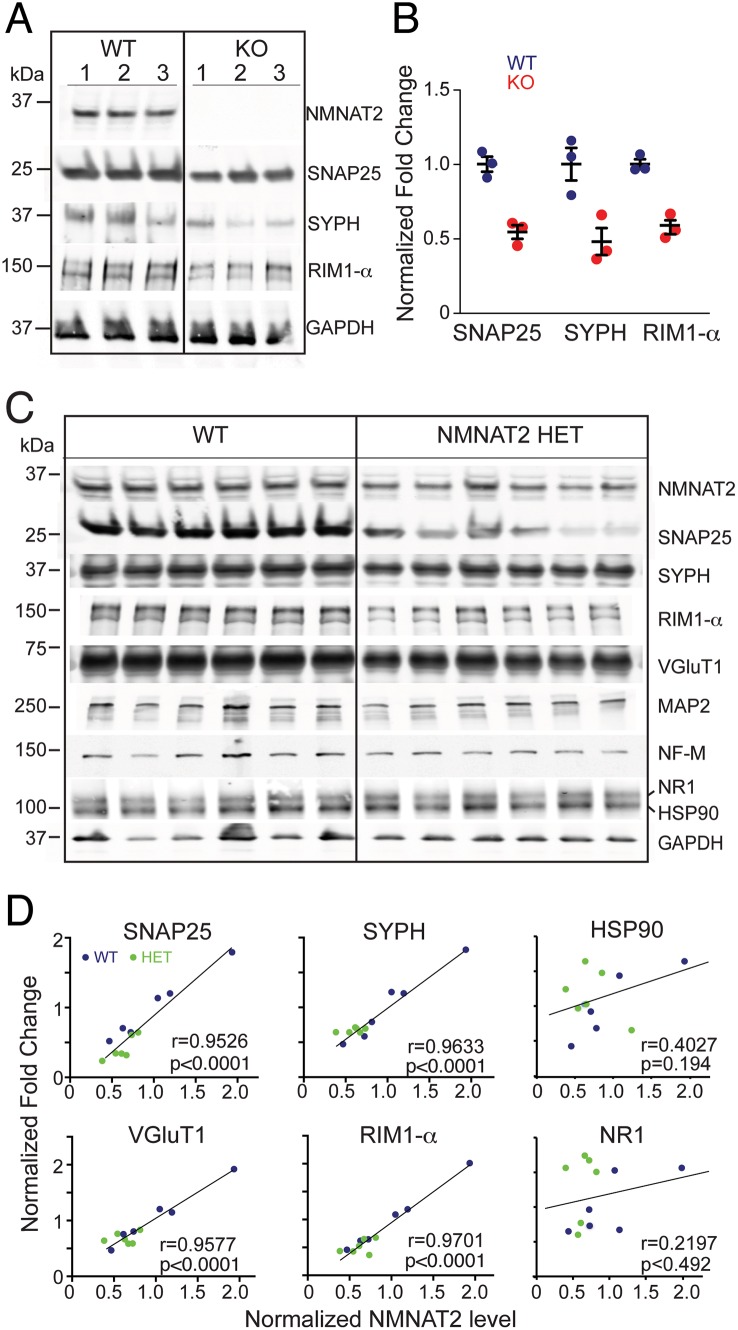
Fig 7. NMNAT2 abundance is positively correlated to the levels of synaptic proteins.
(A–B) Levels of synaptic proteins analyzed by western blotting in DIV10 WT, HET and KO cortical neurons. n = 3 independent experiments for each genotypes. (C–D) Western analysis for the abundance of synaptic proteins in the hippocampi of 8-mo-old NMNAT2 HET and WT (n = 6 per genotype). The regression lines show the relationships between NMNAT2 and SNAP25, SYPH, VGluT1, RIM1α, HSP90, NR1. Protein levels were normalized to GAPDH. Individual values for 7B and 7D are provided in S1 Data.

Comment in

References

    1. Zhai RG, Cao Y, Hiesinger PR, Zhou Y, Mehta SQ, Schulze KL, et al. Drosophila NMNAT maintains neural integrity independent of its NAD synthesis activity. PLoS Biol. 2006;4(12):e416 - PMC - PubMed
    1. Zhai RG, Zhang F, Hiesinger PR, Cao Y, Haueter CM, Bellen HJ. NAD synthase NMNAT acts as a chaperone to protect against neurodegeneration. Nature. 2008;452(7189):887–91. 10.1038/nature06721 - DOI - PMC - PubMed
    1. Chiang PW, Wang J, Chen Y, Fu Q, Zhong J, Chen Y, et al. Exome sequencing identifies NMNAT1 mutations as a cause of Leber congenital amaurosis. Nat Genet. 2012;44(9):972–4. 10.1038/ng.2370 - DOI - PubMed
    1. Koenekoop RK, Wang H, Majewski J, Wang X, Lopez I, Ren H, et al. Mutations in NMNAT1 cause Leber congenital amaurosis and identify a new disease pathway for retinal degeneration. Nat Genet. 2012;44(9):1035–9. 10.1038/ng.2356 - DOI - PMC - PubMed
    1. Perrault I, Hanein S, Zanlonghi X, Serre V, Nicouleau M, Defoort-Delhemmes S, et al. Mutations in NMNAT1 cause Leber congenital amaurosis with early-onset severe macular and optic atrophy. Nat Genet. 2012;44(9):975–7. 10.1038/ng.2357 - DOI - PubMed

MeSH terms

Substances