


The association between habitual physical activity and cigarette cravings, and influence of smokers' characteristics in disadvantaged smokers not ready to quit
- PMID: 27256353
- PMCID: PMC4917568
- DOI: 10.1007/s00213-016-4326-6
The association between habitual physical activity and cigarette cravings, and influence of smokers' characteristics in disadvantaged smokers not ready to quit
Abstract
Rationale: Habitual physical activity (PA) may have an important role in suppressing cigarette cravings. Systematic reviews show a strong acute effect of bouts of PA on reducing cigarette cravings, and it may be that these effects accumulate.
Objectives: The aim was to investigate the relationship between habitual levels of PA and cigarette cravings in disadvantaged smokers not ready to quit by examining baseline cross-sectional data from the Exercise Assisted Reduction then Stop smoking study (EARS).
Methods: A series of linear regression models were applied to investigate the relationship between habitual PA and cigarette cravings and to identify additional predictors of cigarette cravings. The analyses were extended by including interaction terms with PA to identify potential moderators of the relationship between PA and cravings.
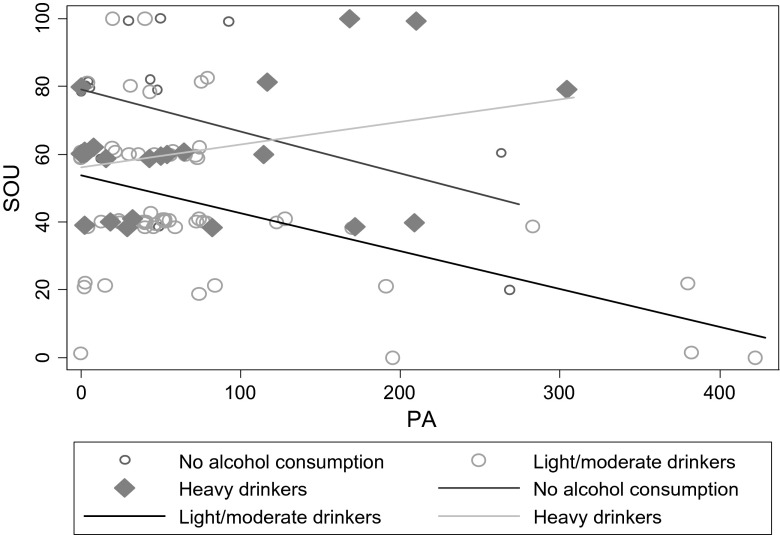
Results: A higher level of moderate intensity PA was associated with lower cravings (p = 0.033). Additional predictors were the mood and physical symptoms scale (p = 0.007; higher scores were associated with higher cravings) and alcohol consumption (p = 0.002; higher consumption was associated with lower cravings). In addition, a moderation effect of alcohol consumption was found; at higher levels of alcohol consumption, higher PA was significantly associated with higher cravings (p = 0.023).
Conclusions: Overall, participation in regular PA is associated with reduced cigarette cravings; among those with heavy alcohol consumption, this participation is associated with higher cravings. These exploratory analyses suggest that further research into the relationship between PA, alcohol consumption and cigarette cravings is needed.
Keywords: Alcohol; Cigarette cravings; Cross-sectional; Disadvantaged; Exercise; Smoking; Urges to smoke.
Figures
References
-
- Blair SN, Haskell WL, Ho P, Paffenbarger RS, Jr, Vranizan KM, Farquhar JW, Wood PD. Assessment of habitual physical activity by a seven-day recall in a community survey and controlled experiments. Am J Epidemiol. 1985;122:794–804. - PubMed
-
- Bull FC, The Expert Working Groups . Physical activity guidelines in the U.K.: review and recommendations. Loughborough University: School of Sport EaHS; 2010.
MeSH terms
Grants and funding
LinkOut - more resources
Full Text Sources
Other Literature Sources
Medical
