. 2016 Oct:109:112-120.
doi: 10.1016/j.neuropharm.2016.05.021. Epub 2016 May 30.

Inhaled delivery of Δ(9)-tetrahydrocannabinol (THC) to rats by e-cigarette vapor technology

Affiliations

Inhaled delivery of Δ(9)-tetrahydrocannabinol (THC) to rats by e-cigarette vapor technology

Jacques D Nguyen et al. Neuropharmacology. 2016 Oct.

Abstract

Most human Δ(9)-tetrahydrocannabinol (THC) use is via inhalation, and yet few animal studies of inhalation exposure are available. Popularization of non-combusted methods for the inhalation of psychoactive drugs (Volcano(®), e-cigarettes) further stimulates a need for rodent models of this route of administration. This study was designed to develop and validate a rodent chamber suitable for controlled exposure to vaporized THC in a propylene glycol vehicle, using an e-cigarette delivery system adapted to standard size, sealed rat housing chambers. The in vivo efficacy of inhaled THC was validated using radiotelemetry to assess body temperature and locomotor responses, a tail-flick assay for nociception and plasma analysis to verify exposure levels. Hypothermic responses to inhaled THC in male rats depended on the duration of exposure and the concentration of THC in the vehicle. The temperature nadir was reached after ∼40 min of exposure, was of comparable magnitude (∼3 °Celsius) to that produced by 20 mg/kg THC, i.p. and resolved within 3 h (compared with a 6 h time course following i.p. THC). Female rats were more sensitive to hypothermic effects of 30 min of lower-dose THC inhalation. Male rat tail-flick latency was increased by THC vapor inhalation; this effect was blocked by SR141716 pretreatment. The plasma THC concentration after 30 min of inhalation was similar to that produced by 10 mg/kg THC i.p. This approach is flexible, robust and effective for use in laboratory rats and will be of increasing utility as users continue to adopt "vaping" for the administration of cannabis.

Keywords: Cannabis; In vivo; Marijuana; Substance abuse; Tetrad; Vape.


Figures

Figure 1
Figure 1
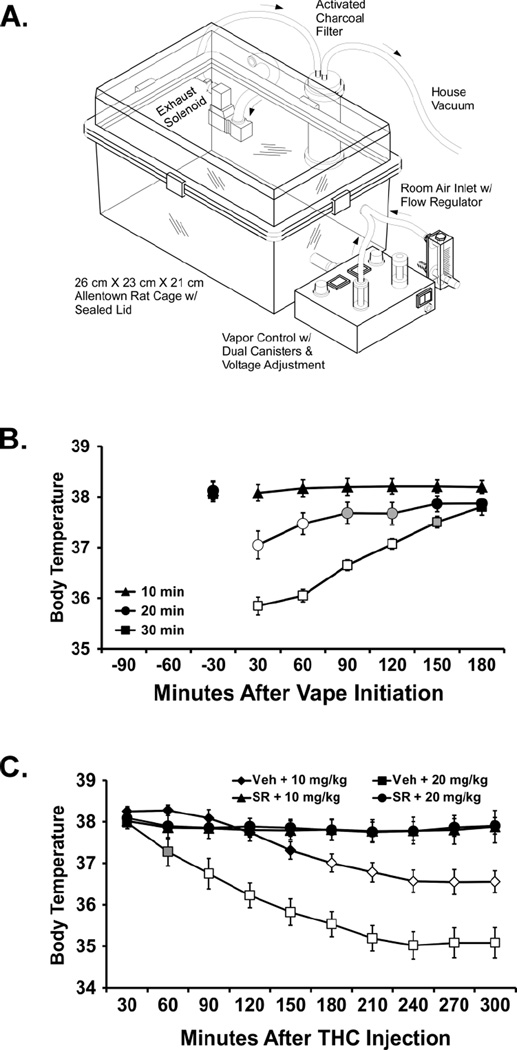
A) Schematic of the apparatus used, adapted from a patent application filed by La Jolla Alcohol Research, Inc. Minor details varied in the present study which was conducted during development of this device. B) Mean (N=8; ±SEM) body temperature of male Sprague-Dawley rats following THC vapor inhalation for 10, 20 or 30 min. A significant difference from both the baseline and the other exposure conditions is indicated by the open symbols and from the 10 min condition by the shaded symbols. C) Mean (N=7) body temperature following intraperitoneal injection of vehicle (Veh) or SR141716 (SR) and then THC (10, 20 mg/kg). A significant difference from all other conditions is indicated by open symbols and from the Veh + 10 mg/kg condition by the shaded symbol.
Figure 2
Figure 2
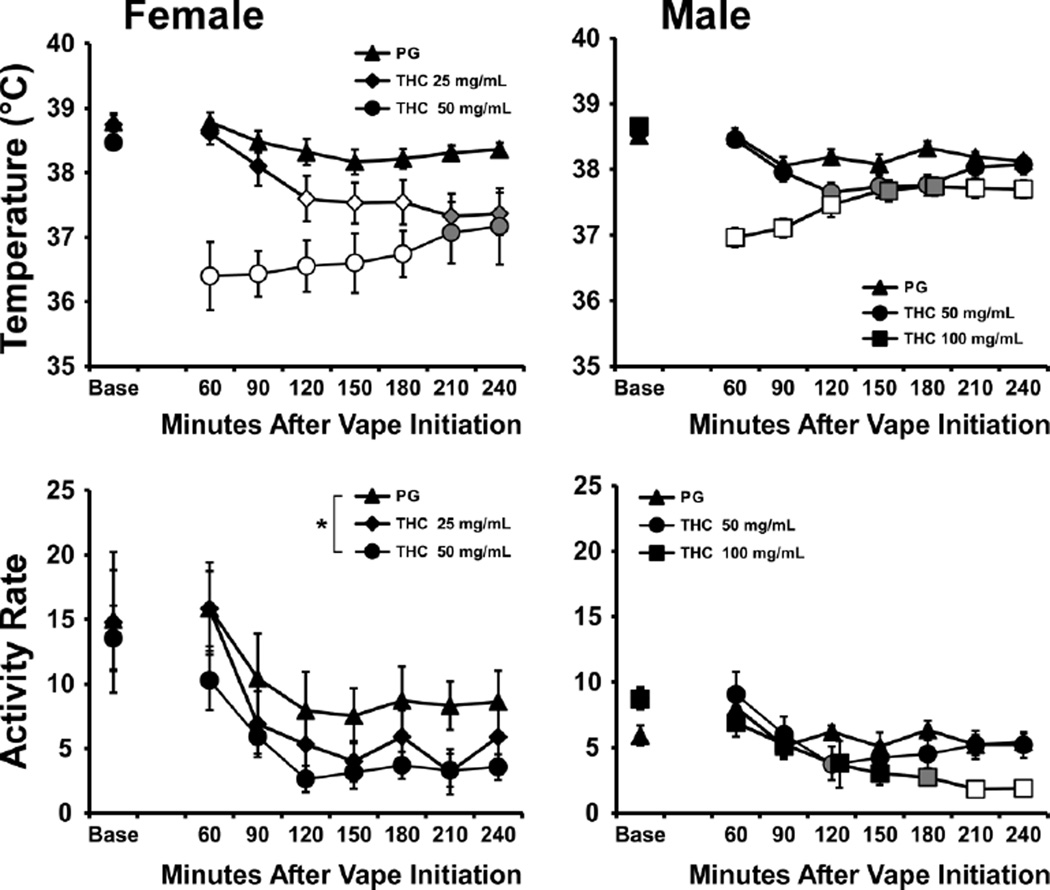
Mean body temperature (upper panels) and activity rates (lower panels) of female (N=5; ±SEM) and male (N=8; ±SEM) Wistar rats after inhalation of PG or THC (50 mg/mL in PG) vapor inhalation for 30 min. A significant difference from baseline and both of the other conditions is indicated by the open symbols and from the baseline and the PG condition by the shaded symbols. Marginal mean differences are indicated by *. Base = baseline.
Figure 3
Figure 3
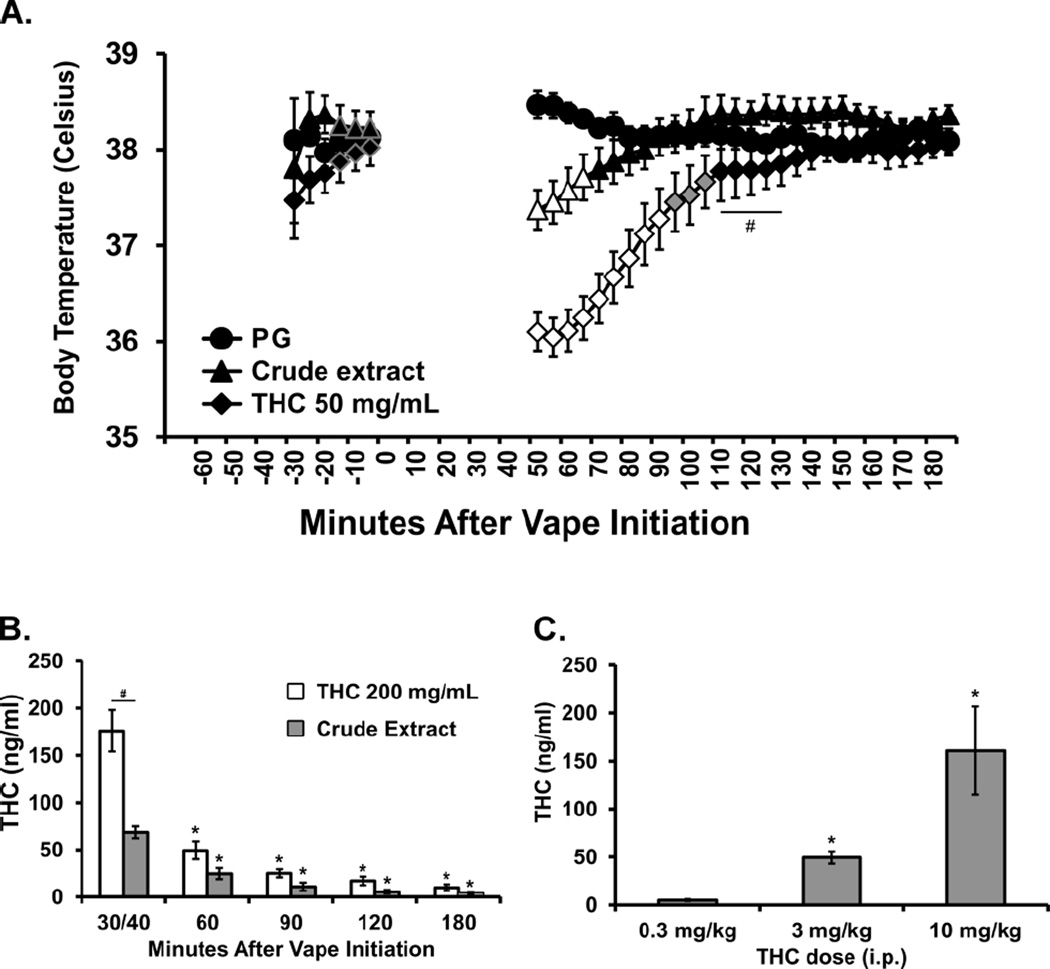
A) Mean (N=8; ±SEM) body temperature of male Sprague-Dawley rats after inhalation of PG, Crude marijuana extract or THC vapor inhalation for 40 min. Temperature is represented in the 5 min samples as collected. A significant difference from both the baseline and the other exposure conditions is indicated by the open symbols, from the PG Vehicle condition by the shaded symbols and from the Crude condition by #. The three baseline samples for the THC and crude extract conditions are outlined in grey for clarity. Also shown are B) mean (N=5; ±SEM) plasma THC concentrations after vapor inhalation of THC for 30 min or of crude extract for 40 min; and C) mean (N=6) plasma concentrations of THC after injection of THC (0.3, 3, 10 mg/kg, i.p.). A significant difference from the first time point or the 0.3 mg/kg, i.p. dose is indicated by * and between THC and Crude materials by #.
Figure 4
Figure 4
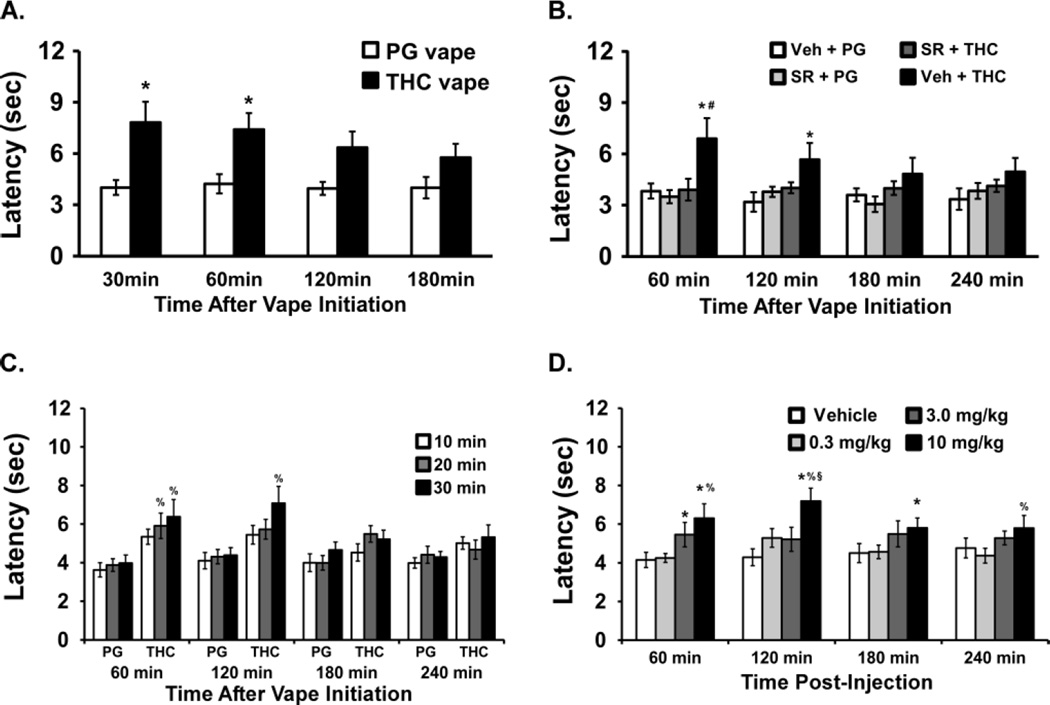
Mean tail-flick latency measured following A) 20 min of PG or THC exposure (N=14); B) 20 min of exposure with pre-treatment with SR141716 (SR; 4 mg/kg, i.p.) or Vehicle (N=8); C) 10, 20 or 30 min of PG or THC exposure (N=14); D) Injection of THC (N=10; 0.3–10 mg/kg, i.p.) Significant differences compared with respective vehicle condition are indicated by *, differences from SR+THC vapor by #, from the lowest dose (10 min or 0.3 mg/kg) by % and from the 3.0 mg/kg dose by §.

References

    1. Aarde SM, Angrish D, Barlow DJ, Wright MJ, Jr, Vandewater SA, Creehan KM, et al. Mephedrone (4-methylmethcathinone) supports intravenous self-administration in Sprague-Dawley and Wistar rats. Addict Biol. 2013a;18(5):786–799. - PMC - PubMed
    1. Aarde SM, Creehan KM, Vandewater SA, Dickerson TJ, Taffe MA. In vivo potency and efficacy of the novel cathinone alpha-pyrrolidinopentiophenone and 3,4-methylenedioxypyrovalerone: self-administration and locomotor stimulation in male rats. Psychopharmacology (Berl) 2015a;232(16):3045–3055. - PMC - PubMed
    1. Aarde SM, Huang PK, Creehan KM, Dickerson TJ, Taffe MA. The novel recreational drug 3,4-methylenedioxypyrovalerone (MDPV) is a potent psychomotor stimulant: self-administration and locomotor activity in rats. Neuropharmacology. 2013b;71:130–140. - PMC - PubMed
    1. Aarde SM, Huang PK, Dickerson TJ, Taffe MA. Binge-like acquisition of 3,4-methylenedioxypyrovalerone (MDPV) self-administration and wheel activity in rats. Psychopharmacology (Berl) 2015b;232(11):1867–1877. - PMC - PubMed
    1. Abel EL. Chronopharmacology of delta9-tetrahydrocannabinol hypothermia in mice. Experientia. 1973;29(12):1528–1529. - PubMed

Publication types