


Multimodal imaging patterns predict survival in recurrent glioblastoma patients treated with bevacizumab
- PMID: 27257279
- PMCID: PMC6693191
- DOI: 10.1093/neuonc/now086
Multimodal imaging patterns predict survival in recurrent glioblastoma patients treated with bevacizumab
Abstract
Background: Bevacizumab is a humanized antibody against vascular endothelial growth factor approved for treatment of recurrent glioblastoma. There is a need to discover imaging biomarkers that can aid in the selection of patients who will likely derive the most survival benefit from bevacizumab.
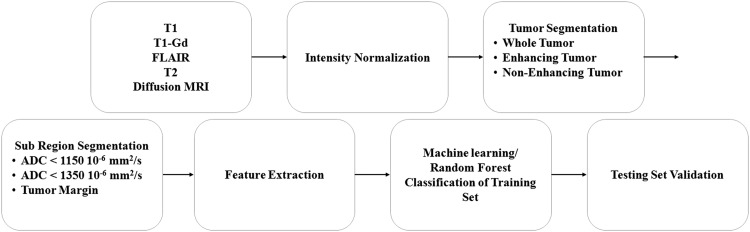
Methods: The aim of the study was to examine if pre- and posttherapy multimodal MRI features could predict progression-free survival and overall survival (OS) for patients with recurrent glioblastoma treated with bevacizumab. The patient population included 84 patients in a training cohort and 42 patients in a testing cohort, separated based on pretherapy imaging date. Tumor volumes of interest were segmented from contrast-enhanced T1-weighted and fluid attenuated inversion recovery images and were used to derive volumetric, shape, texture, parametric, and histogram features. A total of 2293 pretherapy and 9811 posttherapy features were used to generate the model.
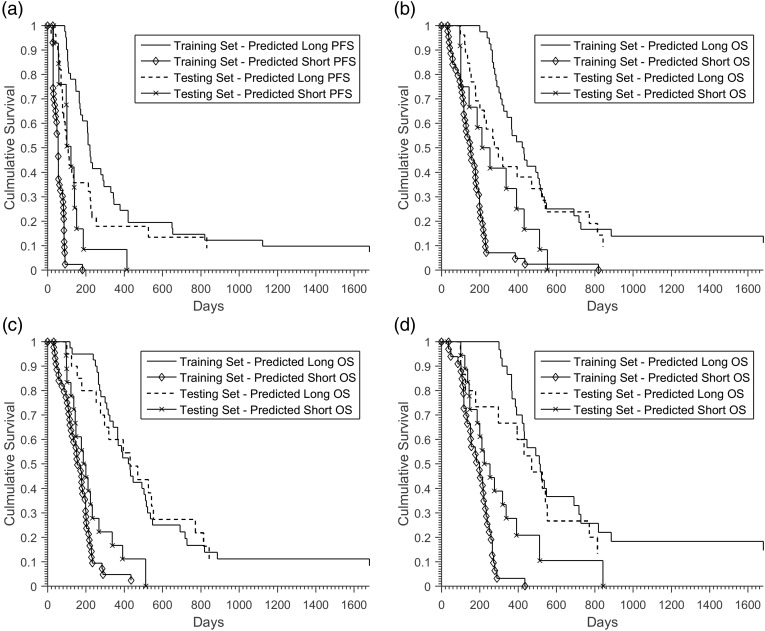
Results: Using standard radiographic assessment criteria, the hazard ratio for predicting OS was 3.38 (P < .001). The hazard ratios for pre- and posttherapy features predicting OS were 5.10 (P < .001) and 3.64 (P < .005) for the training and testing cohorts, respectively.
Conclusion: With the use of machine learning techniques to analyze imaging features derived from pre- and posttherapy multimodal MRI, we were able to develop a predictive model for patient OS that could potentially assist clinical decision making.
Keywords: bevacizumab; glioblastoma; machine learning; recurrent; survival.
© The Author(s) 2016. Published by Oxford University Press on behalf of the Society for Neuro-Oncology. All rights reserved. For permissions, please e-mail: journals.permissions@oup.com.
Figures
References
-
- Stupp R, Mason WP, van den Bent MJ et al. . Radiotherapy plus concomitant and adjuvant temozolomide for glioblastoma. N Engl J Med. 2005;352(10):987–996. - PubMed
-
- Wen PY, Kesari S. Malignant gliomas in adults. N Engl J Med. 2008;359(5):492–507. - PubMed
-
- Norden AD, Drappatz J, Muzikansky A et al. . An exploratory survival analysis of anti-angiogenic therapy for recurrent malignant glioma. J Neurooncol. 2009;92(2):149–155. - PubMed
Publication types
MeSH terms
Substances
LinkOut - more resources
Full Text Sources
Other Literature Sources
Medical
