


Deregulation of the HOXA9/MEIS1 axis in acute leukemia
- PMID: 27258906
- PMCID: PMC5653247
- DOI: 10.1097/MOH.0000000000000245
Deregulation of the HOXA9/MEIS1 axis in acute leukemia
Abstract
Purpose of review: HOXA9 is a homeodomain transcription factor that plays an essential role in normal hematopoiesis and acute leukemia, in which its overexpression is strongly correlated with poor prognosis. The present review highlights recent advances in the understanding of genetic alterations leading to deregulation of HOXA9 and the downstream mechanisms of HOXA9-mediated transformation.
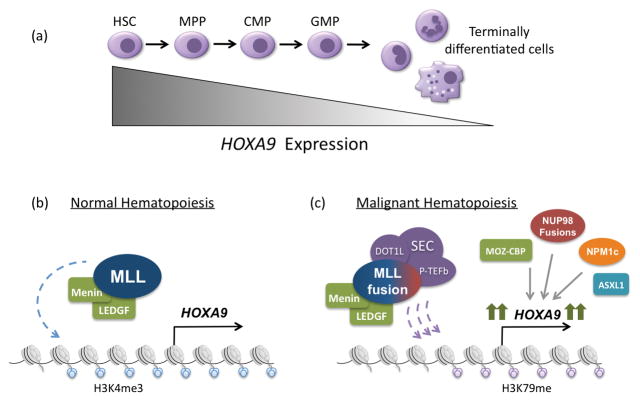
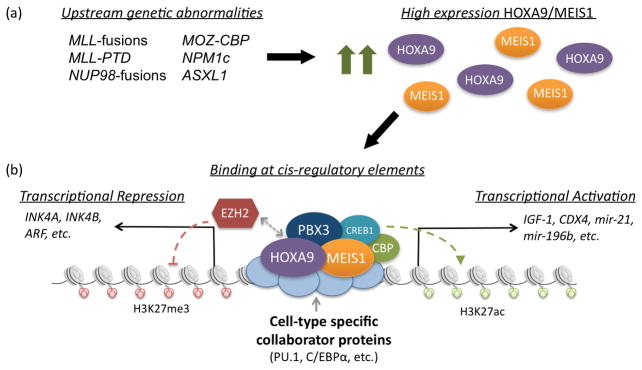
Recent findings: A variety of genetic alterations including MLL translocations, NUP98-fusions, NPM1 mutations, CDX deregulation, and MOZ-fusions lead to high-level HOXA9 expression in acute leukemias. The mechanisms resulting in HOXA9 overexpression are beginning to be defined and represent attractive therapeutic targets. Small molecules targeting MLL-fusion protein complex members, such as DOT1L and menin, have shown promising results in animal models, and a DOT1L inhibitor is currently being tested in clinical trials. Essential HOXA9 cofactors and collaborators are also being identified, including transcription factors PU.1 and C/EBPα, which are required for HOXA9-driven leukemia. HOXA9 targets including IGF1, CDX4, INK4A/INK4B/ARF, mir-21, and mir-196b and many others provide another avenue for potential drug development.
Summary: HOXA9 deregulation underlies a large subset of aggressive acute leukemias. Understanding the mechanisms regulating the expression and activity of HOXA9, along with its critical downstream targets, shows promise for the development of more selective and effective leukemia therapies.
Conflict of interest statement
There are no conflicts of interest.
Figures
References
-
- Goodman FR. Limb malformations and the human HOX genes. American journal of medical genetics. 2002;112(3):256–65. - PubMed
-
- Lewis EB. A gene complex controlling segmentation in Drosophila. Nature. 1978;276(5688):565–70. - PubMed
-
- Krumlauf R. Hox genes in vertebrate development. Cell. 1994;78:191–201. - PubMed
-
- Alharbi RA, Pettengell R, Pandha HS, Morgan R. The role of HOX genes in normal hematopoiesis and acute leukemia. Leukemia. 2013;27(5):1000–8. - PubMed
Publication types
MeSH terms
Substances
Grants and funding
LinkOut - more resources
Full Text Sources
Other Literature Sources
Medical
Research Materials
Miscellaneous
