. 2016:1427:305-18.
doi: 10.1007/978-1-4939-3615-1_18.

Quantifying Spiral Ganglion Neurite and Schwann Behavior on Micropatterned Polymer Substrates

Affiliations

Quantifying Spiral Ganglion Neurite and Schwann Behavior on Micropatterned Polymer Substrates

Elise L Cheng et al. Methods Mol Biol. 2016.

Abstract

The first successful in vitro experiments on the cochlea were conducted in 1928 by Honor Fell (Fell, Arch Exp Zellforsch 7(1):69-81, 1928). Since then, techniques for culture of this tissue have been refined, and dissociated primary culture of the spiral ganglion has become a widely accepted in vitro model for studying nerve damage and regeneration in the cochlea. Additionally, patterned substrates have been developed that facilitate and direct neural outgrowth. A number of automated and semi-automated methods for quantifying this neurite outgrowth have been utilized in recent years (Zhang et al., J Neurosci Methods 160(1):149-162, 2007; Tapias et al., Neurobiol Dis 54:158-168, 2013). Here, we describe a method to study the effect of topographical cues on spiral ganglion neurite and Schwann cell alignment. We discuss our microfabrication process, characterization of pattern features, cell culture techniques for both spiral ganglion neurons and spiral ganglion Schwann cells. In addition, we describe protocols for reducing fibroblast count, immunocytochemistry, and methods for quantifying neurite and Schwann cell alignment.

Keywords: Dissociated culture; Explant; Photopolymerization; Primary culture; Spiral ganglion; Topographical micropattern.


Figures
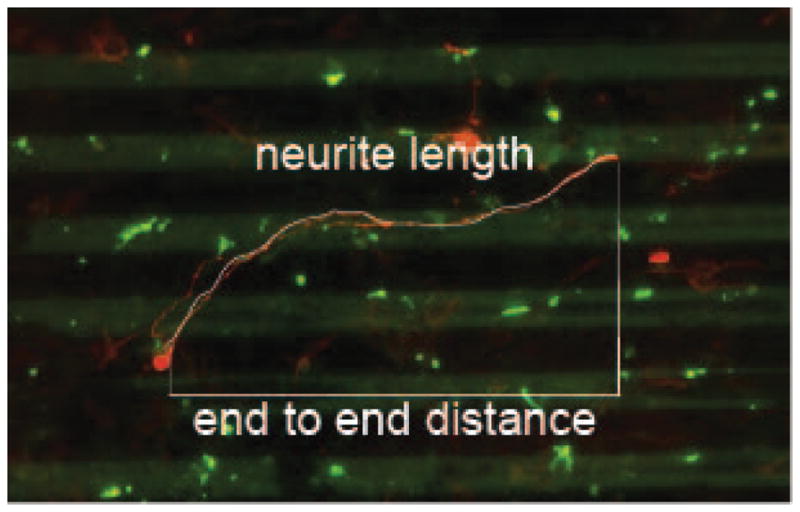
Figure 1
Figure 1
Method for quantifying neurite alignment to linear patterns. Alignment ratio is defined as the ratio of neurite length to end-to-end distance. As the length of the neurite increases over the end-to-end distance, the alignment ratio increases. A perfectly aligned neurite would have an alignment ratio of 1.
Figure 2
Figure 2
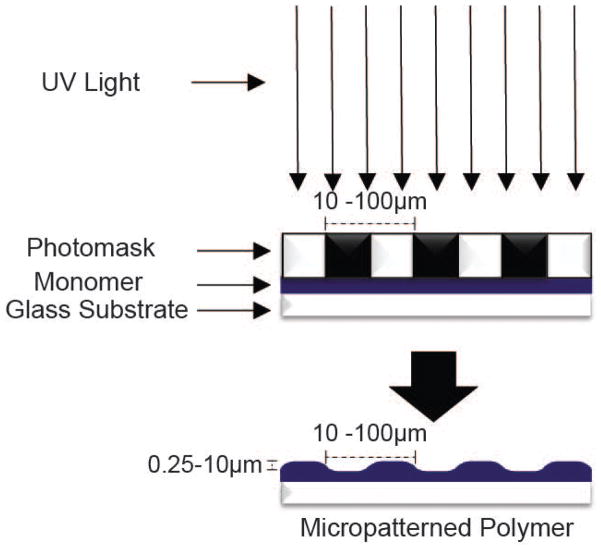
Schematic of photopatterning process. Monomer is selectively exposed to UV light through transparent bands of the photomask resulting in raised microfeatures across the polymer surface.
Figure 3
Figure 3
Characterization of micropatterned surfaces. A) Representative SEM images showing gradually sloping transitions of a parallel line patterned polymer of 8 μm amplitude and 50 μm periodicity. B) 2 D profile of micropatterned polymer using white light interferometry showing 1 μm amplitude and 50 um periodicity. Inset: 3 D representation of 100 μm2 area of the same polymer (Figures adapted from reference . Permission for reproduction granted by Elsevier).

References

    1. Fell HB. The development in vitro of the isolated otocyst of the embryonic fowl. Arch Exp Zellforsch. 1928;7(1):69–81.
    1. Zhang Y, Zhou X, Degterev A, Lipinski M, Adjeroh D, Yuan J, Wong ST. A novel tracing algorithm for high throughput imaging Screening of neuron-based assays. J Neurosci Methods. 2007;160(1):149–162. doi: 10.1016/j.jneumeth.2006.07.028. - DOI - PubMed
    1. Tapias V, Greenamyre JT, Watkins SC. Automated imaging system for fast quantitation of neurons, cell morphology and neurite morphometry in vivo and in vitro. Neurobiol Dis. 2013;54:158–168. doi: 10.1016/j.nbd.2012.11.018. - DOI - PMC - PubMed
    1. Hoffman-Kim D, Mitchel JA, Bellamkonda RV. Topography, cell response, and nerve regeneration. Annu Rev Biomed Eng. 2010;12:203–231. doi: 10.1146/annurev-bioeng-070909-105351. - DOI - PMC - PubMed
    1. Li S, Tuft BW, Xu L, Polacco MA, Clarke JC, Guymon CA, Hansen MR. Microtopographical features generated by photopolymerization recruit RhoA/ROCK through TRPV1 to direct cell and neurite growth. Biomaterials. 2015;53:95–106. doi: 10.1016/j.biomaterials.2015.02.057. - DOI - PMC - PubMed

Substances

LinkOut - more resources