


Pathological conformations involving the amino terminus of tau occur early in Alzheimer's disease and are differentially detected by monoclonal antibodies
- PMID: 27260838
- PMCID: PMC4983528
- DOI: 10.1016/j.nbd.2016.05.016
Pathological conformations involving the amino terminus of tau occur early in Alzheimer's disease and are differentially detected by monoclonal antibodies
Abstract
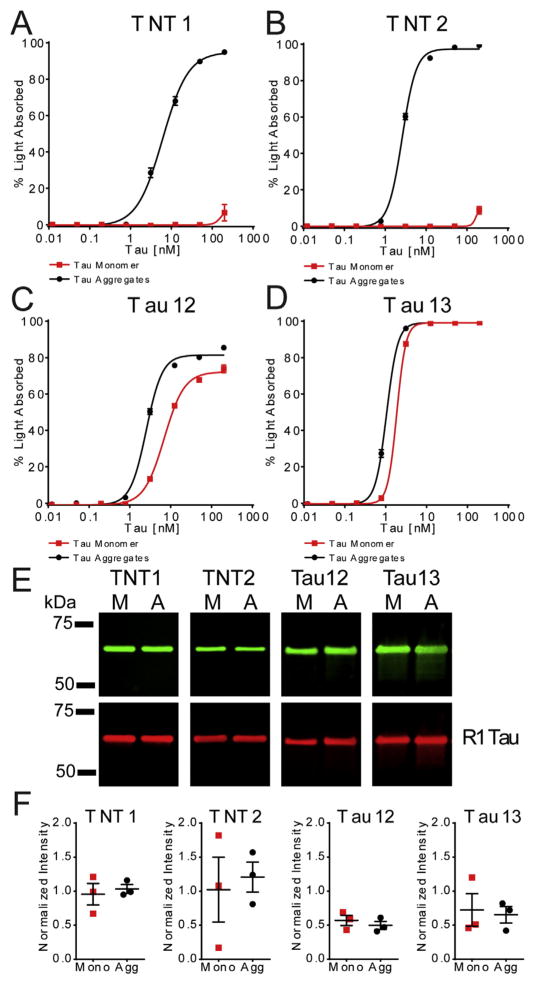
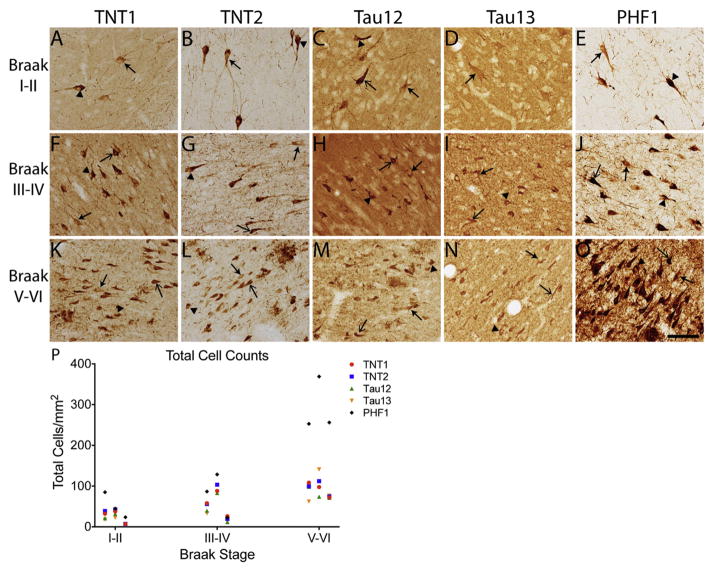
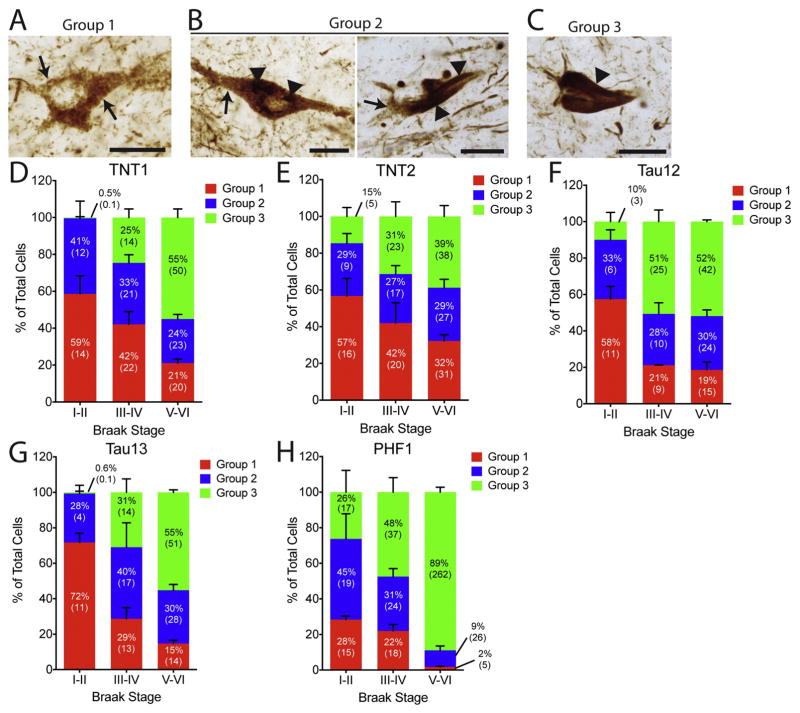
Conformational changes involving the amino terminus of the tau protein are among the earliest alterations associated with tau pathology in Alzheimer's disease and other tauopathies. This region of tau contains a phosphatase-activating domain (PAD) that is aberrantly exposed in pathological forms of the protein, an event that is associated with disruptions in anterograde fast axonal transport. We utilized four antibodies that recognize the amino terminus of tau, TNT1, TNT2 (a novel antibody), Tau12, and Tau13, to further study this important region. Using scanning alanine mutations in recombinant tau proteins, we refined the epitopes of each antibody. We examined the antibodies' relative abilities to specifically label pathological tau in non-denaturing and denaturing assays to gain insight into some of the mechanistic details of PAD exposure. We then determined the pattern of tau pathology labeled by each antibody in human hippocampal sections at various disease stages in order to characterize PAD exposure in the context of disease progression. The characteristics of reactivity for the antibodies fell into two groups. TNT1 and TNT2 recognized epitopes within amino acids 7-12 and specifically identified recombinant tau aggregates and pathological tau from Alzheimer's disease brains in a conformation-dependent manner. These antibodies labeled early pre-tangle pathology from neurons in early Braak stages and colocalized with thiazine red, a marker of fibrillar pathology, in classic neurofibrillary tangles. However, late tangles were negative for TNT1 and TNT2 indicating a loss of the epitope in later stages of tangle evolution. In contrast, Tau12 and Tau13 both identified discontinuous epitopes in the amino terminus and were unable to differentiate between normal and pathological tau in biochemical and tissue immunohistological assays. Despite the close proximity of these epitopes, the antibodies demonstrated remarkably different abilities to identify pathological changes in tau indicating that detection of conformational alterations involving PAD exposure is not achieved by all N-terminal tau antibodies and that a relatively discrete region of the N-terminus (i.e., amino acids 7-12, the TNT1 and TNT2 epitope) is central to the differences between normal and pathological tau. The appearance of PAD in early tau pathology and its disappearance in late-stage tangles suggest that toxic forms of tau are associated with the earliest forms of tau deposits. Collectively, these findings demonstrate that the TNT antibodies are useful markers for early conformational display of PAD and provide information regarding conformational changes that have potential implications in the toxic mechanisms of tau pathology.
Keywords: Alzheimer's disease; Antibodies; Conformation; Neurodegeneration; Protein aggregation; Protein misfolding; Tau; Tauopathies.
Copyright © 2016 The Authors. Published by Elsevier Inc. All rights reserved.
Conflict of interest statement
The authors report no conflicts of interest.
Figures




References
-
- Augustinack JC, et al. Specific tau phosphorylation sites correlate with severity of neuronal cytopathology in Alzheimer’s disease. Acta Neuropathol (Berl) 2002;103:26–35. - PubMed
-
- Bancher C, et al. Accumulation of abnormally phosphorylated tau precedes the formation of neurofibrillary tangles in Alzheimer’s disease. Brain Res. 1989;477:90–99. - PubMed
-
- Bancher C, et al. Abnormal phosphorylation of tau precedes ubiquitination in neurofibrillary pathology of Alzheimer disease. Brain Res. 1991;539:11–18. - PubMed
-
- Berry RW, et al. Tau epitope display in progressive supranuclear palsy and corticobasal degeneration. J Neurocytol. 2004;33:287–295. - PubMed
-
- Bobinski M, et al. Relationships between regional neuronal loss and neurofibrillary changes in the hippocampal formation and duration and severity of Alzheimer disease. J Neuropathol Exp Neurol. 1997;56:414–420. - PubMed
MeSH terms
Substances
Grants and funding
LinkOut - more resources
Full Text Sources
Other Literature Sources
Medical
