


Inpatient Walking Activity to Predict Readmission in Older Adults
- PMID: 27264549
- PMCID: PMC5325689
- DOI: 10.1016/j.apmr.2015.09.029
Inpatient Walking Activity to Predict Readmission in Older Adults
Abstract
Objective: To compare the 30-day readmission predictive power of in-hospital walking activity and in-hospital activities of daily living (ADLs) in older acutely ill patients. In addition, we sought to identify preliminary walking thresholds that could support the targeting of interventions aimed at minimizing rehospitalizations.
Design: Prospective, observational clinical cohort study. Step counts during hospitalization were assessed via accelerometry. ADL function was assessed within 48 hours of admission.
Setting: Acute care hospital.
Participants: One hundred sixty-four ambulatory persons aged 65 years and older admitted to the hospital from the community with an acute medical illness.
Interventions: Not applicable.
Main outcome measures: Readmission back to the index hospital (yes vs no) within 30 days of discharge.
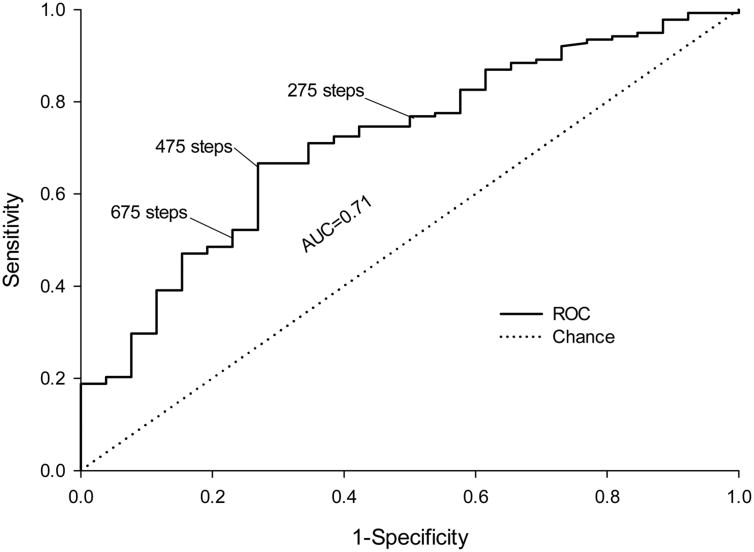
Results: Twenty-six patients (15.8%) were readmitted within 30 days of discharge. Walking activity during hospitalization was more strongly and significantly associated with 30-day readmission (odds ratio=0.90; 95% confidence interval, 0.82-0.98) than ADL function (odds ratio=0.45; 95% confidence interval, 0.14-1.45) after adjusting for relevant readmission risk factors. The predictive accuracy (area under the curve) was highest for models that included walking activity and changed little with the addition of ADLs. A walking threshold of 275 steps or more per day identified patients at reduced 30-day readmission risk.
Conclusions: Walking activity was a stronger predictor of readmission than ADLs. Monitoring patient activity during hospitalization may provide clinicians with valuable information on early readmission risk not captured by measures of ADLs. Further study is needed to replicate these findings and monitor walking activity posthospitalization to further advance our understanding of readmission risk.
Keywords: Accelerometry; Activities of daily living; Geriatrics; Patient readmission; Rehabilitation.
Copyright © 2016 American Congress of Rehabilitation Medicine. Published by Elsevier Inc. All rights reserved.
Figures
References
-
- DeFrances CJ, Lucas CA, Buie VC, Golosinskiy A. 2006 National Hospital Discharge Survey. Natl Health Stat Report. 2008:1–20. - PubMed
-
- Jha AK, Orav EJ, Epstein AM. Public reporting of discharge planning and rates of readmissions. N Engl J Med. 2009;361:2637–2645. - PubMed
-
-
111th Congress. Patient Protection and Affordable Care Act (Public Law 111-148). 1-5-2010.
-
-
- Hernandez AF, Granger CB. Prediction is very hard, especially about the future: comment on “factors associated with 30-day readmission rates after percutaneous coronary intervention”. Arch Intern Med. 2012;172:117–119. - PubMed
-
- Coleman EA, Parry C, Chalmers S, Min SJ. The care transitions intervention: results of a randomized controlled trial. Arch Intern Med. 2006;166:1822–1828. - PubMed
Publication types
MeSH terms
Grants and funding
LinkOut - more resources
Full Text Sources
Other Literature Sources
Medical
