Review
. 2017 Apr;14(4):321-330.
doi: 10.1038/cmi.2016.26. Epub 2016 Jun 6.

NK cell education via nonclassical MHC and non-MHC ligands

Affiliations
Review

NK cell education via nonclassical MHC and non-MHC ligands

Yuke He et al. Cell Mol Immunol. 2017 Apr.

Abstract

Natural killer (NK) cell education, a process for achieving functional maturation and self-tolerance, has been previously defined by the interaction between self-major histocompatibility complex class I (MHC-I) molecules and their specific inhibitory receptors. Over the past several years, growing evidence has highlighted the important roles of nonclassical MHC-I and non-MHC-I molecules in NK cell education. Herein, we review the current knowledge of NK cell education, with a particular focus on nonclassical MHC-I- and non-MHC-I-dependent education, and compare them with the classical MHC-I-dependent education theory. In addition, we update and extend this theory by presenting the 'Confining Model', discussing cis and trans characteristics, reassessing quantity and quality control, and elucidating the redundancy of NK cell education in tumor and virus infection.


Conflict of interest statement

The authors declare no conflict of interest.

Figures
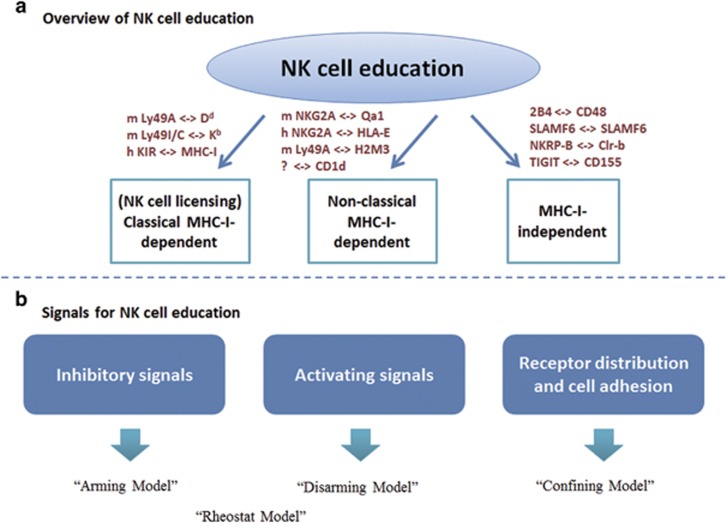
Figure 1
Figure 1
Outline of NK cell education. (a) Overview of NK cell education. NK cell education, a broad concept regarding the acquisition of NK cell function and self-tolerance, can be defined as classical MHC-I-dependent, nonclassical MHC-I-independent and MHC-I-independent. (b) Signals for NK cell education. Inhibitory signals, activating signals, and adhesion signals are involved in NK cell education. In the 'Arming Model', inhibitory receptors provide critical signals for education through their ITIM motifs. The 'Disarming Model' highlights the important role of activating receptors. NK cells are disarmed (hypo-responsive) if they are without inhibitory signals to balance the chronic activating stimulations. The 'Rheostat Model' proposes a quantitative perspective of NK cell education, suggesting that the increase or decrease in NK cell responsiveness is quantitatively controlled by the strength of the inhibitory input. The 'Confining Model' demonstrates that the confinement of receptor distribution is indispensable for NK cell education. ITIM, immunoreceptor tyrosine-based inhibitory motif; MHC, major histocompatibility complex; NK cells, natural killer cells.
Figure 2
Figure 2
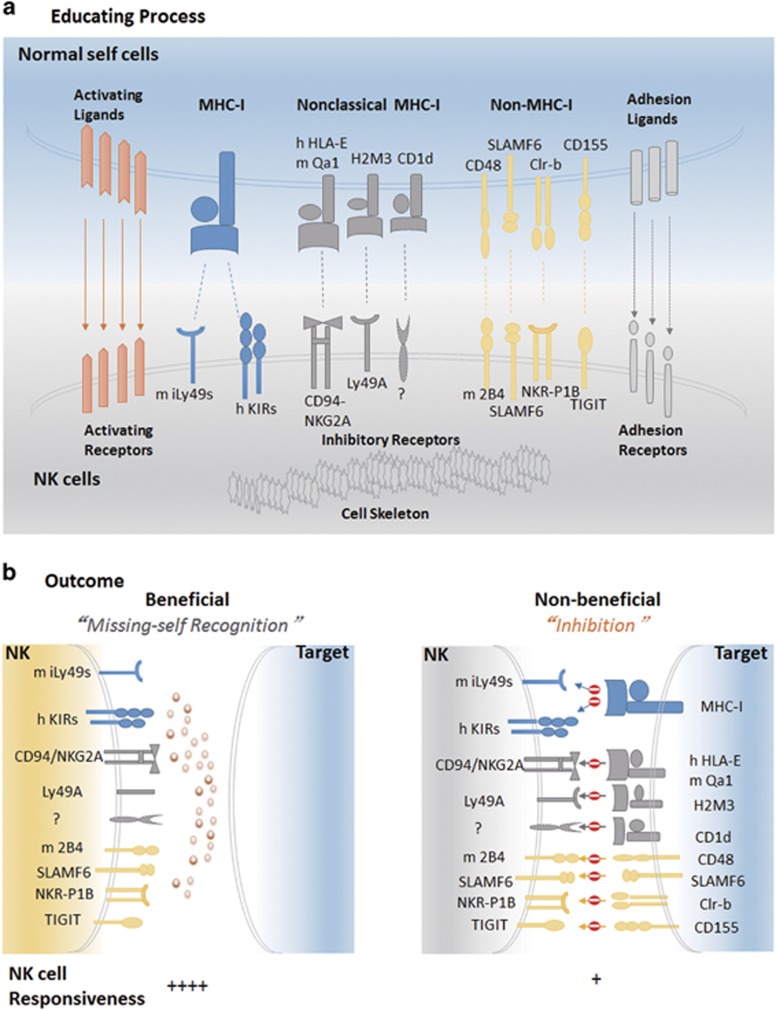
Schematic representation of the role of education on target recognition. (a) Educating process. During development, NK cells acquire functional maturation through an adaptation to the host. In this process, inhibitory receptors are directly involved by engaging self-ligands (either MHC-I-dependent or not) to educate NK cells to acquire effector responses. (b) Outcome. Differential roles of the education process are shown with respect to the presence of inhibitory ligands on target cells. Education is beneficial to allow NK cells with the expression of inhibitory receptors to sense missing self. However, when inhibitory ligands are sufficient on target cells, the inhibition by ligation of inhibitory receptors with their cognate ligands impedes the activation of educated NK cells. NK cells, natural killer cells.
Figure 3
Figure 3
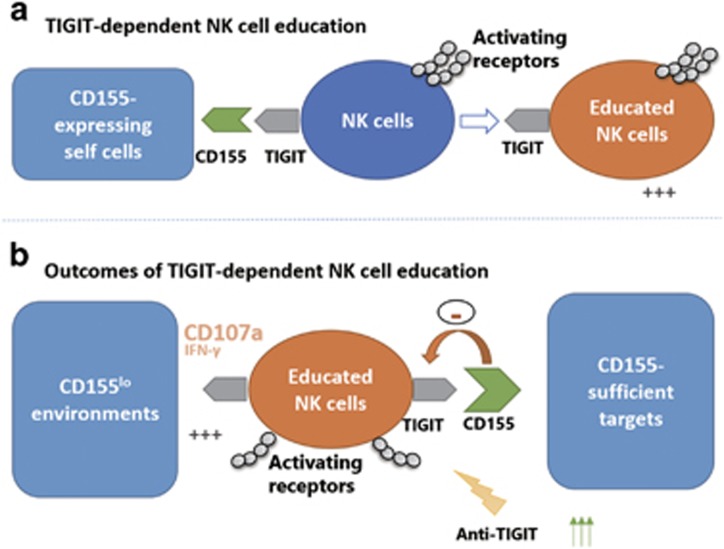
TIGIT-CD155 axis regulates NK cell education (He, 2016, unpublished data). (a) During NK cell development, CD155 molecules on self-cells is involved in educating TIGIT+ NK cells to obtain final functional maturation. (b) The TIGIT-CD155 system is important for NK cells in sensing missing CD155 targets. However, CD155-sufficient targets inhibit the responsiveness of functional TIGIT+ NK cells. NK cells, natural killer cells.

References

    1. Kim S, Poursine-Laurent J, Truscott S, Lybarger L, Song Y-J, Yang L et al. Licensing of natural killer cells by host major histocompatibility complex class I molecules. Nature 2005; 436: 709–713. - PubMed
    1. Raulet DH, Vance RE. Self-tolerance of natural killer cells. Nat Rev Immunol 2006; 6: 520–531. - PubMed
    1. Anfossi N, André P, Guia S, Falk CS, Roetynck S, Stewart CA et al. Human NK cell education by inhibitory receptors for MHC Class I. Immunity 2006; 25: 331–342. - PubMed
    1. Yokoyama WM, Kim S. Licensing of natural killer cells by self-major histocompatibility complex class I. Immunol Rev 2006; 214: 143–154. - PubMed
    1. Elliott JM, Yokoyama WM. Unifying concepts of MHC-dependent natural killer cell education. Trends Immunol 2011; 32: 364–372. - PMC - PubMed