. 2016 Jun:15:27-37.
doi: 10.1016/j.epidem.2016.01.002. Epub 2016 Feb 1.

A generalized-growth model to characterize the early ascending phase of infectious disease outbreaks

Affiliations

A generalized-growth model to characterize the early ascending phase of infectious disease outbreaks

Cécile Viboud et al. Epidemics. 2016 Jun.

Abstract

Background: A better characterization of the early growth dynamics of an epidemic is needed to dissect the important drivers of disease transmission, refine existing transmission models, and improve disease forecasts.

Materials and methods: We introduce a 2-parameter generalized-growth model to characterize the ascending phase of an outbreak and capture epidemic profiles ranging from sub-exponential to exponential growth. We test the model against empirical outbreak data representing a variety of viral pathogens in historic and contemporary populations, and provide simulations highlighting the importance of sub-exponential growth for forecasting purposes.

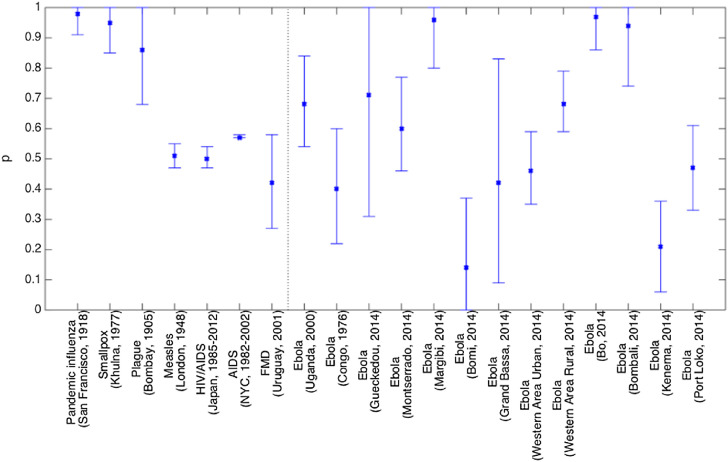
Results: We applied the generalized-growth model to 20 infectious disease outbreaks representing a range of transmission routes. We uncovered epidemic profiles ranging from very slow growth (p=0.14 for the Ebola outbreak in Bomi, Liberia (2014)) to near exponential (p>0.9 for the smallpox outbreak in Khulna (1972), and the 1918 pandemic influenza in San Francisco). The foot-and-mouth disease outbreak in Uruguay displayed a profile of slower growth while the growth pattern of the HIV/AIDS epidemic in Japan was approximately linear. The West African Ebola epidemic provided a unique opportunity to explore how growth profiles vary by geography; analysis of the largest district-level outbreaks revealed substantial growth variations (mean p=0.59, range: 0.14-0.97). The districts of Margibi in Liberia and Bombali and Bo in Sierra Leone had near-exponential growth, while the districts of Bomi in Liberia and Kenema in Sierra Leone displayed near constant incidences.

Conclusions: Our findings reveal significant variation in epidemic growth patterns across different infectious disease outbreaks and highlights that sub-exponential growth is a common phenomenon, especially for pathogens that are not airborne. Sub-exponential growth profiles may result from heterogeneity in contact structures or risk groups, reactive behavior changes, or the early onset of interventions strategies, and consideration of "deceleration parameters" may be useful to refine existing mathematical transmission models and improve disease forecasts.


Figures

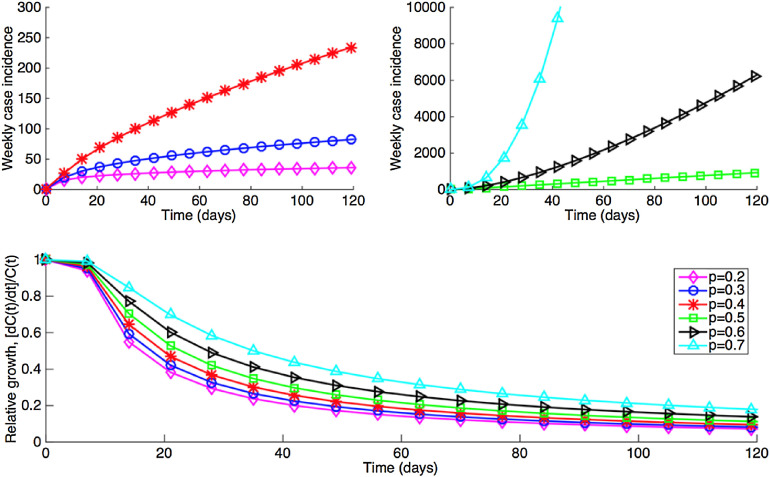
Fig. 1
Fig. 1
Simulated profiles of epidemic growth (case incidence and relative growth rates) supported by the generalized growth model. The deceleration parameter p is varied while parameter r is fixed at 1.5 per day and C(0) = 5.
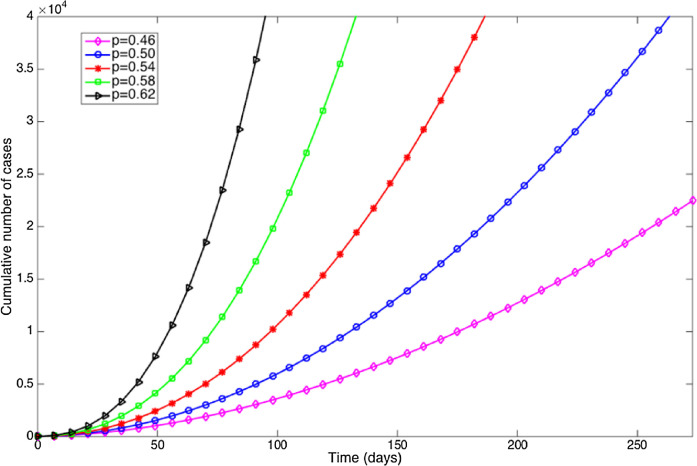
Fig. 2
Fig. 2
Simulations assessing sensitivity of cumulative cases to small variations of the parameter p (0.46–0.62) in the generalized-growth model while fixing parameter r at 1.5 per day and C(0) = 5.
Fig. 3
Fig. 3
Estimates of p and corresponding 95% confidence intervals derived from various infectious disease outbreak datasets of case incidence series by fitting the generalized-growth model to the initial phase of the epidemics as explained in the text. The vertical dashed line separates Ebola and non-Ebola outbreak estimates.
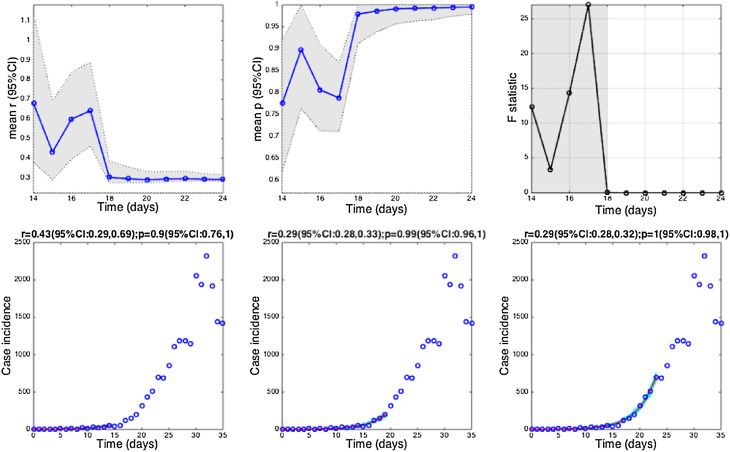
Fig. 4
Fig. 4
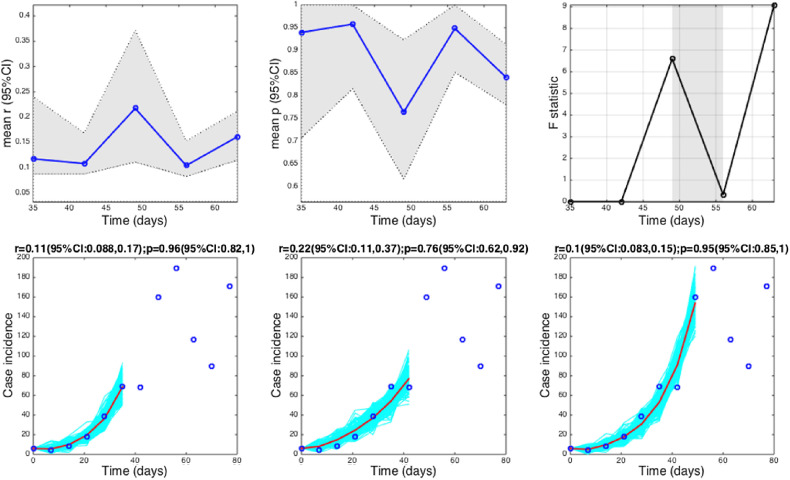
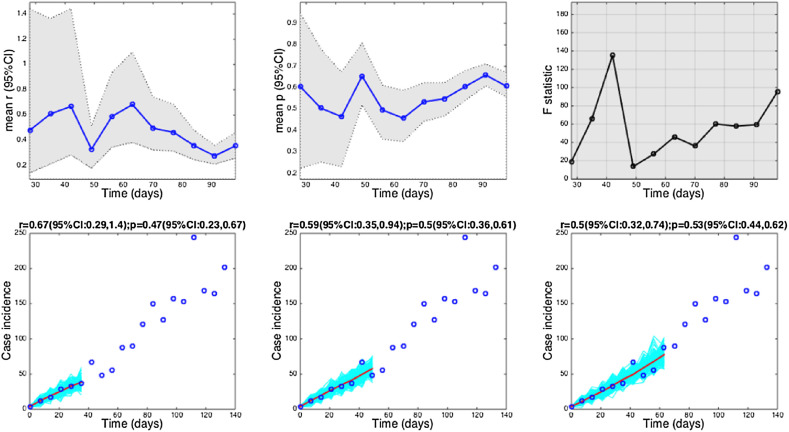
The 1918 influenza pandemic in San Francisco. Estimates and 95% confidence intervals for parameters r and p obtained by nonlinear least-square fitting the generalized growth model to an increasing amount of case incidence data during the initial epidemic growth phase are shown in the first two panels. The statistical comparisons of the generalized-growth model fit to the simpler exponential growth model where p = 1 (gray shaded periods indicate periods where the generalized-growth model provides a better fit compared to the exponential growth model) are also shown in the upper right panel. Representative fits of the generalized-growth model to various epidemic growth phases are displayed in the bottom panels.
Fig. 5
Fig. 5
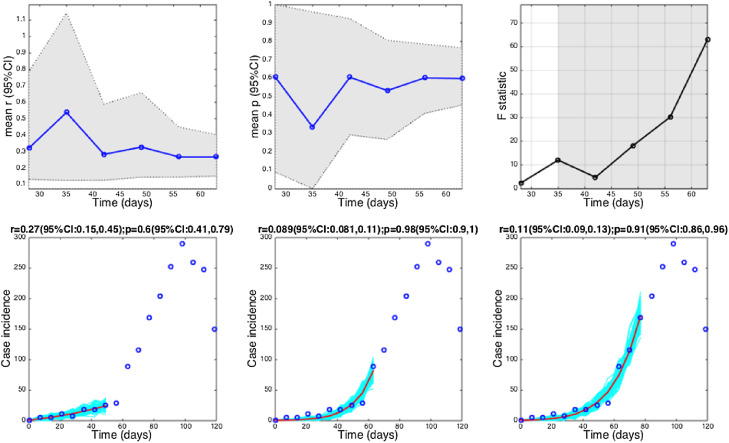
Smallpox epidemic in Khulna municipality, Bangladesh in 1972. Estimates and 95% confidence intervals for parameters r and p obtained by nonlinear least-square fitting the generalized growth model to an increasing amount of case incidence data during the initial epidemic growth phase are shown in the first two panels. The statistical comparisons of the generalized-growth model fit to the simpler exponential growth model where p = 1 (gray shaded periods indicate periods where the generalized-growth model provides a better fit compared to the exponential growth model) are also shown in the upper right panel. Representative fits of the generalized-growth model to various epidemic growth phases are displayed in the bottom panels.
Fig. 6
Fig. 6
The 2001 foot-and-mouth disease epidemic in Uruguay. Estimates and 95% confidence intervals for parameters r and p obtained by nonlinear least-square fitting the generalized growth model to an increasing amount of case incidence data during the initial epidemic growth phase are shown in the first two panels. The statistical comparisons of the generalized-growth model fit to the simpler exponential growth model where p = 1 (gray shaded periods indicate periods where the generalized-growth model provides a better fit compared to the exponential growth model) are also shown in the upper right panel. Representative fits of the generalized-growth model to various epidemic growth phases are displayed in the bottom panels.
Fig. 7
Fig. 7
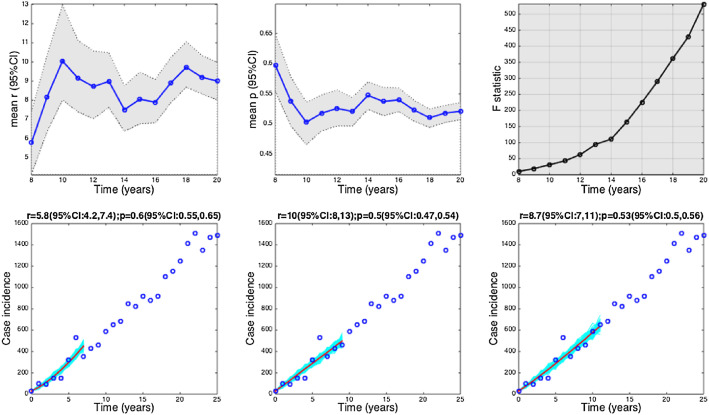
The HIV/AIDS epidemic in Japan (1985–2012). Estimates and 95% confidence intervals for parameters r and p obtained by nonlinear least-square fitting the generalized growth model to an increasing amount of case incidence data during the initial epidemic growth phase are shown in the first two panels. The statistical comparisons of the generalized-growth model fit to the simpler exponential growth model where p = 1 (gray shaded periods indicate periods where the generalized-growth model provides a better fit compared to the exponential growth model) are also shown in the upper right panel. Representative fits of the generalized-growth model to various epidemic growth phases are displayed in the bottom panels.
Fig. 8
Fig. 8
The 2014–2015 Ebola epidemic in Montserrado, Liberia. Estimates and 95% confidence intervals for parameters r and p obtained by nonlinear least-square fitting the generalized growth model to an increasing amount of case incidence data during the initial epidemic growth phase are shown in the first two panels. The statistical comparisons of the generalized-growth model fit to the simpler exponential growth model where p = 1 (gray shaded periods indicate periods where the generalized-growth model provides a better fit compared to the exponential growth model) are also shown in the upper right panel. Representative fits of the generalized-growth model to various epidemic growth phases are displayed in the bottom panels.
Fig. 9
Fig. 9
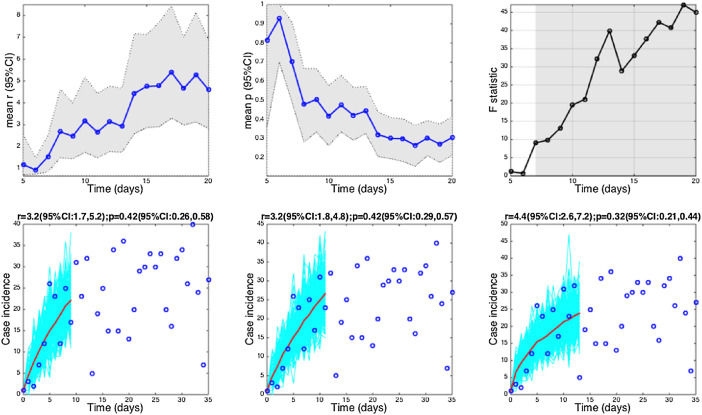
The 2014–2015 Ebola epidemic in Western Area Urban, Sierra Leone. Estimates and 95% confidence intervals for parameters r and p obtained by nonlinear least-square fitting the generalized growth model to an increasing amount of case incidence data during the initial epidemic growth phase are shown in the first two panels. The statistical comparisons of the generalized-growth model fit to the simpler exponential growth model where p = 1 (gray shaded periods indicate periods where the generalized-growth model provides a better fit compared to the exponential growth model) are also shown in the upper right panel. Representative fits of the generalized-growth model to various epidemic growth phases are displayed in the bottom panels.
None

References

    1. Chowell G., Viboud C., Hyman J.M., Simonsen L. The Western Africa ebola virus disease epidemic exhibits both global exponential and local polynomial growth rates. PLoS Curr. 2015:7. doi: 10.1371/currents.outbreaks.8b55f4bad99ac5c5db3663e916803261. - DOI - PMC - PubMed
    1. Cleaton J.M., Viboud C., Simonsen L., Hurtado A.M., Chowell G. Characterizing Ebola transmission patterns based on internet news reports. Clin. Infect. Dis. Off. Publ. Infect. Dis. Soc.Am. 2015;62(1):24–31. - PMC - PubMed
    1. Faye O., Boelle P.Y., Heleze E., Faye O., Loucoubar C., Magassouba N., Soropogui B., Keita S., Gakou T., Bah el H.I. Chains of transmission and control of Ebola virus disease in Conakry, Guinea, in 2014: an observational study. Lancet Infect. Dis. 2015;15(3):320–326. - PMC - PubMed
    1. Lipsitch M., Cohen T., Cooper B., Robins J.M., Ma S., James L., Gopalakrishna G., Chew S.K., Tan C.C., Samore M.H. Transmission dynamics and control of severe acute respiratory syndrome. Science. 2003;300(5627):1966–1970. - PMC - PubMed
    1. Chowell G., Fenimore P.W., Castillo-Garsow M.A., Castillo-Chavez C. SARS outbreaks in Ontario, Hong Kong and Singapore: the role of diagnosis and isolation as a control mechanism. J. Theor. Biol. 2003;224(1):1–8. - PMC - PubMed

MeSH terms