Review
. 2016 Oct:40:1-10.
doi: 10.1016/j.gde.2016.05.010. Epub 2016 Jun 3.

Regeneration of pancreatic insulin-producing cells by in situ adaptive cell conversion

Affiliations
Review

Regeneration of pancreatic insulin-producing cells by in situ adaptive cell conversion

Simona Chera et al. Curr Opin Genet Dev. 2016 Oct.

Abstract

The impaired ability to produce or respond to insulin, a hormone synthetized by the pancreatic β-cells, leads to diabetes. There is an excruciating need of finding new approaches to protect or restore these cells once they are lost. Replacement and ex vivo directed reprogramming methods have an undeniable therapeutic potential, yet they exhibit crucial flaws. The in vivo conversion of adult cells to functional insulin-producing cells is a promising alternative for regenerative treatments in diabetes. The stunning natural transdifferentiation potential of the adult endocrine pancreas was recently uncovered. Modulating molecular targets involved in β-cell fate maintenance or in general differentiation mechanisms can further potentiate this intrinsic cell plasticity, which leads to insulin production reconstitution.


Figures

Figure 1
Figure 1
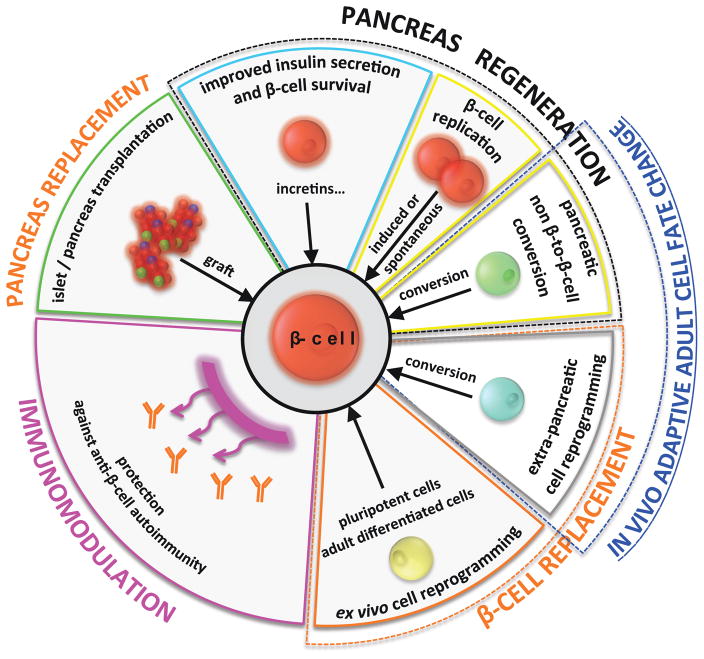
Synopsis of present-day and tentative approaches to treat diabetes. Today, physicians try to maintain and improve insulin secretion and β-cell survival / function; in extreme situations, the only solution is transplantation (of isolated islets or total pancreas). The two prospective broad strategies of the regenerative medicine approach are β-cell replacement and β-cell regeneration. The two largely rely on the exploitation of the recently discovered cell plasticity of the adult. Developing an efficient protective immunomodulation against β-cell autoimmunity will be an additional requirement in T1D conditions.
Figure 2
Figure 2
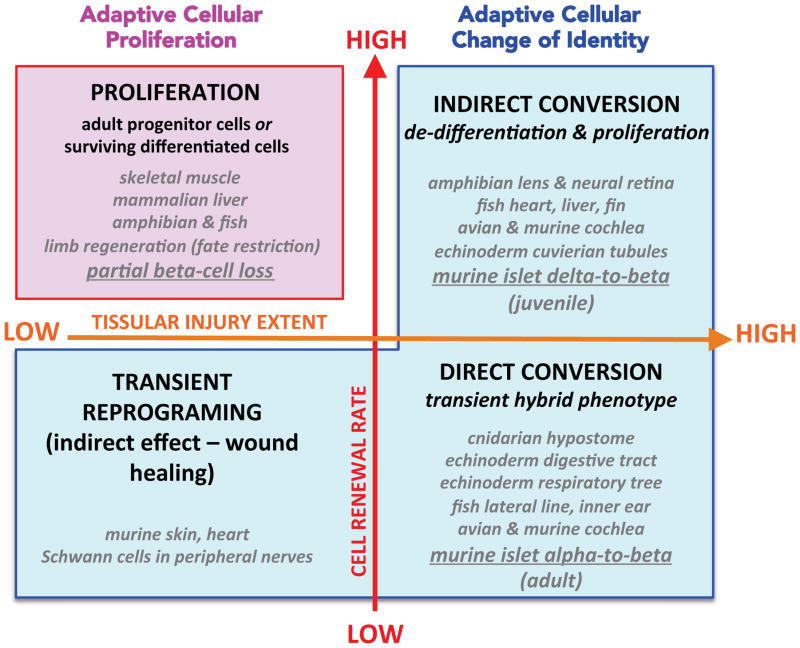
The natural strategies to replenish lost cell populations in vivo rely upon adaptive increased cell proliferation, in tissues with high renewal rates, or on adaptive changes of cell identity (conversion), in tissues with low proliferation capacity. At the tissular injury level, limb amputation does not imply the loss of a given specific cell type, since in the remaining member all cell types are present, in contrast with selective cell ablation situations; therefore, limb regeneration after partial amputation appears as “low tissular injury” condition. The examples listed are referenced in Table 1.
Figure 3
Figure 3
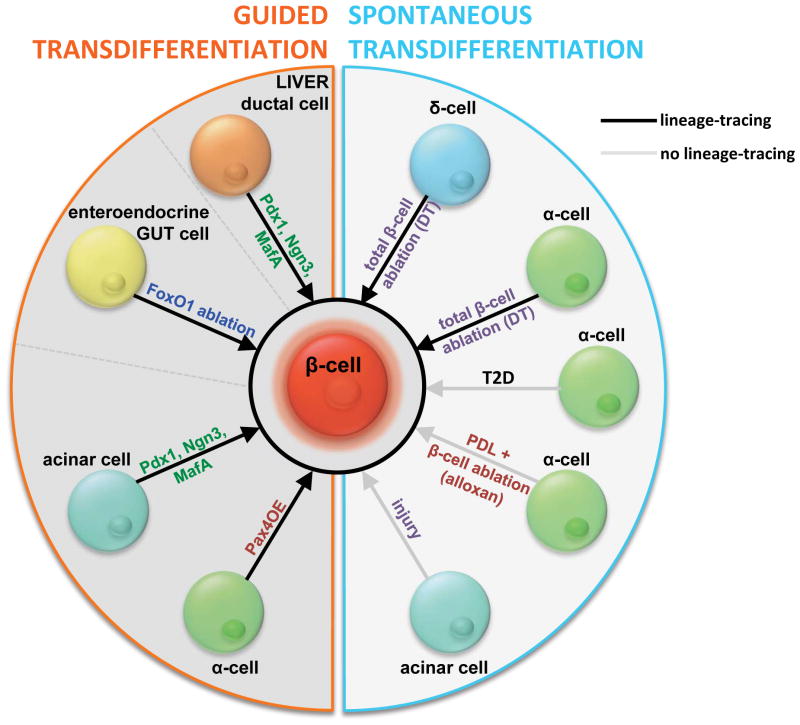
Integrative view of the innate and guided cell conversion approaches aimed at reconstituting lost β-cells, classified according to the cell type of origin and the nature of the reprogramming stimuli. DT, diphtheria toxin-mediated β-cell ablation (as used in references # and #51); PDL, pancreatic duct ligation (surgical method to trigger pancreatitis in rodent models, and therefore study pancreatic tissue remodeling).

References

    1. Gillespie KM. Type 1 diabetes: pathogenesis and prevention. CMAJ. 2006;175:165–170. doi: 10.1503/cmaj.060244. - DOI - PMC - PubMed
    1. Alejandro EU, Gregg B, Blandino-Rosano M, Cras-Meneur C, Bernal-Mizrachi E. Natural history of beta-cell adaptation and failure in type 2 diabetes. Mol Aspects Med. 2015;42:19–41. doi: 10.1016/j.mam.2014.12.002. - DOI - PMC - PubMed
    1. Pagliuca FW, et al. Generation of functional human pancreatic beta cells in vitro. Cell. 2014;159:428–439. doi: 10.1016/j.cell.2014.09.040. With an scalable suspension-based culture system, the authors generated glucose-responsive insulin-producing cells using sequential modulation of multiple signaling pathways in a three-dimensional cell culture system, without any genetic modification. These are the first surrogate differentiated glucose-responsive insulin-producing cells obtained in vitro, which function like adult human β-cells. - DOI - PMC - PubMed
    1. Russ HA, et al. Controlled induction of human pancreatic progenitors produces functional beta-like cells in vitro. EMBO J. 2015;34:1759–1772. doi: 10.15252/embj.201591058. - DOI - PMC - PubMed
    1. Desgraz R, Bonal C, Herrera PL. β-cell regeneration: the pancreatic intrinsic faculty. Trends Endocrinol Metab. 2011;22:34–43. doi: 10.1016/j.tem.2010.09.004. - DOI - PubMed

Publication types

MeSH terms