


Global Trends in Pancreatic Cancer Mortality From 1980 Through 2013 and Predictions for 2017
- PMID: 27266982
- PMCID: PMC5028258
- DOI: 10.1016/j.cgh.2016.05.034
Global Trends in Pancreatic Cancer Mortality From 1980 Through 2013 and Predictions for 2017
Abstract
Background & aims: Pancreatic cancer is a leading cause of cancer mortality, and its mortality has not decreased in recent years. We sought to determine global trends in pancreatic cancer mortality.
Methods: We derived data on deaths from pancreatic cancer from the World Health Organization database for 59 countries from 1980 through 2013. Age-standardized mortalities were computed for persons of all ages and for persons 35-64 years old; for selected countries, they were computed for persons 25-49 years old. Joinpoint regression models were used to identify significant changes in mortality. For selected larger countries, we predicted number of deaths and mortality for 2017.
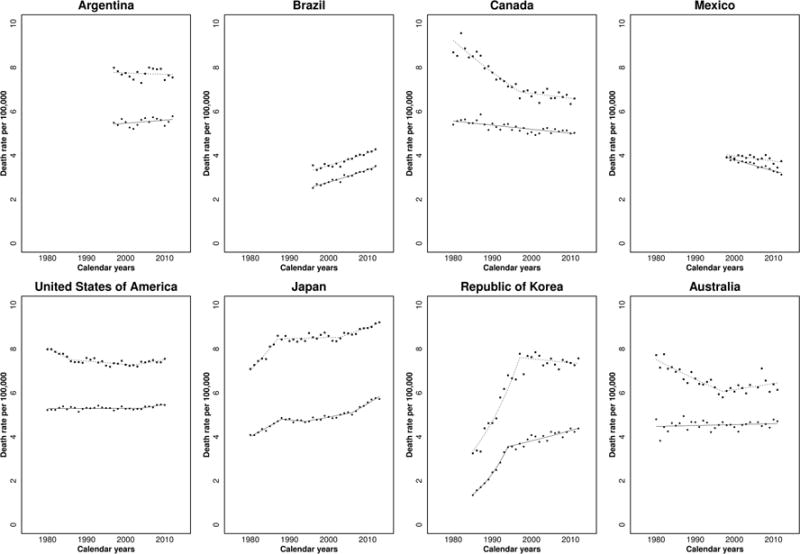
Results: Between 1980 and 2013, overall pancreatic cancer mortality in men increased in the European Union (EU) as well as in Southern and Eastern Europe, Brazil, Japan, and Republic of Korea. Overall pancreatic cancer mortality decreased in most Northern European countries, Australia, Canada, Mexico, and the United States (US). In women, mortality increased in the EU, Brazil, US, Japan, and Republic of Korea but decreased in Canada and Mexico. In 2012, Eastern Europe and Japan had the highest pancreatic cancer mortality for both sexes. In men 25-49 years old, mortality decreased in the EU, US, Japan, and most large European countries. On the basis of our data, we predict overall pancreatic cancer mortality in 2017 to level off in men in the EU and US but increase in Japan. In women, mortality will continue to increase in most countries except the US; the greatest increase is predicted to occur in Japan.
Conclusions: Mortality from pancreatic cancer has not decreased as it has for other cancers in recent years. A notable exception is a decrease in mortality in men 25-49 years old, which could indicate a reversal in the current increasing global trends.
Keywords: Pancreatic Tumor; Predictions; Rate of Death; Trends.
Copyright © 2016 AGA Institute. Published by Elsevier Inc. All rights reserved.
Conflict of interest statement
The authors declare no conflicts of interest.
Figures



References
-
- Ferlay J, Soerjomataram I, Dikshit R, et al. Cancer incidence and mortality worldwide: sources, methods and major patterns in GLOBOCAN 2012. Int J Cancer. 2015;136:E359–86. - PubMed
-
- Malvezzi M, Bertuccio P, Levi F, et al. European cancer mortality predictions for the year 2014. Ann Oncol. 2014;25:1650–6. - PubMed
-
- Malvezzi M, Bertuccio P, Rosso T, et al. European cancer mortality predictions for the year 2015: does lung cancer have the highest death rate in EU women? Ann Oncol. 2015;26:779–86. - PubMed
-
- Bosetti C, Bertuccio P, Negri E, et al. Pancreatic cancer: overview of descriptive epidemiology. Mol Carcinog. 2012;51:3–13. - PubMed
-
- Rahib L, Smith BD, Aizenberg R, et al. Projecting cancer incidence and deaths to 2030: the unexpected burden of thyroid, liver, and pancreas cancers in the United States. Cancer Res. 2014;74:2913–21. - PubMed
Publication types
MeSH terms
Grants and funding
LinkOut - more resources
Full Text Sources
Other Literature Sources
Medical
