


Association mapping for cold tolerance in two large maize inbred panels
- PMID: 27267760
- PMCID: PMC4895824
- DOI: 10.1186/s12870-016-0816-2
Association mapping for cold tolerance in two large maize inbred panels
Abstract
Background: Breeding for cold tolerance in maize promises to allow increasing growth area and production in temperate zones. The objective of this research was to conduct genome-wide association analyses (GWAS) in temperate maize inbred lines and to find strategies for pyramiding genes for cold tolerance. Two panels of 306 dent and 292 European flint maize inbred lines were evaluated per se and in testcrosses under cold and control conditions in a growth chamber. We recorded indirect measures for cold tolerance as the traits number of days from sowing to emergence, relative leaf chlorophyll content or quantum efficiency of photosystem II. Association mapping for identifying genes associated to cold tolerance in both panels was based on genotyping with 49,585 genome-wide single nucleotide polymorphism (SNP) markers.
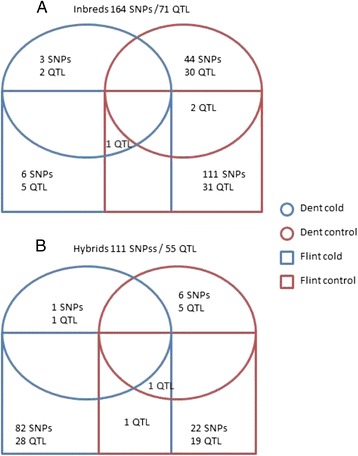
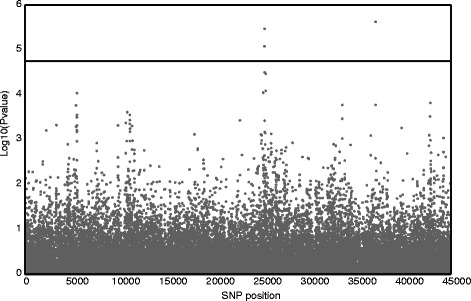
Results: We found 275 significant associations, most of them in the inbreds evaluated per se, in the flint panel, and under control conditions. A few candidate genes coincided between the current research and previous reports. A total of 47 flint inbreds harbored the favorable alleles for six significant quantitative trait loci (QTL) detected for inbreds per se evaluated under cold conditions, four of them had also the favorable alleles for the main QTL detected from the testcrosses. Only four dent inbreds (EZ47, F924, NK807 and PHJ40) harbored the favorable alleles for three main QTL detected from the evaluation of the dent inbreds per se under cold conditions. There were more QTL in the flint panel and most of the QTL were associated with days to emergence and ΦPSII.
Conclusions: These results open new possibilities to genetically improve cold tolerance either with genome-wide selection or with marker assisted selection.
Keywords: Chilling; Cold tolerance; GWAS, Maize; QTL.
Figures
References
-
- Strigens A, Grieder C, Haussmann BIG, Melchinger AE. Genetic variation among inbred lines and testcrosses of maize for early growth parameters and their relationship to final dry matter yield. Crop Sci. 2012;52:1084–92. doi: 10.2135/cropsci2011.08.0426. - DOI
-
- Kucharik CJ. A multidecadal trend of earlier corn planting in the central USA. Agron J. 2006;98:1544–50. doi: 10.2134/agronj2006.0156. - DOI
-
- Revilla P, Butrón A, Cartea ME, Malvar RA, Ordás A. Breeding for cold tolerance. In: Ashraf M, Harris PJC, editors. Abiotic Stresses. Plant resistance through breeding and molecular approaches. New York: The Haworth Press, Inc; 2005. pp. 301–98.
-
- Revilla P, Rodríguez VM, Ordás A, Rincent R, Charcosset A, Giauffret C, et al. Cold tolerance in two large maize inbred panels adapted to European climates. Crop Sci. 2014;54:1981–91. doi: 10.2135/cropsci2013.11.0733. - DOI
-
- Rodríguez VM, Butrón A, Rady MOA, Soengas P, Revilla P. Identification of QTLs involved in the response to cold stress in maize (Zea mays L.) Mol Breed. 2014;33:363–71. doi: 10.1007/s11032-013-9955-4. - DOI
Publication types
MeSH terms
LinkOut - more resources
Full Text Sources
Other Literature Sources
