Review
. 2017 Jul:60-61:96-109.
doi: 10.1016/j.matbio.2016.06.001. Epub 2016 Jun 4.

Engineered matrices for skeletal muscle satellite cell engraftment and function

Affiliations
Review

Engineered matrices for skeletal muscle satellite cell engraftment and function

Woojin M Han et al. Matrix Biol. 2017 Jul.

Abstract

Regeneration of traumatically injured skeletal muscles is severely limited. Moreover, the regenerative capacity of skeletal muscle declines with aging, further exacerbating the problem. Recent evidence supports that delivery of muscle satellite cells to the injured muscles enhances muscle regeneration and reverses features of aging, including reduction in muscle mass and regenerative capacity. However, direct delivery of satellite cells presents a challenge at a translational level due to inflammation and donor cell death, motivating the need to develop engineered matrices for muscle satellite cell delivery. This review will highlight important aspects of satellite cell and their niche biology in the context of muscle regeneration, and examine recent progresses in the development of engineered cell delivery matrices designed for skeletal muscle regeneration. Understanding the interactions of muscle satellite cells and their niche in both native and engineered systems is crucial to developing muscle pathology-specific cell- and biomaterial-based therapies.

Keywords: Aging; Biomaterial; Extracellular matrix; Niche; Satellite cells; Skeletal muscle; Stem cell therapy.


Figures

Figure 1
Figure 1
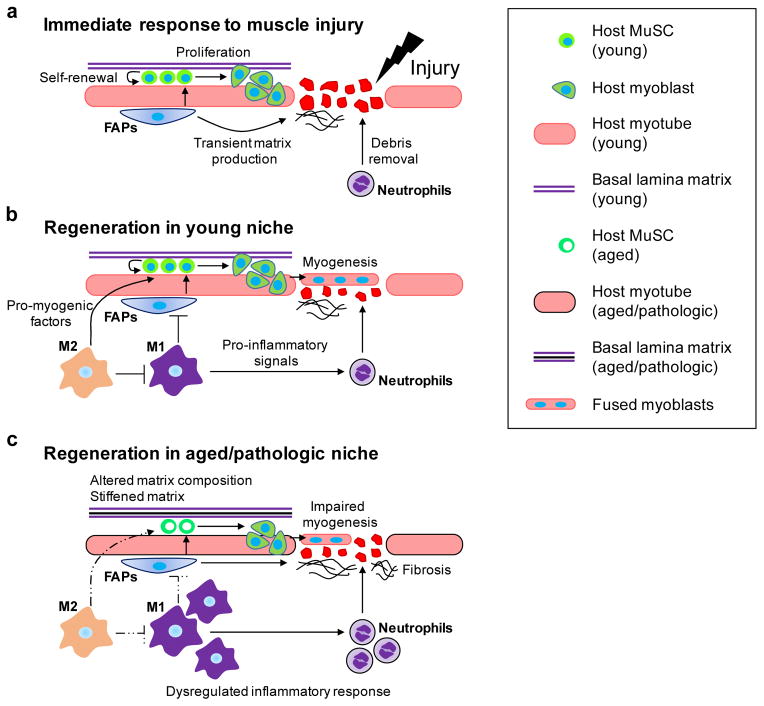
(a) Immediate response to muscle injury. Upon injury, quiescent muscle satellite cells (MuSCs) activate, self-renew, proliferate, and differentiate into myoblasts. Fibroadipogenic progenitors (FAPs) also activate, differentiate, and subsequently secrete transient extracellular matrix. Neutrophils infiltrate the site of injury and remove debris. (b) Regeneration in young niche. Pro-inflammatory M1 macrophages induce FAP apoptosis and recruit neutrophils. Anti-inflammatory M2 macrophages secrete anti-inflammatory, myogenic, and angiogenic factors. Myoblasts differentiate and fuse to form new muscle fibers. (c) Regeneration in aged/pathologic niche. MuSC niche composition is altered and results in stiffening. Normal inflammatory response is dysregulated, where inflammation persists over a longer period of time. FAPs over-secrete extracellular matrix, leading to progressive fibrosis. Myogenesis is impaired.
Figure 2
Figure 2
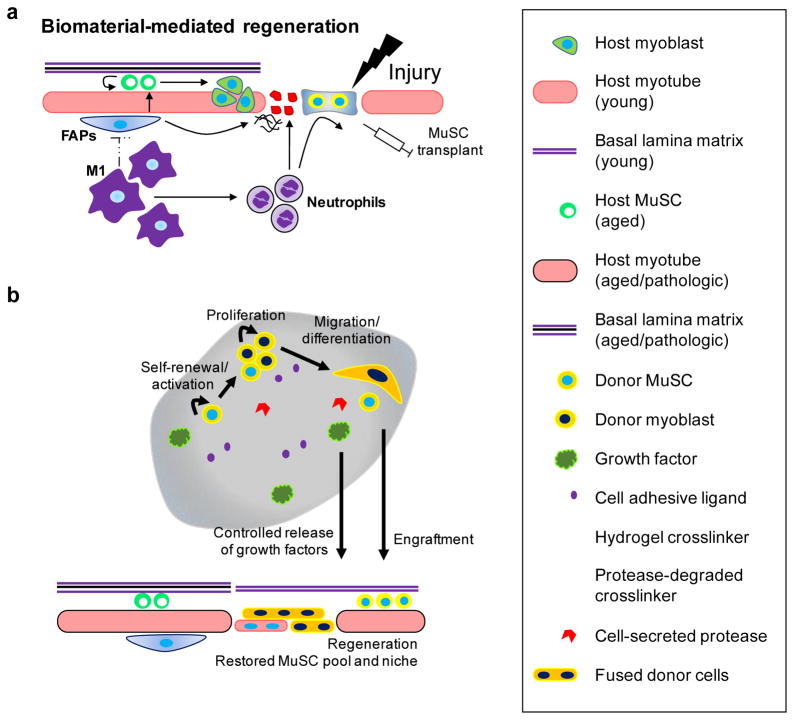
(a) Biomaterial-mediated regeneration. Upon injury, quiescent muscle satellite cells are delivered within a biomaterial. Biomaterial encapsulation provides initial protection of the transplanted cells from inflammation. (b) Biomaterial promotes cell survival by providing integrin attachment sites. Donor cells within the biomaterial activate, self-renew, proliferate, migrate, and differentiate to induce host muscle regeneration. Encapsulated growth factor is released in a controlled manner, as the biomaterial is degraded by the cell-secreted proteases.

References

    1. Järvinen TA, Järvinen M, Kalimo H. Regeneration of injured skeletal muscle after the injury. Muscles Ligaments Tendons J. 2013;3:337–345. - PMC - PubMed
    1. Järvinen TAH, Järvinen TLN, Kääriäinen M, Kalimo H, Järvinen M. Muscle injuries: biology and treatment. Am J Sports Med. 2005;33:745–764. doi: 10.1177/0363546505274714. - DOI - PubMed
    1. Turner NJ, Badylak SF. Regeneration of skeletal muscle. Cell Tissue Res. 2012;347:759–774. doi: 10.1007/s00441-011-1185-7. - DOI - PubMed
    1. Ryall JG, Schertzer JD, Lynch GS. Cellular and molecular mechanisms underlying age-related skeletal muscle wasting and weakness. Biogerontology. 2008;9:213–228. doi: 10.1007/s10522-008-9131-0. - DOI - PubMed
    1. Carlson BM, Faulkner JA. Muscle transplantation between young and old rats: age of host determines recovery. Am J Physiol. 1989;256:C1262–1266. - PubMed

MeSH terms

LinkOut - more resources