Review
. 2017 Jan 12;36(2):158-167.
doi: 10.1038/onc.2016.192. Epub 2016 Jun 6.

Base changes in tumour DNA have the power to reveal the causes and evolution of cancer

Affiliations
Review

Base changes in tumour DNA have the power to reveal the causes and evolution of cancer

M Hollstein et al. Oncogene. .

Abstract

Next-generation sequencing (NGS) technology has demonstrated that the cancer genomes are peppered with mutations. Although most somatic tumour mutations are unlikely to have any role in the cancer process per se, the spectra of DNA sequence changes in tumour mutation catalogues have the potential to identify the mutagens, and to reveal the mutagenic processes responsible for human cancer. Very recently, a novel approach for data mining of the vast compilations of tumour NGS data succeeded in separating and precisely defining at least 30 distinct patterns of sequence change hidden in mutation databases. At least half of these mutational signatures can be readily assigned to known human carcinogenic exposures or endogenous mechanisms of mutagenesis. A quantum leap in our knowledge of mutagenesis in human cancers has resulted, stimulating a flurry of research activity. We trace here the major findings leading first to the hypothesis that carcinogenic insults leave characteristic imprints on the DNA sequence of tumours, and culminating in empirical evidence from NGS data that well-defined carcinogen mutational signatures are indeed present in tumour genomic DNA from a variety of cancer types. The notion that tumour DNAs can divulge environmental sources of mutation is now a well-accepted fact. This approach to cancer aetiology has also incriminated various endogenous, enzyme-driven processes that increase the somatic mutation load in sporadic cancers. The tasks now confronting the field of molecular epidemiology are to assign mutagenic processes to orphan and newly discovered tumour mutation patterns, and to determine whether avoidable cancer risk factors influence signatures produced by endogenous enzymatic mechanisms. Innovative research with experimental models and exploitation of the geographical heterogeneity in cancer incidence can address these challenges.


Figures
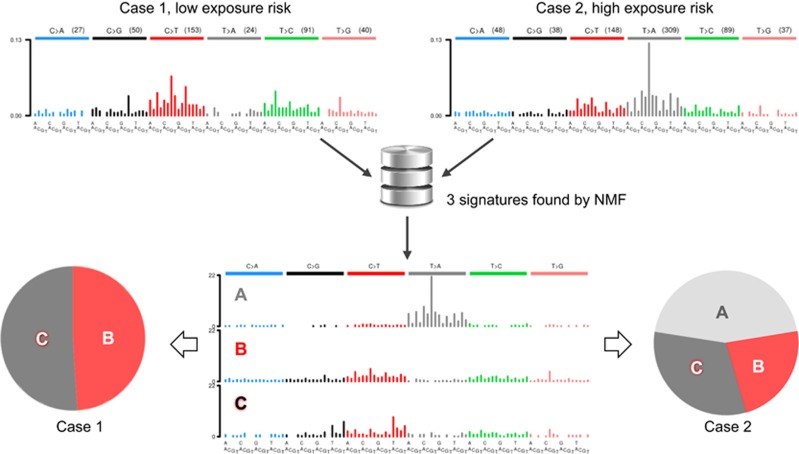
Figure 1
Figure 1
When patients with the same cancer type have different exposure histories, the mutation patterns in their tumours can be strikingly different. Two representative cases of upper urinary tract urothelial tumours from regions of either low or high risk of exposure to the carcinogen aristolochic acid were analysed using whole-exome sequencing. The single-base substitution distribution spectra are shown on top. Performing NMF on the studied case series identified three distinct mutational signatures (A, B and C; middle panel). The pie charts show the proportionate contribution of individual signatures to the mutational load in each tumour. The absence of signature A in case 1 argues that the two tumours have distinct aetiologies.
Figure 2
Figure 2
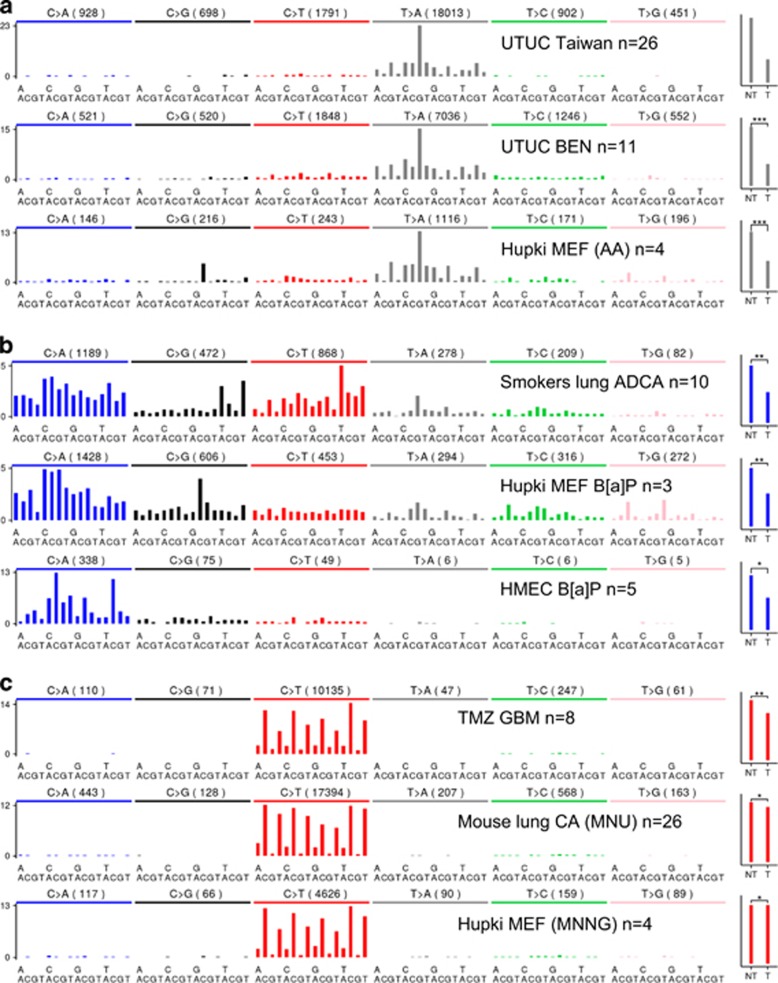
A carcinogen's fingerprint in human tumour DNA can be reproduced in experimental systems. Mutation distribution spectra (showing frequency of base substitution type and context) from exome sequencing of primary human tumours, cells exposed in culture, or tumours of exposed mice. (a) Upper panels: spectra in upper urinary tract urothelial carcinomas (UTUC) of patients from Taiwan, China and from Balkan Endemic nephropathy (BEN) regions of Europe, two populations known to be exposed to AA., , The lower panel shows that exposure of Hupki MEF to AA induces a similar mutational profile. Pooled data from multiple samples are shown for each data set. (b) Mutational spectra observed in lung adenocarcinomas (ADCA) of heavy smokers (upper panel) have features in common with spectra in Hupki MEF (middle panel) and human mammary epithelial cells (HMEC, lower panel) exposed to B[a]P, a tobacco carcinogen. (c) Spectra attributable to alkylation agents; upper panel: temozolomide treatment-related glioblastoma (TMZ GBM); middle panel: lung carcinoma of mice treated with methylnitrosourea (MNU); lower panel: Hupki MEF cells treated with methylnitrosoguanidine (MNNG). The bar graphs to the right show strand bias ratios. Strand bias reflects transcription-coupled repair of chemically damaged DNA bases (NT, non-transcribed strand; T, transcribed strand). Asterisks indicate χ2 test P-values for strand bias significance (*P<10E−5; **P<10E−20; ***P<10E−320; P=0 for UTUC Taiwan, in top panel of (a)). Note the less pronounced transcriptional strand bias ratios associated with the effects of alkylating agents.

References

    1. Stratton MR. Exploring the genomes of cancer cells: progress and promise. Science 2011; 331: 1553–1558. - PubMed
    1. Garraway LA, Lander ES. Lessons from the cancer genome. Cell 2013; 153: 17–37. - PubMed
    1. Greenman C, Stephens P, Smith R, Dalgliesh GL, Hunter C, Bignell G et al. Patterns of somatic mutation in human cancer genomes. Nature 2007; 446: 153–158. - PMC - PubMed
    1. Stratton MR, Campbell PJ, Futreal PA. The cancer genome. Nature 2009; 458: 719–724. - PMC - PubMed
    1. Vogelstein B, Papadopoulos N, Velculescu VE, Zhou S, Diaz LAJr, Kinzler KW. Cancer genome landscapes. Science 2013; 339: 1546–1558. - PMC - PubMed

Publication types