Review
. 2016 Jul 30;22(3):423-35.
doi: 10.5056/jnm16060.

Diagnosis and Treatment of Dyssynergic Defecation

Affiliations
Review

Diagnosis and Treatment of Dyssynergic Defecation

Satish S C Rao et al. J Neurogastroenterol Motil. .

Abstract

Dyssynergic defecation is common and affects up to one half of patients with chronic constipation. This acquired behavioral problem is due to the inability to coordinate the abdominal and pelvic floor muscles to evacuate stools. A detailed history, prospective stool diaries, and a careful digital rectal examination will not only identify the nature of bowel dysfunction, but also raise the index of suspicion for this evacuation disorder. Anorectal physiology tests and balloon expulsion test are essential for a diagnosis. Newer techniques such as high-resolution manometry and magnetic resonance defecography can provide mechanistic insights. Recently, randomized controlled trials have shown that biofeedback therapy is more effective than laxatives and other modalities, both in the short term and long term, without side effects. Also, symptom improvements correlated with changes in underlying pathophysiology. Biofeedback therapy has been recommended as the first-line of treatment for dyssynergic defecation. Here, we provide an overview of the burden of illness and pathophysiology of dyssynergic defecation, and how to diagnose and treat this condition with biofeedback therapy.

Keywords: Constipation; Defecation; Laxatives.


Figures
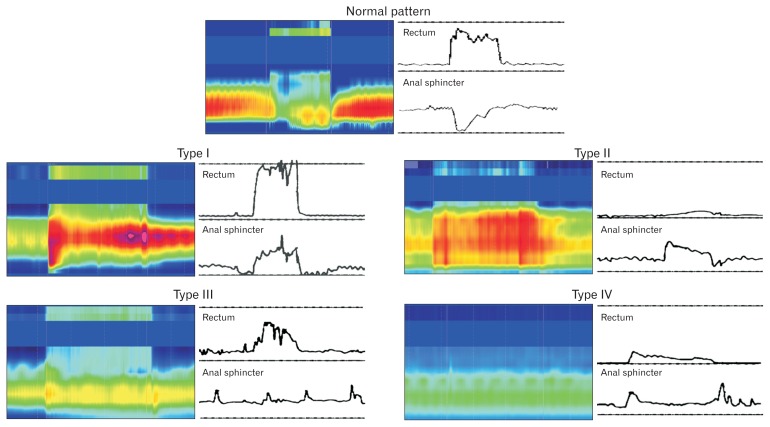
Figure 1
Figure 1
This series of conventional manometry and high-resolution manometry tracings reveals patterns that are commonly seen during attempted defecation in a healthy individual (top panel) and in patients with dyssynergic defecation. In a normal pattern of defecation, the subject can generate a good pushing force (increase in intra rectal pressure) and simultaneously relax the anal sphincter. In contrast, patients with dyssynergic defecation exhibit one of four abnormal patterns of defecation. In type I dyssynergia, the subject can generate an adequate propulsive force (rise in intra rectal pressure ≥ 40 mmHg) along with paradoxical increase in anal sphincter pressure. In type II dyssynergia, the subject is unable to generate an adequate propulsive force; additionally there is paradoxical anal contraction. In type III dyssynergia, the subject can generate an adequate propulsive force but there is either absent relaxation (a flat line) or inadequate (≤ 20%) relaxation of anal sphincter. In type IV dyssynergia, the subject is unable to generate an adequate propulsive force together with an absent or inadequate relaxation of anal sphincter.
Figure 2
Figure 2
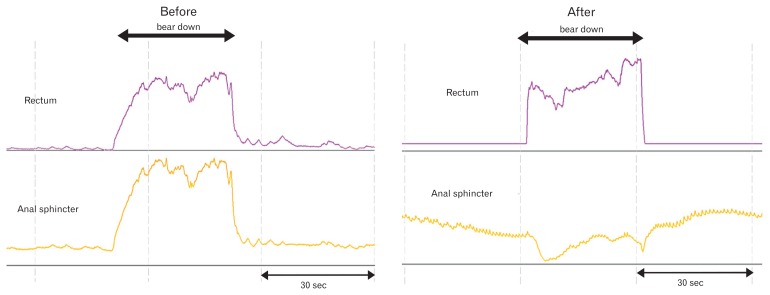
The rectal and anal sphincter pressure changes, and manometric patterns in a patient with constipation and dyssynergic defecation, before and after biofeedback therapy.

References

    1. Rao SS. Dyssynergic defecation and biofeedback therapy. Gastroenterol Clin North Am. 2008;37:569–586. doi: 10.1016/j.gtc.2008.06.011. - DOI - PMC - PubMed
    1. Preston DM, Lennard-Jones JE. Anismus in chronic constipation. Dig Dis Sci. 1985;30:413–418. doi: 10.1007/BF01318172. - DOI - PubMed
    1. Whitehead WE, Wald A, Diamant NE, Enck P, Pemberton JH, Rao SS. Functional disorders of the anus and rectum. Gut. 1999;45(suppl 2):II55–II59. doi: 10.1136/gut.45.2008.ii55. - DOI - PMC - PubMed
    1. Rao SS, Welcher KD, Leistikow JS. Obstructive defecation: a failure of rectoanal coordination. Am J Gastroenterol. 1998;93:1042–1050. doi: 10.1111/j.1572-0241.1998.00326.x. - DOI - PubMed
    1. Glia A, Gylin M, Gullberg K, Lindberg G. Biofeedback retraining in patients with functional constipation and paradoxical puborectalis contraction: comparison of anal manometry and sphincter electromyography for feedback. Dis Colon Rectum. 1997;40:889–895. doi: 10.1007/BF02051194. - DOI - PubMed

LinkOut - more resources