Effect of the INSIGHT Responsive Parenting Intervention on Rapid Infant Weight Gain and Overweight Status at Age 1 Year: A Randomized Clinical Trial
- PMID: 27271455
- PMCID: PMC4969142
- DOI: 10.1001/jamapediatrics.2016.0445
Effect of the INSIGHT Responsive Parenting Intervention on Rapid Infant Weight Gain and Overweight Status at Age 1 Year: A Randomized Clinical Trial
Erratum in
-
Errors in Discussion Section, Conclusion, and Figure Legend.JAMA Pediatr. 2016 Dec 1;170(12):1230. doi: 10.1001/jamapediatrics.2016.3457. JAMA Pediatr. 2016. PMID: 27723892 No abstract available.
Abstract
Importance: Rapid infant weight gain is associated with later obesity, but interventions to prevent rapid infant growth and reduce risk for overweight status in infancy are lacking.
Objective: To examine the effect of a responsive parenting (RP) intervention on infant weight gain between birth and 28 weeks and overweight status at age 1 year.
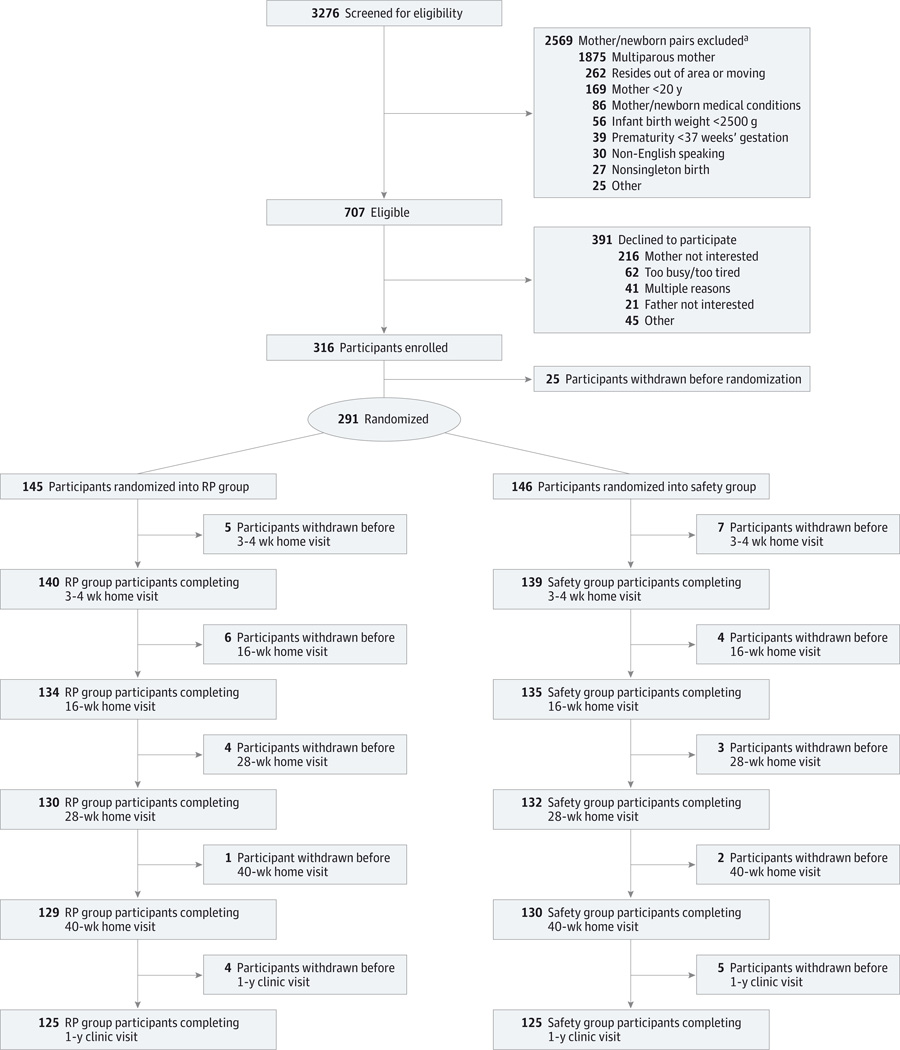
Design, setting, and participants: The Intervention Nurses Start Infants Growing on Healthy Trajectories (INSIGHT) study is an ongoing randomized clinical trial comparing an RP intervention designed to prevent childhood obesity with a safety control. The study includes primiparous mother-newborn dyads (n = 291) and was conducted at the Penn State Milton S. Hershey Medical Center, Hershey, Pennsylvania, in addition to home visits. Enrollment was initiated in January 2012, and evaluable population analyses for this study were conducted between April 2015 and November 2015.
Interventions: At 2 weeks post partum, initial intervention materials appropriate to the assigned treatment group were mailed to the participant's home. Research nurses conducted home visits at 3 weeks, 16 weeks, 28 weeks, and 40 weeks, and a research center visit occurred at 1 year. The Intervention Nurses Start Infants Growing on Healthy Trajectories curriculum included messages about infant feeding, sleep hygiene, active social play, emotion regulation, and growth record education. The control group received a developmentally appropriate home safety intervention also delivered by nurse home visitors.
Main outcomes and measures: Conditional weight gain from birth to 28 weeks was calculated. General linear models examined intervention effect on conditional weight gain. The intervention's effect on infant weight-for-length percentiles was tested using analysis of variance. Logistic regression compared the odds of overweight status (weight for length ≥95th percentile) at 1 year as a function of conditional weight gain.
Results: Of the mothers included in the study, 246 were white (88%), 260 were non-Hispanic (93%), 210 were married (75%), and 201 were working full time (72%) at time of enrollment. The mean conditional weight gain score was lower among infants in the RP group compared with the control group (-0.18; 95% CI, -0.36 to -0.001), reflecting that the RP infants gained weight more slowly than control group infants (0.18; 95% CI, 0.02-0.34); this effect did not differ by feeding mode (predominantly fed breast milk or not). Infants in the RP group also had lower mean weight-for-length percentiles at 1 year than infants in the control group (57.5%; 95% CI, 52.56%-62.37% vs 64.4%; 95% CI, 59.94%-69.26%; P = .04) and were less likely to be overweight at age 1 year (5.5% vs 12.7%; P = .05).
Conclusions and relevance: An RP intervention is associated with reduced rapid weight gain during the first 6 months after birth and overweight status at age 1 year.
Trial registration: clinicaltrials.gov Identifier: NCT01167270.
Conflict of interest statement
Figures


Comment in
-
Infant Eating Behaviors and Risk for Overweight.JAMA. 2016 Nov 15;316(19):2036-2037. doi: 10.1001/jama.2016.16899. JAMA. 2016. PMID: 27838708 No abstract available.
-
The INSIGHT responsive parenting intervention reduced infant weight gain and overweight status.Arch Dis Child Educ Pract Ed. 2018 Feb;103(1):57-58. doi: 10.1136/archdischild-2017-313112. Epub 2017 Jul 6. Arch Dis Child Educ Pract Ed. 2018. PMID: 28684547 No abstract available.
References
-
- Mei Z, Grummer-Strawn LM, Scanlon KS. Does overweight in infancy persist through the preschool years? an analysis of CDC Pediatric Nutrition Surveillance System data. Soz Praventivmed. 2003;48(3):161–167. - PubMed
-
- Stettler N, Zemel BS, Kumanyika S, Stallings VA. Infant weight gain and childhood overweight status in a multicenter, cohort study. Pediatrics. 2002;109(2):194–199. - PubMed
-
- Leunissen RW, Kerkhof GF, Stijnen T, Hokken-Koelega A. Timing and tempo of first-year rapid growth in relation to cardiovascular and metabolic risk profile in early adulthood. JAMA. 2009;301(21):2234–2242. - PubMed
-
- Barker DJ, Osmond C, Forsén TJ, Kajantie E, Eriksson JG. Trajectories of growth among children who have coronary events as adults. N Engl J Med. 2005;353(17):1802–1809. - PubMed
Publication types
MeSH terms
Associated data
Grants and funding
LinkOut - more resources
Full Text Sources
Other Literature Sources
Medical
Miscellaneous