


Hereditary angioedema with normal C1 inhibitor and factor XII mutation: a series of 57 patients from the French National Center of Reference for Angioedema
- PMID: 27271546
- PMCID: PMC4991515
- DOI: 10.1111/cei.12820
Hereditary angioedema with normal C1 inhibitor and factor XII mutation: a series of 57 patients from the French National Center of Reference for Angioedema
Abstract
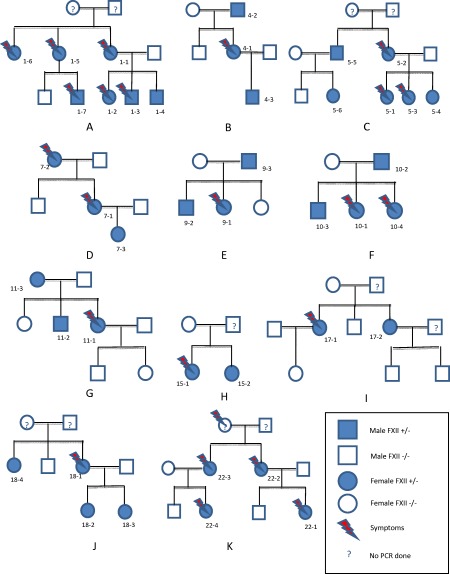
Hereditary angioedema (HAE) is a rare disease associated with either a quantitative or qualitative deficiency in C1-inhibitor (C1-INH) or normal C1-INH. HAE with normal C1-INH is associated in 20% of cases with mutations in the gene for factor XII (FXII) or FXII-HAE. A recent review described 41 families, including 14 German and 15 Spanish families. We have constructed a register of French patients and their characteristics. A national survey was launched through the French National Center of Reference for Angioedema (CREAK) to study the clinical, biological and therapeutic characteristics of patients with HAE linked to a mutation of FXII gene. Fifty-seven patients were identified from 24 different families. In most cases they were young women (mean age at diagnosis: 31 years, mean age at first symptom: 21 years, female/male ratio: 76%). Twenty-one per cent of the patients experienced angioedema attacks only during pregnancy or when on oestrogen contraception. Sixty-three per cent had attacks at all times, but they were more severe during these same periods. Male carriers of the mutation were more frequently asymptomatic than females (P = 0·003). C1-INH concentrate and icatibant were both effective for treating attacks. The prophylactic use of tranexamic acid led to a 64% decrease in the number of attacks. This is one of the largest series reported of HAE patients with FXII mutation. The therapeutic management appeared to be identical to that of HAE with C1-INH deficiency.
Keywords: C1 inhibitor; bradykinin; factor XII; hereditary angioedema.
© 2016 British Society for Immunology.
Figures
References
-
- Bork K, Barnstedt S, Koch P, Traupe P. Hereditary angioedema with normal C1‐inhibitor activity in women. Lancet 2000; 356:213–7. - PubMed
-
- Binkley KE, Davis A. Clinical, biochemical, and genetic characterization of a novel estrogen‐dependent inherited form of angioedema. J Allergy Clin Immunol 2000; 106:546–50. - PubMed
-
- Cugno M, Nussberger J, Cicardi M, Agostoni A. Bradykinin and the pathophysiology of angioedema. Int Immunopharmacol 2003; 3:311–7. - PubMed
-
- Dewald G, Bork K. Missense mutations in the coagulation factor XII (Hageman factor) gene in hereditary angioedema with normal C1 inhibitor. Biochem Biophys Res Commun 2006; 343:1286–9. - PubMed
-
- Bork K, Gul D, Hardt J, Dewald G. Hereditary angioedema with normal C1 inhibitor: clinical symptoms and course. Am J Med 2007; 120:987–92. - PubMed
MeSH terms
Substances
LinkOut - more resources
Full Text Sources
Other Literature Sources
