


Integrated Care for Older Adults Improves Perceived Quality of Care: Results of a Randomized Controlled Trial of Embrace
- PMID: 27271728
- PMCID: PMC5400746
- DOI: 10.1007/s11606-016-3742-y
Integrated Care for Older Adults Improves Perceived Quality of Care: Results of a Randomized Controlled Trial of Embrace
Abstract
Background: All community-living older adults might benefit from integrated care, but evidence is lacking on the effectiveness of such services for perceived quality of care.
Objective: To examine the impact of Embrace, a community-based integrated primary care service, on perceived quality of care.
Design: Stratified randomized controlled trial.
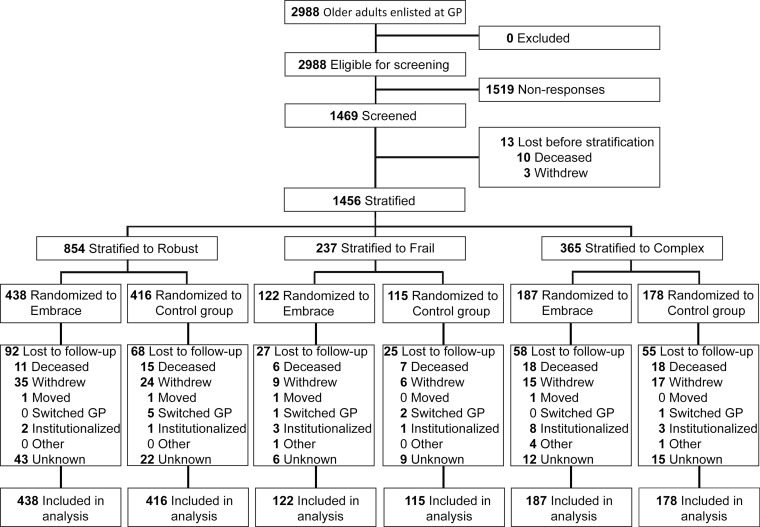
Participants: Integrated care and support according to the "Embrace" model was provided by 15 general practitioners in the Netherlands. Based on self-reported levels of case complexity and frailty, a total of 1456 community-living older adults were stratified into non-disease-specific risk profiles ("Robust," "Frail," and "Complex care needs"), and randomized to Embrace or control groups.
Intervention: Embrace provides integrated, person-centered primary care and support to all older adults living in the community, with intensity of care dependent on risk profile.
Measurements: Primary outcome was quality of care as reported by older adults on the Patient Assessment of Integrated Elderly Care (PAIEC). Effects were assessed using mixed model techniques for the total sample and per risk profile. Professionals' perceived level of implementation of integrated care was evaluated within the Embrace condition using the Assessment of Integrated Elderly Care.
Key results: Older adults in the Embrace group reported a higher level of perceived quality of care than those in the control group (B = 0.33, 95 % CI = 0.15-0.51, ES d = 0.19). The advantages of Embrace were most evident in the "Frail" and "Complex care needs" risk profiles. We found no significant advantages for the "Robust" risk profile. Participating professionals reported a significant increase in the perceived level of implementation of integrated care (ES r = 0.71).
Conclusions: This study shows that providing a population-based integrated care service to community-living older adults improved the quality of care as perceived by older adults and participating professionals.
Keywords: integrated care; older adults; patient-centered care; quality of care; randomized controlled trial.
Conflict of interest statement
Funding
This study was part of the Dutch National Care for the Elderly Program and funded by The Netherlands Organization for Health Research (ZonMw), file number 314010201, and the Dutch Healthcare Authority (NZA), file number 300-1021. ZonMw and NZA had no role in study design, data collection, data analysis, data interpretation, writing of the manuscript, or the decision to submit the manuscript for publication.
Conflict of interest
All authors declared that they do not have a conflict of interest.
Figures
Comment in
-
Capsule Commentary on Uittenbroek et al., Integrated Care for Older Adults Improves Perceived Quality of Care: Results of a Randomized Controlled Trial of Embrace.J Gen Intern Med. 2017 May;32(5):557. doi: 10.1007/s11606-016-3820-1. J Gen Intern Med. 2017. PMID: 27456237 Free PMC article. No abstract available.
References
-
- Allen JO. Ageism as a risk factor for chronic disease. Gerontologist. 2015. - PubMed
-
- World Health Organization. WHO global strategy on people-centred and integrated health services. 2015;WHO/HIS/SDS/2015.6.
-
- Boult C, Wieland GD. Comprehensive primary care for older patients with multiple chronic conditions: "Nobody rushes you through." JAMA. 2010;304(17):1936–1943. - PubMed
Publication types
MeSH terms
LinkOut - more resources
Full Text Sources
Other Literature Sources
