


The Development and Evaluation of an Online Healthcare Toolkit for Autistic Adults and their Primary Care Providers
- PMID: 27271730
- PMCID: PMC5023610
- DOI: 10.1007/s11606-016-3763-6
The Development and Evaluation of an Online Healthcare Toolkit for Autistic Adults and their Primary Care Providers
Abstract
Background: The healthcare system is ill-equipped to meet the needs of adults on the autism spectrum.
Objective: Our goal was to use a community-based participatory research (CBPR) approach to develop and evaluate tools to facilitate the primary healthcare of autistic adults.
Design: Toolkit development included cognitive interviewing and test-retest reliability studies. Evaluation consisted of a mixed-methods, single-arm pre/post-intervention comparison.
Participants: A total of 259 autistic adults and 51 primary care providers (PCPs) residing in the United States.
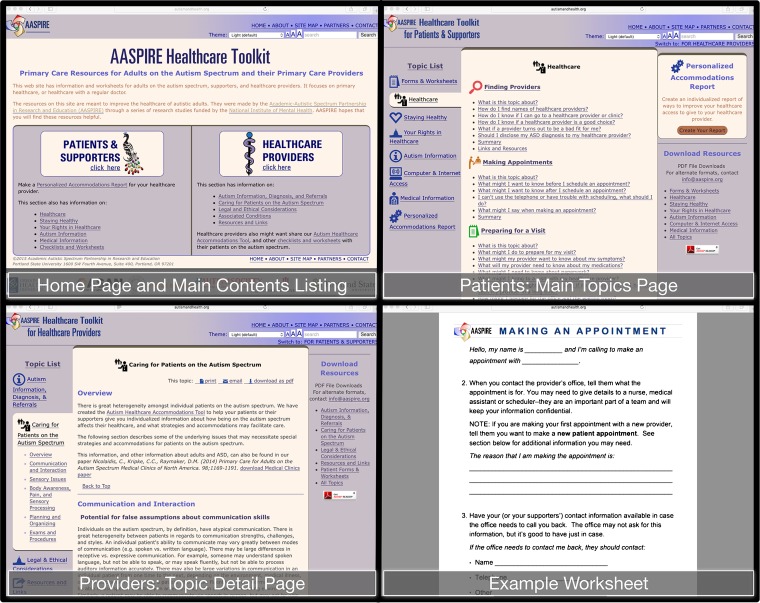
Interventions: The AASPIRE Healthcare toolkit includes the Autism Healthcare Accommodations Tool (AHAT)-a tool that allows patients to create a personalized accommodations report for their PCP-and general healthcare- and autism-related information, worksheets, checklists, and resources for patients and healthcare providers.
Main measures: Satisfaction with patient-provider communication, healthcare self-efficacy, barriers to healthcare, and satisfaction with the toolkit's usability and utility; responses to open-ended questions.
Key results: Preliminary testing of the AHAT demonstrated strong content validity and adequate test-retest stability. Almost all patient participants (>94 %) felt that the AHAT and the toolkit were easy to use, important, and useful. In pre/post-intervention comparisons, the mean number of barriers decreased (from 4.07 to 2.82, p < 0.0001), healthcare self-efficacy increased (from 37.9 to 39.4, p = 0.02), and satisfaction with PCP communication improved (from 30.9 to 32.6, p = 0.03). Patients stated that the toolkit helped clarify their needs, enabled them to self-advocate and prepare for visits more effectively, and positively influenced provider behavior. Most of the PCPs surveyed read the AHAT (97 %), rated it as moderately or very useful (82 %), and would recommend it to other patients (87 %).
Conclusions: The CBPR process resulted in a reliable healthcare accommodation tool and a highly accessible healthcare toolkit. Patients and providers indicated that the tools positively impacted healthcare interactions. The toolkit has the potential to reduce barriers to healthcare and improve healthcare self-efficacy and patient-provider communication.
Trial registration: ClinicalTrials.gov NCT01579669.
Keywords: adults; autism; community-based participatory research; healthcare interactions; primary care.
Conflict of interest statement
Compliance with Ethical Standards Funding This study was funded by the National Institute of Mental Health (R34MH092503). Prior Presentations Portions of this paper were presented at the 2015 TASH conference in Portland, OR, December 2015. Conflict of Interest The authors declare that they have no conflict of interest. Note We understand that language describing autism spectrum disorders is controversial, and we respect the many valid opinions on this issue. We choose to use identity-first language (e.g. autistic adult) instead of person-first language (e.g. person with autism) due to the preferences of the autistic self-advocacy community.25.
Comment in
-
Capsule Commentary on Nicolaidis et al., The Development and Evaluation of an Online Healthcare Toolkit for Autistic Adults and their Primary Care Providers.J Gen Intern Med. 2016 Oct;31(10):1219. doi: 10.1007/s11606-016-3834-8. J Gen Intern Med. 2016. PMID: 27510465 Free PMC article. No abstract available.
References
Publication types
MeSH terms
Associated data
Grants and funding
LinkOut - more resources
Full Text Sources
Other Literature Sources
Medical
