


Genome-Wide Association Study of Acute Renal Graft Rejection
- PMID: 27272414
- PMCID: PMC5215306
- DOI: 10.1111/ajt.13912
Genome-Wide Association Study of Acute Renal Graft Rejection
Abstract
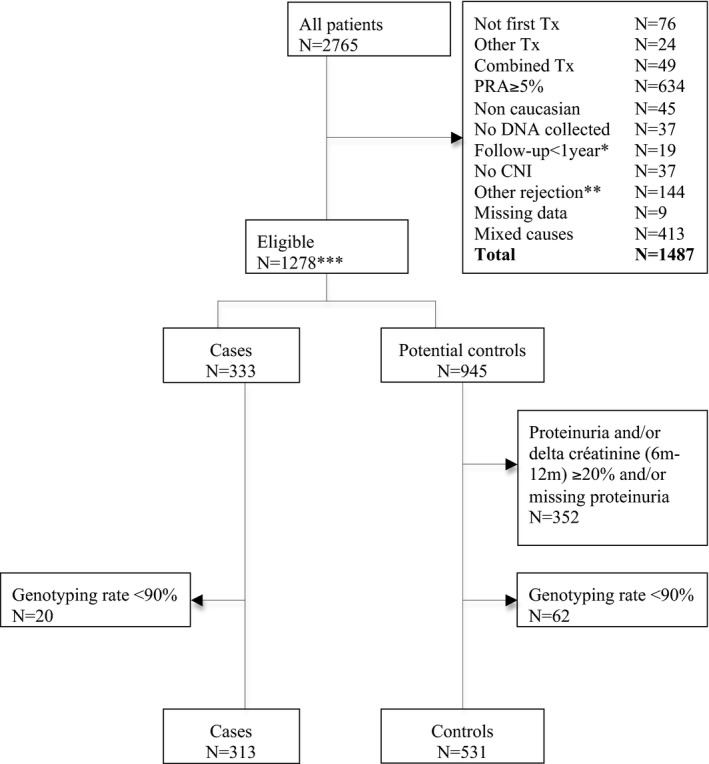
Acute renal rejection is a major risk factor for chronic allograft dysfunction and long-term graft loss. We performed a genome-wide association study to detect loci associated with biopsy-proven acute T cell-mediated rejection occurring in the first year after renal transplantation. In a discovery cohort of 4127 European renal allograft recipients transplanted in eight European centers, we used a DNA pooling approach to compare 275 cases and 503 controls. In an independent replication cohort of 2765 patients transplanted in two European countries, we identified 313 cases and 531 controls, in whom we genotyped individually the most significant single nucleotide polymorphisms (SNPs) from the discovery cohort. In the discovery cohort, we found five candidate loci tagged by a number of contiguous SNPs (more than five) that was never reached in iterative in silico permutations of our experimental data. In the replication cohort, two loci remained significantly associated with acute rejection in both univariate and multivariate analysis. One locus encompasses PTPRO, coding for a receptor-type tyrosine kinase essential for B cell receptor signaling. The other locus involves ciliary gene CCDC67, in line with the emerging concept of a shared building design between the immune synapse and the primary cilium.
Keywords: basic (laboratory) research/science; biomarker; genetics; genomics; immunogenetics; immunosuppression/immune modulation; kidney transplantation/nephrology; microarray/gene array; rejection: T cell mediated (TCMR).
© The Authors. American Journal of Transplantation published by Wiley Periodicals, Inc. on behalf of American Society of Transplant Surgeons.
Figures

References
-
- Wissing KM, Fomegne G, Broeders N, et al. HLA mismatches remain risk factors for acute kidney allograft rejection in patients receiving quadruple immunosuppression with anti‐interleukin‐2 receptor antibodies. Transplantation 2008; 85: 411–416. - PubMed
-
- Ekberg H, Tedesco‐Silva H, Demirbas A, et al. Reduced exposure to calcineurin inhibitors in renal transplantation. N Engl J Med 2007; 357: 2562–2575. - PubMed
-
- Goldfarb‐Rumyantzev AS, Naiman N. Genetic predictors of acute renal transplant rejection. Nephrol Dial Transplant 2010; 25: 1039–1047. - PubMed
-
- Goldfarb‐Rumyantzev AS, Shihab F, Emerson L, et al. A population‐based assessment of the familial component of acute kidney allograft rejection. Nephrol Dial Transplant 2009; 24: 2575–2583. - PubMed
-
- Solez K, Colvin RB, Racusen LC, et al. Banff 07 classification of renal allograft pathology: Updates and future directions. Am J Transplant 2008; 8: 753–760. - PubMed
MeSH terms
Substances
LinkOut - more resources
Full Text Sources
Other Literature Sources
Medical
