Trends in Obesity Among Adults in the United States, 2005 to 2014
- PMID: 27272580
- PMCID: PMC11197437
- DOI: 10.1001/jama.2016.6458
Trends in Obesity Among Adults in the United States, 2005 to 2014
Abstract
Importance: Between 1980 and 2000, the prevalence of obesity increased significantly among adult men and women in the United States; further significant increases were observed through 2003-2004 for men but not women. Subsequent comparisons of data from 2003-2004 with data through 2011-2012 showed no significant increases for men or women.
Objective: To examine obesity prevalence for 2013-2014 and trends over the decade from 2005 through 2014 adjusting for sex, age, race/Hispanic origin, smoking status, and education.
Design, setting, and participants: Analysis of data obtained from the National Health and Nutrition Examination Survey (NHANES), a cross-sectional, nationally representative health examination survey of the US civilian noninstitutionalized population that includes measured weight and height.
Exposures: Survey period.
Main outcomes and measures: Prevalence of obesity (body mass index ≥30) and class 3 obesity (body mass index ≥40).
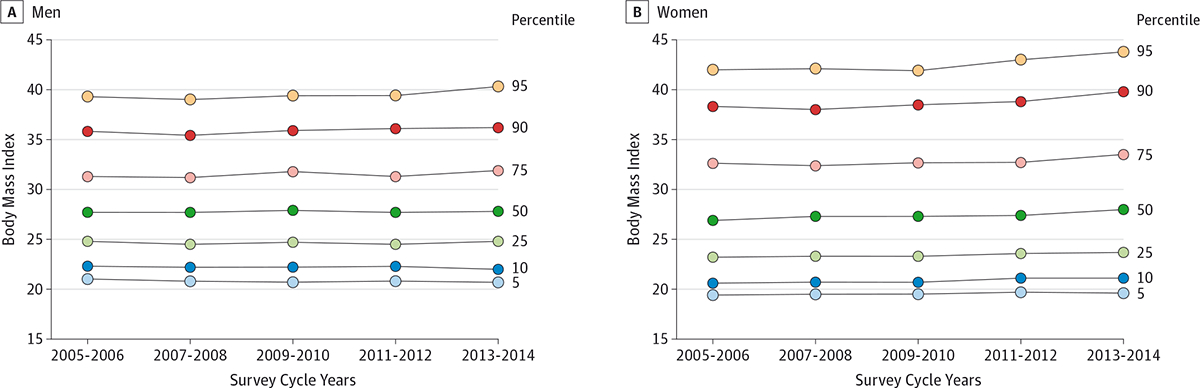
Results: This report is based on data from 2638 adult men (mean age, 46.8 years) and 2817 women (mean age, 48.4 years) from the most recent 2 years (2013-2014) of NHANES and data from 21,013 participants in previous NHANES surveys from 2005 through 2012. For the years 2013-2014, the overall age-adjusted prevalence of obesity was 37.7% (95% CI, 35.8%-39.7%); among men, it was 35.0% (95% CI, 32.8%-37.3%); and among women, it was 40.4% (95% CI, 37.6%-43.3%). The corresponding prevalence of class 3 obesity overall was 7.7% (95% CI, 6.2%-9.3%); among men, it was 5.5% (95% CI, 4.0%-7.2%); and among women, it was 9.9% (95% CI, 7.5%-12.3%). Analyses of changes over the decade from 2005 through 2014, adjusted for age, race/Hispanic origin, smoking status, and education, showed significant increasing linear trends among women for overall obesity (P = .004) and for class 3 obesity (P = .01) but not among men (P = .30 for overall obesity; P = .14 for class 3 obesity).
Conclusions and relevance: In this nationally representative survey of adults in the United States, the age-adjusted prevalence of obesity in 2013-2014 was 35.0% among men and 40.4% among women. The corresponding values for class 3 obesity were 5.5% for men and 9.9% for women. For women, the prevalence of overall obesity and of class 3 obesity showed significant linear trends for increase between 2005 and 2014; there were no significant trends for men. Other studies are needed to determine the reasons for these trends.
Conflict of interest statement
Figures
Comment in
-
The Unrelenting Challenge of Obesity.JAMA. 2016 Jun 7;315(21):2277-8. doi: 10.1001/jama.2016.6190. JAMA. 2016. PMID: 27272578 No abstract available.
-
Obesity: The obesity epidemic in the USA - no end in sight?Nat Rev Endocrinol. 2016 Sep;12(9):499-500. doi: 10.1038/nrendo.2016.121. Epub 2016 Jul 29. Nat Rev Endocrinol. 2016. PMID: 27469344 No abstract available.
-
Use of Projection Analyses and Obesity Trends.JAMA. 2016 Sep 27;316(12):1317. doi: 10.1001/jama.2016.11962. JAMA. 2016. PMID: 27673311 No abstract available.
References
-
- Flegal KM, Carroll MD, Kit BK, Ogden CL. Prevalence of obesity and trends in the distribution of body mass index among US adults, 1999–2010. JAMA. 2012;307(5):491–497. - PubMed
-
- Flegal KM, Carroll MD, Kuczmarski RJ, Johnson CL. Overweight and obesity in the United States: prevalence and trends, 1960–1994. Int J Obes Relat Metab Disord. 1998;22(1):39–47. - PubMed
-
- Flegal KM, Carroll MD, Ogden CL, Curtin LR. Prevalence and trends in obesity among US adults, 1999–2008. JAMA. 2010;303(3):235–241. - PubMed
-
- Flegal KM, Carroll MD, Ogden CL, Johnson CL. Prevalence and trends in obesity among US adults, 1999–2000. JAMA. 2002;288(14):1723–1727. - PubMed
-
- Hedley AA, Ogden CL, Johnson CL, Carroll MD, Curtin LR, Flegal KM. Prevalence of overweight and obesity among US children, adolescents, and adults, 1999–2002. JAMA. 2004;291(23):2847–2850. - PubMed
MeSH terms
Grants and funding
LinkOut - more resources
Full Text Sources
Other Literature Sources
Medical