. 2016 Jun 7:6:27181.
doi: 10.1038/srep27181.

Sesterterpene ophiobolin biosynthesis involving multiple gene clusters in Aspergillus ustus

Affiliations

Sesterterpene ophiobolin biosynthesis involving multiple gene clusters in Aspergillus ustus

Hangzhen Chai et al. Sci Rep. .

Abstract

Terpenoids are the most diverse and abundant natural products among which sesterterpenes account for less than 2%, with very few reports on their biosynthesis. Ophiobolins are tricyclic 5-8-5 ring sesterterpenes with potential pharmaceutical application. Aspergillus ustus 094102 from mangrove rizhosphere produces ophiobolin and other terpenes. We obtained five gene cluster knockout mutants, with altered ophiobolin yield using genome sequencing and in silico analysis, combined with in vivo genetic manipulation. Involvement of the five gene clusters in ophiobolin synthesis was confirmed by investigation of the five key terpene synthesis relevant enzymes in each gene cluster, either by gene deletion and complementation or in vitro verification of protein function. The results demonstrate that ophiobolin skeleton biosynthesis involves five gene clusters, which are responsible for C15, C20, C25, and C30 terpenoid biosynthesis.


Figures
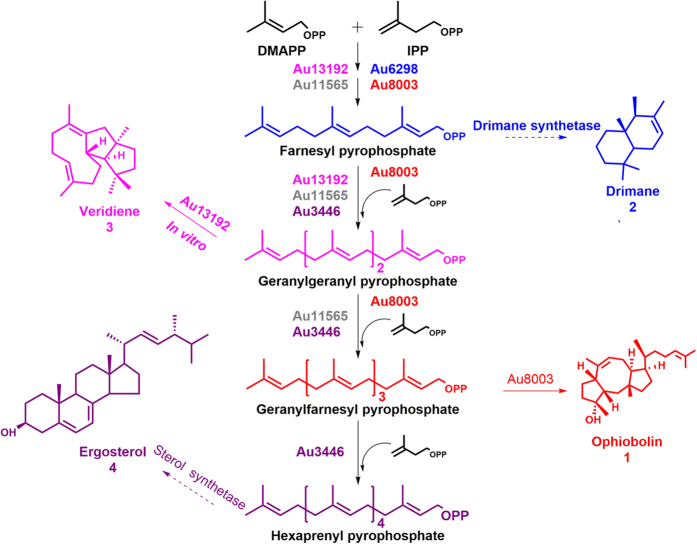
Figure 1
Figure 1. Hypothesized pathway of sesterterpene ophiobolin biosynthesis in A. ustus.
Au8003 is the enzyme responsible for chain elongation from DMAPP and IPP to GFPP, as well as cyclization from GFPP to the end product ophiobolin (1). Production of ophiobolin is also connected with four other pathways via intermediates of DMAPP, IPP, FPP, GGPP, and GFPP. The enzymes Au6298, Au13192 and Au11565 could catalyze chain length elongation from DMAPP and IPP to the end products FPP, GGPP and GFPP, respectively. FPP could be used for drimane (2) synthesis by drimane synthetase or for HexPP synthesis by Au3446, which may then be used to synthesize ergosterol (4). GGPP produced by Au13192 (with the silent TC domain) is an important precursor for ophiobolin (1) production, but it can also produce veridiene (3) in vitro. GGPP or GFPP produced by Au11565 and Au3446 are also substrates for ophiobolin production.
Figure 2
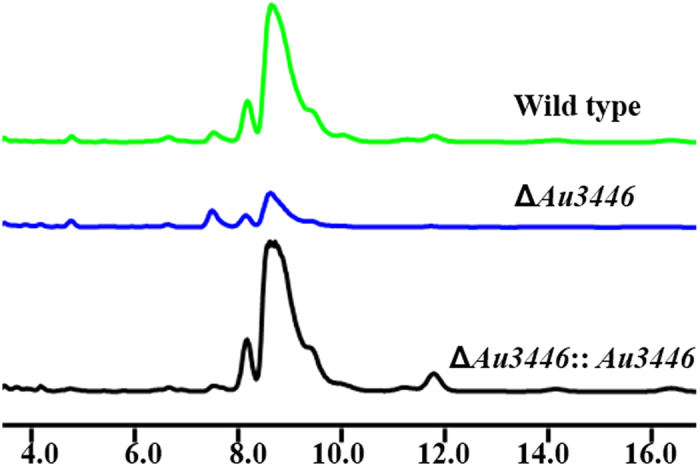
Figure 2. Au3446 gene deletion and complementation.
HPLC analysis of ophiobolin production by wild type, ΔAu3446 mutant and the Au3446Δ::Au3446 complementary A. ustus strain of 094102.
Figure 3
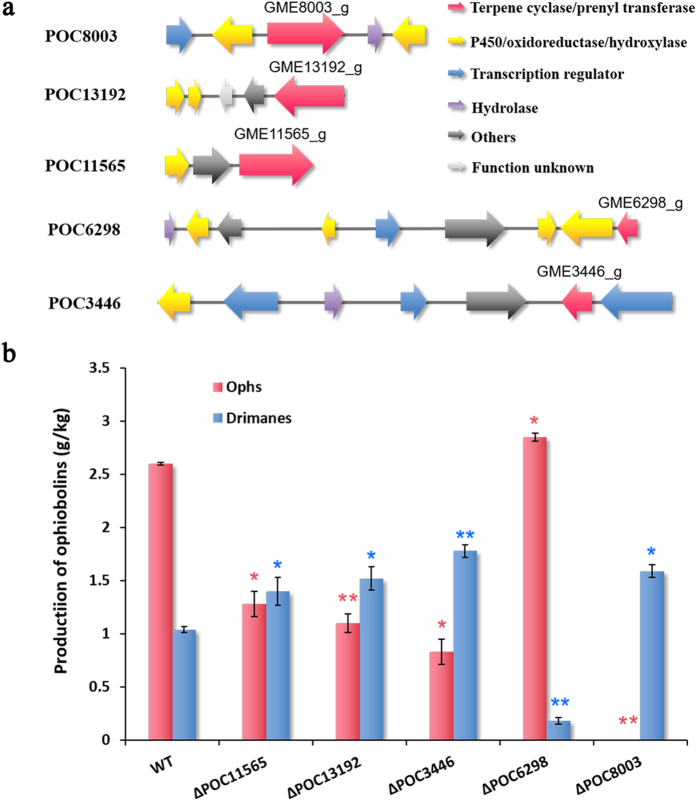
Figure 3. Gene cluster inactivation.
(a) Five gene clusters of Aspergillus ustus are involved in ophiobolin synthesis. Red: terpene cyclase(or prenyl transferase); yellow, cytochrome P450 or oxidoreductase or hydroxylase; blue, transcription regulator; purple, hydrolase; black, other function; gray, function unknown. Numbers on or near the open reading frame are gene codes. (b) Production of ophiobolin and drimane by the five mutants relative to the wild type strain analysed by HPLC. Data are means ± SE of at least five independent measurements. *P < 0.05, **P < 0.01 vs wild type strain, student’s t-test.
Figure 4
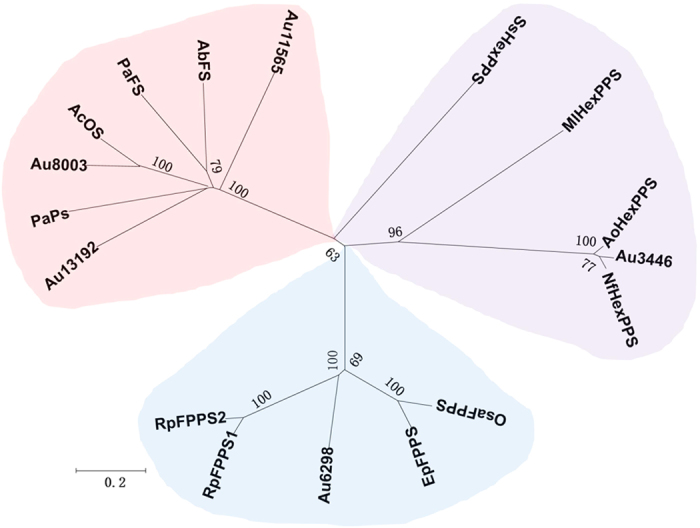
Figure 4. Neighbour-joining phylogenetic tree based on amino acid sequences of bifunctional diterpene and sesterterpene synthases, farnesyl pyrophosphate synthases and hexaprenyl pyrophosphate synthases.
The terpene synthases involved in ophiobolin biosynthesis are found in three clusters. light orange: bifunctional di(sester) terpene synthases; light purple: hexaprenyl pyrophosphate synthases; light blue: farnesyl pyrophosphate synthases. The tree was generated based on the Kimura 2-parameter matrix in MEGA software (version 5.0). Numbers at nodes are bootstrap values obtained using bootstrapping with 1000 repetitions. The scale bar corresponds to 0.2 substitutions per nucleotide position. Aspergillus clavatus ophiobolin F synthase (AcOS A1C8C3), Phomopsis amygdali phomopsene synthase (PaPS AB254159), Phomopsis amygdali fusicoccadiene synthase (PaFS AB267396), Alternaria brassicicola fusicoccadiene synthase (AbFS C9K2Q3), Ornithogalum saundersiae farnesyl pyrophosphate synthase (OsaFPPS KF509889), Rhopalosiphum padi isoprenyl diphosphate synthase (RpFPPS1 HQ850372 and RpFPPS2, HQ850373), Euphorbia pekinensis farnesyl diphosphate synthase (EpFPPS FJ755465), Sulfolobus Solfataricus Hexaprenyl Pyrophosphate Synthase (SsHexPPS 2AZK_B), Micrococcus luteus heterodimeric hexaprenyl diphosphate synthase (MlHexPPS 3AQB_B), Aspergillus oryzae hexaprenyl pyrophosphate synthase (AoHexPPSXP_001824458), Neosartorya fischeri hexaprenyl pyrophosphate synthetase (NfHexPPS XP_001263839).
Figure 5
Figure 5. GC-MS profiles of the products of in vitro enzymatic reactions.
The chromatograms of Au8003 reaction product ophiobolin F extracted at m/z 358 (a): (I) GGPP+IPP, (II) FPP+IPP, (III) GPP+IPP, (IV) DMAPP+IPP and (V) IPP, and MS Spectra of peak 1 (b); chromatograms of Au13192 reaction product veridiene extracted at m/z 272 (c): (I) FPP+IPP, (II) GPP+IPP, (III) DMAPP+IPP, (IV) IPP and MS Spectra of peak 2 (d); chromatograms of phosphatase hydolysate of Au6298 reaction product FPP extracted at m/z 222 (e): (I) DMAPP+IPP, (II) IPP only and MS Spectra of peak 3 (f).

References

    1. Buckingham J. Dictionary of Natural Products on DVD. (CRC, 2007).
    1. Quin M. B., Flynn C. M. & Schmidt-Dannert C. Traversing the fungal terpenome. Nat. Prod. Rep. 31, 1449–1473 (2014). - PMC - PubMed
    1. Christianson D. W. Roots of biosynthetic diversity. Science 316, 60–61 (2007). - PubMed
    1. Keller N. P., Turner G. & Bennett J. W. Fungal secondary metabolism – from biochemistry to genomics. Nat. Rev. Microbiol. 3, 937–947 (2005). - PubMed
    1. Hoffmeister D. & Keller N. P. Natural products of filamentous fungi: enzymes, genes, and their regulation. Nat. Prod. Rep. 24, 393–416 (2007). - PubMed

Publication types