


Review
doi: 10.1038/nsmb.3195.
Epub 2016 Jun 7.
Nanodiscs for structural and functional studies of membrane proteins
Affiliations
- PMID: 27273631
- PMCID: PMC8934039
- DOI: 10.1038/nsmb.3195
Item in Clipboard
Review
Nanodiscs for structural and functional studies of membrane proteins
Nat Struct Mol Biol.
2016 Jun.
Abstract
Membrane proteins have long presented a challenge to biochemical and functional studies. In the absence of a bilayer environment, individual proteins and critical macromolecular complexes may be insoluble and may display altered or absent activities. Nanodisc technology provides important advantages for the isolation, purification, structural resolution and functional characterization of membrane proteins. In addition, the ability to precisely control the nanodisc composition provides a nanoscale membrane surface for investigating molecular recognition events.
Figures
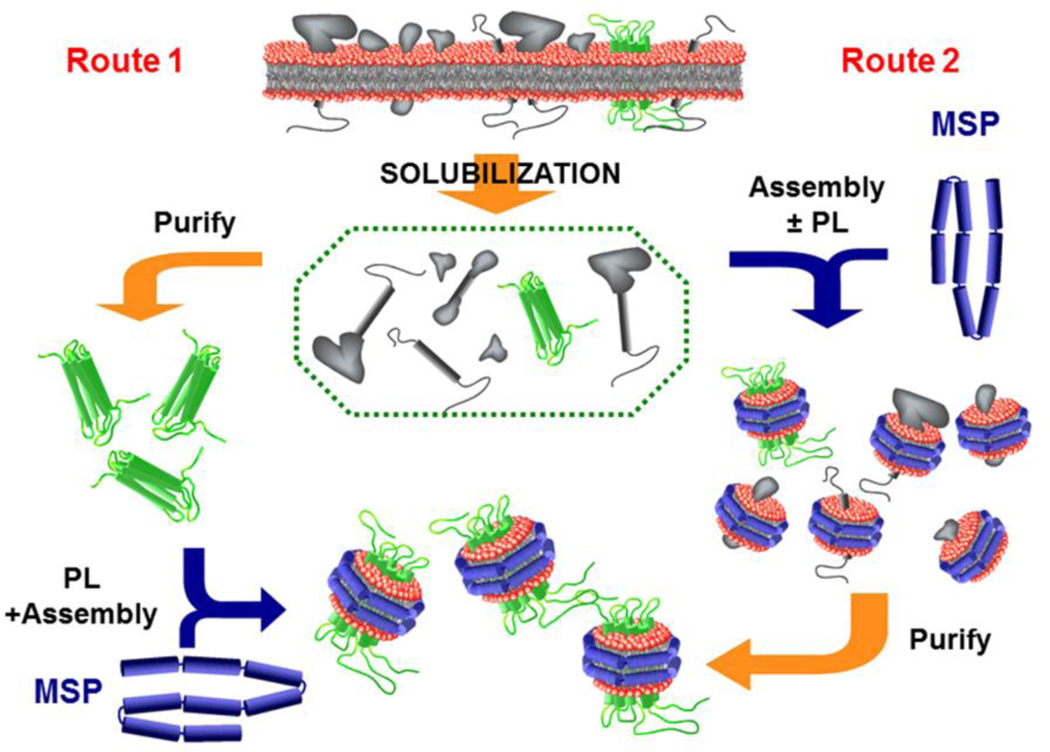
Assembling membrane proteins into Nanodiscs. The standard method for self-assembling a membrane protein into a Nanodisc is shown in Route 1 on the left. A purified MP is detergent solubilized together with the membrane scaffold protein and lipid at the correct stoichiometry, followed by detergent removal though incubation with hydrophobic beads. Often, however, the MP is not stable in detergent for the extended times needed for purification. Alternatively, the starting membrane or tissue can be directly solubilized with excess lipid and scaffold protein with rapid detergent removal resulting in the target, together with other MP in the tissue, being placed into the Nanodisc. Subsequent purification, often with an affinity tag, then takes place where the target is stabilized in the Nanodisc environment. This latter route is also used to generate a soluble membrane protein library that faithfully represents that in the starting tissue.
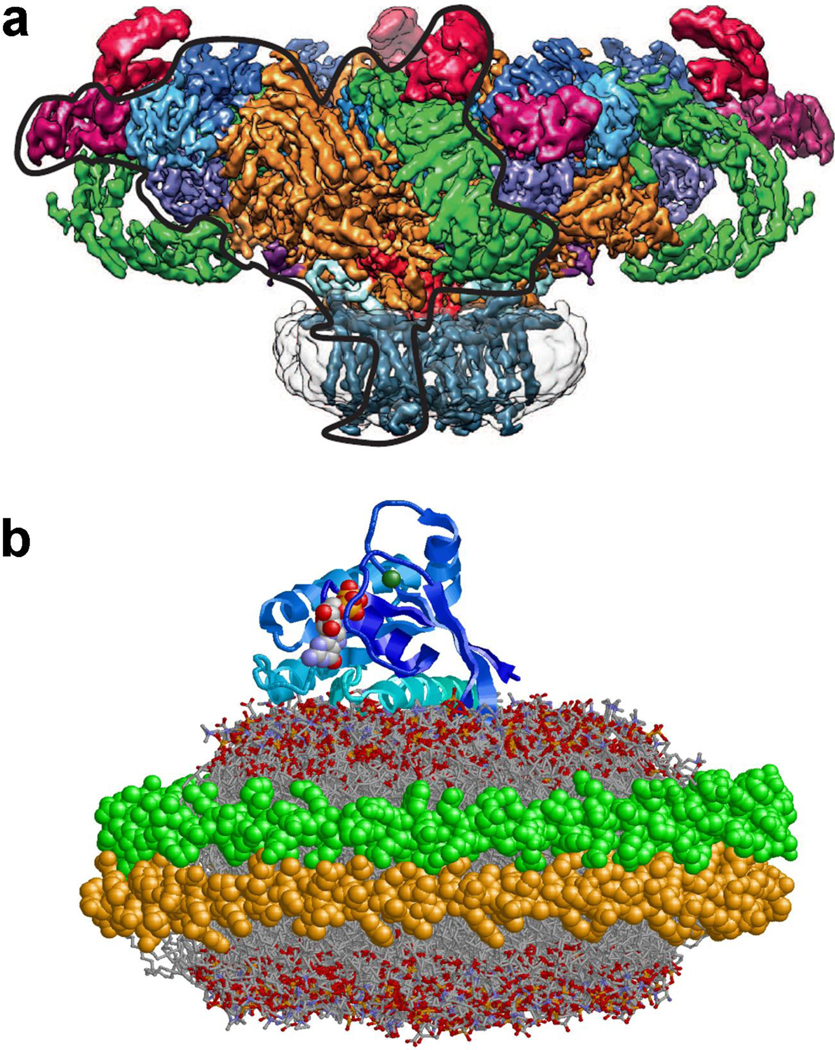
Examples of membrane protein structure in Nanodiscs. (A) The structure of the ryanodine receptor in Nanodisc is resolved to ~6.1 Å using cryo-electron microscopy. The Nanodisc is shown as a light gray envelope with 24 transmembrane helices forming a square structure similar to that of the incorporated voltage-gated sodium channel Nav (reproduced with permission from). (B) The structure of KRas4b bound to the surface of a Nanodisc as determined by NMR spectroscopy (2MSC.pdb file from the Protein Data Bank).
References
-
- Bayburt TH, Grinkova YV & Sligar SG Self-assembly of discoidal phospholipid bilayer nanoparticles with membrane scaffold proteins. Nano Lett. 2, 853–856 (2002).
-
- Denisov IG, Grinkova YV, Lazarides AA & Sligar SG Directed Self-Assembly of Monodisperse Phospholipid Bilayer Nanodiscs with Controlled Size. J. Am. Chem. Soc. 126, 3477–3487 (2004). - PubMed
-
- Bayburt TH, Grinkova YV & Sligar SG Assembly of single bacteriorhodopsin trimers in bilayer nanodiscs. Arch. Biochem. Biophys. 450, 215–222 (2006). - PubMed
Publication types
MeSH terms
Substances
Grants and funding
LinkOut - more resources
Full Text Sources
Other Literature Sources
