


The Epidemiology of Hand, Foot and Mouth Disease in Asia: A Systematic Review and Analysis
- PMID: 27273688
- PMCID: PMC5130063
- DOI: 10.1097/INF.0000000000001242
The Epidemiology of Hand, Foot and Mouth Disease in Asia: A Systematic Review and Analysis
Abstract
Context: Hand, foot and mouth disease (HFMD) is a widespread pediatric disease caused primarily by human enterovirus 71 (EV-A71) and Coxsackievirus A16 (CV-A16).
Objective: This study reports a systematic review of the epidemiology of HFMD in Asia.
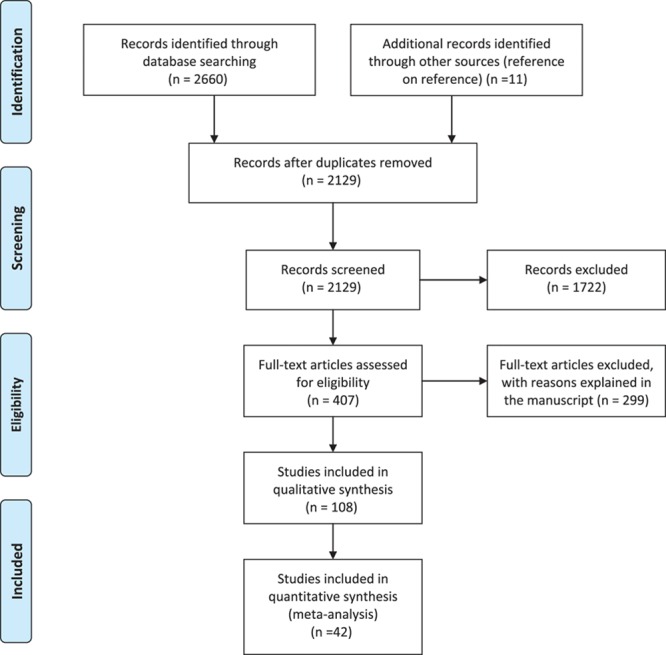
Data sources: PubMed, Web of Science and Google Scholar were searched up to December 2014.
Study selection: Two reviewers independently assessed studies for epidemiologic and serologic information about prevalence and incidence of HFMD against predetermined inclusion/exclusion criteria.
Data extraction: Two reviewers extracted answers for 8 specific research questions on HFMD epidemiology. The results are checked by 3 others.
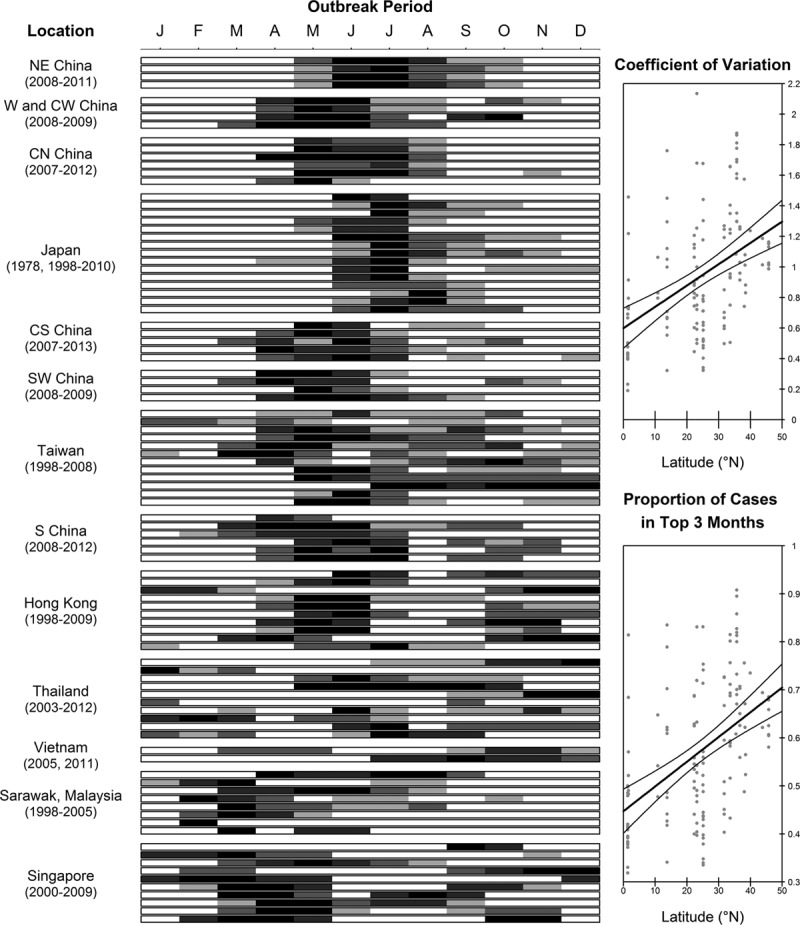
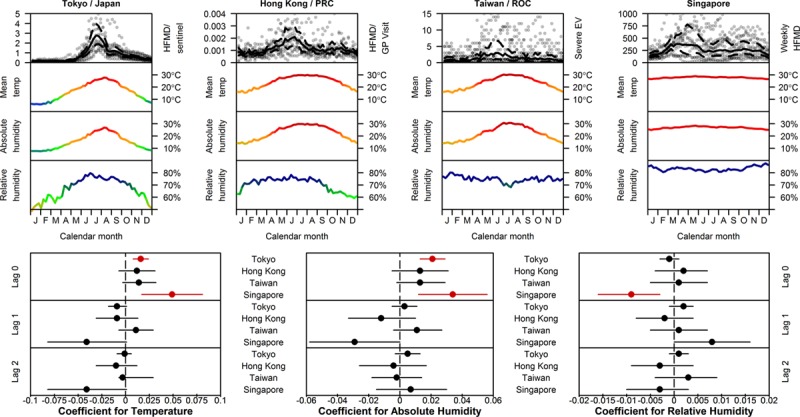
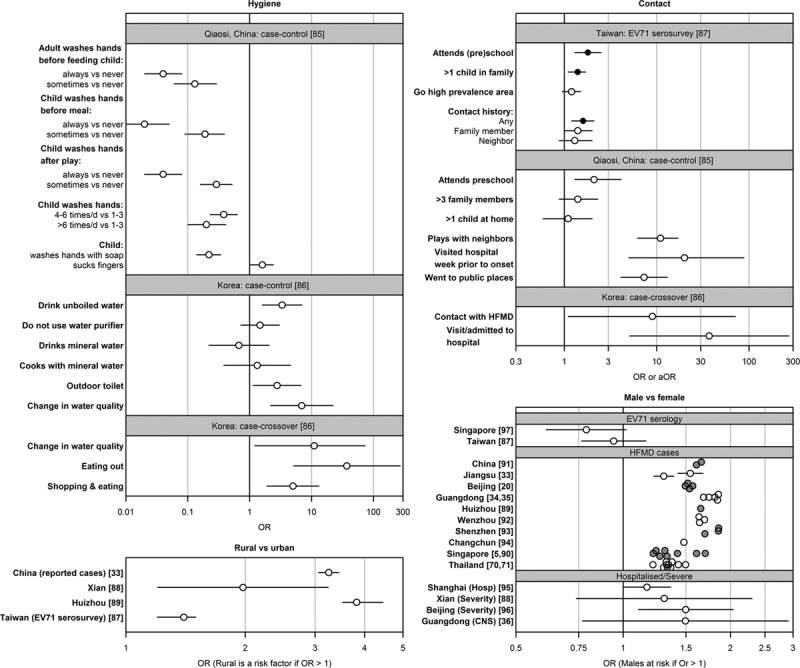
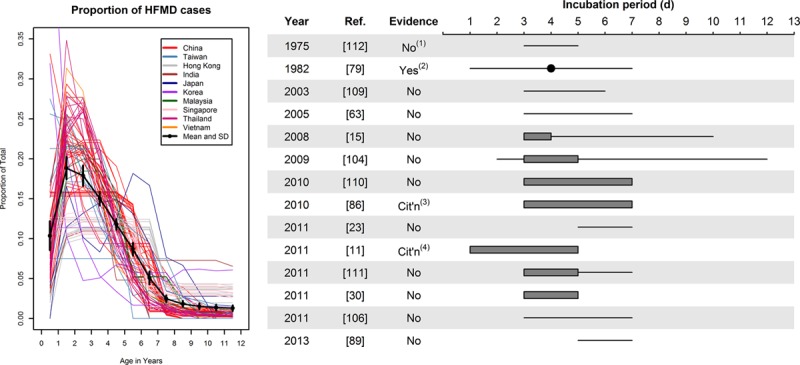
Results: HFMD is found to be seasonal in temperate Asia with a summer peak and in subtropical Asia with spring and fall peaks, but not in tropical Asia; evidence of a climatic role was identified for temperate Japan. Risk factors for HFMD include hygiene, age, gender and social contacts, but most studies were underpowered to adjust rigorously for confounding variables. Both community-level and school-level transmission have been implicated, but their relative importance for HFMD is inconclusive. Epidemiologic indices are poorly understood: No supporting quantitative evidence was found for the incubation period of EV-A71; the symptomatic rate of EV-A71/Coxsackievirus A16 infection was from 10% to 71% in 4 studies; while the basic reproduction number was between 1.1 and 5.5 in 3 studies. The uncertainty in these estimates inhibits their use for further analysis.
Limitations: Diversity of study designs complicates attempts to identify features of HFMD epidemiology.
Conclusions: Knowledge on HFMD remains insufficient to guide interventions such as the incorporation of an EV-A71 vaccine in pediatric vaccination schedules. Research is urgently needed to fill these gaps.
Conflict of interest statement
Supported by Singapore’s Ministry of Health Services Research (HSRG12MAY023), Communicable Disease Public Health Research (CDPHRG12NOV021), the Centre for Infectious Disease Epidemiology and Research, the Ministry of Education Tier 1 grant and the President’s Graduate Fellowship to W.M.K. The funders had no role in the decision to publish. T.B. is employed by commercial company, Standard Analytics. The remaining authors have no financial relationships relevant to this article to disclose. The authors have no conflicts of interest to disclose.
Figures
References
-
- Huang MC, Wang SM, Hsu YW, et al. Long-term cognitive and motor deficits after enterovirus 71 brainstem encephalitis in children. Pediatrics. 2006;118:e1785–e1788. - PubMed
-
- Chang LY, Huang LM, Gau SS, et al. Neurodevelopment and cognition in children after enterovirus 71 infection. N Engl J Med. 2007;356:1226–1234. - PubMed
-
- World Health Organization Western Pacific Region. Hand, foot, and mouth disease situation update. 2014. Dec 29, Available at: http://www.wpro.who.int/emerging_diseases/hfmd_biweekly_29dec2014.pdf?ua=1. Accessed March 11, 2015.
-
- Ang LW, Koh BK, Chan KP, et al. Epidemiology and control of hand, foot and mouth disease in Singapore, 2001–2007. Ann Acad Med Singapore. 2009;38:106–112. - PubMed
-
- Chen SP, Huang YC, Li WC, et al. Comparison of clinical features between coxsackievirus A2 and enterovirus 71 during the enterovirus outbreak in Taiwan, 2008: a children’s hospital experience. J Microbiol Immunol Infect. 2010;43:99–104. - PubMed
Publication types
MeSH terms
LinkOut - more resources
Full Text Sources
Other Literature Sources
