


A review of executive function deficits in autism spectrum disorder and attention-deficit/hyperactivity disorder
- PMID: 27274255
- PMCID: PMC4869784
- DOI: 10.2147/NDT.S104620
A review of executive function deficits in autism spectrum disorder and attention-deficit/hyperactivity disorder
Abstract
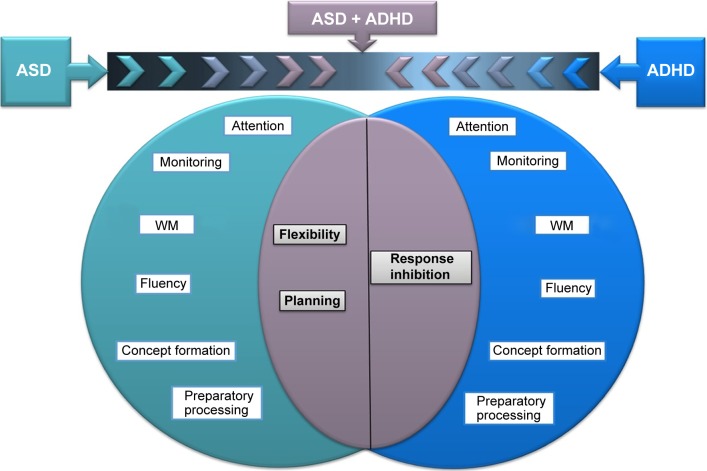
Executive dysfunction has been shown to be a promising endophenotype in neurodevelopmental disorders such as autism spectrum disorder (ASD) and attention-deficit/hyperactivity disorder (ADHD). This article reviewed 26 studies that examined executive function comparing ASD and/or ADHD children. In light of findings from this review, the ASD + ADHD group appears to share impairment in both flexibility and planning with the ASD group, while it shares the response inhibition deficit with the ADHD group. Conversely, deficit in attention, working memory, preparatory processes, fluency, and concept formation does not appear to be distinctive in discriminating from ASD, ADHD, or ASD + ADHD group. On the basis of neurocognitive endophenotype, the common co-occurrence of executive function deficits seems to reflect an additive comorbidity, rather than a separate condition with distinct impairments.
Keywords: ASD + ADHD; attention-deficit/hyperactivity disorder; autism spectrum disorder; executive function; neurocognitive endophenotype.
Figures
References
-
- Ozonoff S. Executive functions in autism. In: Schopler E, Mesibov G, editors. Learning and Cognition in Autism. New York: Plenum Press; 1995. pp. 199–219.
-
- Ozonoff S, Pennington BF, Rogers SJ. Executive function deficits in high-functioning autistic individuals: relationship to theory of mind. J Child Psychol Psychiatry. 1991;32(7):1081–1105. - PubMed
-
- Russell J. Autism as an Executive Disorder. Oxford: Oxford University Press; 1997. How executive disorders can bring about an inadequate “theory of mind”; pp. 256–304.
-
- Barkley RA. Behavioral inhibition, sustained attention, and executive functions: constructing a unifying theory of ADHD. Psychol Bull. 1997;121(1):65–94. - PubMed
Publication types
LinkOut - more resources
Full Text Sources
Other Literature Sources
Medical
