


BUY QUIET INITIATIVE IN THE USA
- PMID: 27274613
- PMCID: PMC4891807
- DOI: 10.1007/s40857-015-0036-1
BUY QUIET INITIATIVE IN THE USA
Abstract
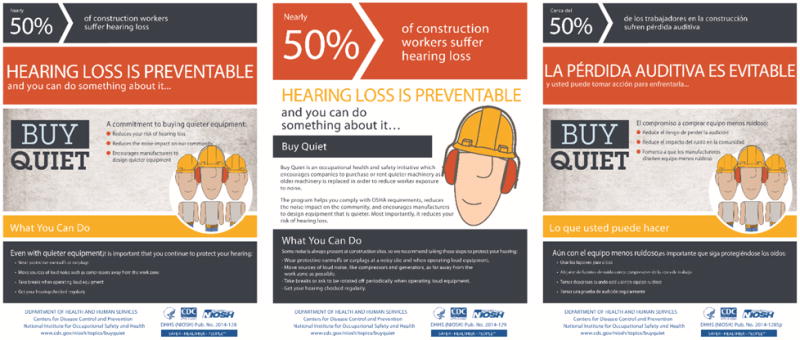
Noise-induced hearing loss is still considered one of the most common work-related illnesses in the United States of America. The U.S. National Institute for Occupational Safety and Health launched a national Buy Quiet campaign to raise awareness of the importance of purchasing quieter equipment. Buy Quiet encourages companies to seek out and demand quieter equipment thus driving the market to design and create quieter products. In the long run, investment in noise controls should be more prevalent as the market demands quieter products. This paradigm occurs as the market for quieter products expands both from the supply side (manufacturers) and the demand side (tool and equipment purchasers). The key to experiencing the reduced costs and increased benefits of Buy Quiet will be to develop partnerships between manufacturers and consumers. To this end, the U.S. National Institute for Occupational Safety and Health continues to work with partners to educate stakeholders about the risks and true costs of noise-induced hearing loss, as well as the economic benefits of buying quieter equipment.
Keywords: Buy Quiet; Noise; engineering controls; hearing loss; prevention.
Figures
References
-
- Occupational Safety and Health Administration. Occupational Noise Exposure. [Online]. Available: https://www.osha.gov/SLTC/noisehearingconservation/. [Accessed 1 July 2015]
-
- Tak S, Davis RR, Calvert GM. Exposure to Hazardous Workplace Noise and Use of Hearing Protection Devices Among US Workers – NHANES, 1999–2004. American Journal of Industrial Medicine. 2009;52(5):358–371. - PubMed
-
- Roo Fd, Gerretsen E, Borst J. Environmental impact of noise from mobile outdoor equipment. 7th European Conference on Noise Control, EURONOISE 2008 and Acoustics ’08; Paris, France. 2008.
-
- National Institute for Occupational Safety and Health. Criteria for a Recommended Standard. U.S. Department of Health and Human Services; Cincinnati, OH: 1998.
Grants and funding
LinkOut - more resources
Full Text Sources
Other Literature Sources