


Epigenetic age acceleration predicts cancer, cardiovascular, and all-cause mortality in a German case cohort
- PMID: 27274774
- PMCID: PMC4891876
- DOI: 10.1186/s13148-016-0228-z
Epigenetic age acceleration predicts cancer, cardiovascular, and all-cause mortality in a German case cohort
Abstract
Background: Previous studies have developed models predicting methylation age from DNA methylation in blood and other tissues (epigenetic clock) and suggested the difference between DNA methylation and chronological ages as a marker of healthy aging. The goal of this study was to confirm and expand such observations by investigating whether different concepts of the epigenetic clocks in a population-based cohort are associated with cancer, cardiovascular, and all-cause mortality.
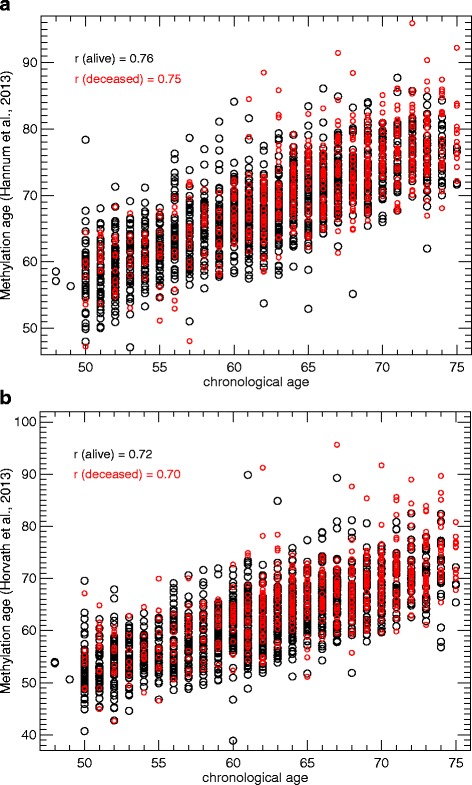
Results: DNA methylation age was estimated in a cohort of 1863 older people, and the difference between age predicted by DNA methylation and chronological age (Δage) was calculated. A case-cohort design and weighted proportional Cox hazard models were used to estimate associations of Δage with cancer, cardiovascular, and all-cause mortality. Hazard ratios for Δage (per 5 years) calculated using the epigenetic clock developed by Horvath were 1.23 (95 % CI 1.10-1.38) for all-cause mortality, 1.22 (95 % CI 1.03-1.45) for cancer mortality, and 1.19 (95 % CI 0.98-1.43) for cardiovascular mortality after adjustment for batch effects, age, sex, educational level, history of chronic diseases, hypertension, smoking status, body mass index, and leucocyte distribution. Associations were similar but weaker for Δage calculated using the epigenetic clock developed by Hannum.
Conclusions: These results show that age acceleration in terms of the difference between age predicted by DNA methylation and chronological age is an independent predictor of all-cause and cause-specific mortality and may be useful as a general marker of healthy aging.
Keywords: DNA methylation age; Epigenetic age acceleration; Epigenetic clock; Mortality risk.
Figures
References
-
- Simmons D. Epigenetic influences and disease. Nat Educ. 2008;1:6.
MeSH terms
LinkOut - more resources
Full Text Sources
Other Literature Sources
Medical
