Clinical Trial
. 2016:2016:1745108.
doi: 10.1155/2016/1745108. Epub 2016 May 4.

Randomized Phase II Study of Docetaxel plus Personalized Peptide Vaccination versus Docetaxel plus Placebo for Patients with Previously Treated Advanced Wild Type EGFR Non-Small-Cell Lung Cancer

Affiliations
Clinical Trial

Randomized Phase II Study of Docetaxel plus Personalized Peptide Vaccination versus Docetaxel plus Placebo for Patients with Previously Treated Advanced Wild Type EGFR Non-Small-Cell Lung Cancer

Koichi Takayama et al. J Immunol Res. 2016.

Abstract

Objectives. To evaluate the efficacy and safety of personalized peptide vaccination (PPV) combined with chemotherapy for patients with previously treated advanced non-small-cell lung cancer (NSCLC). Patients and Methods. Previously treated PS0-1 patients with IIIB/IV EGFR (epidermal growth factor receptor) wild genotype NSCLC were randomly assigned to docetaxel (60 mg/m(2) on Day 1) plus PPV based on preexisting host immunity or docetaxel plus placebo. Docetaxel administration was repeated every 3 weeks until disease progression. Personalized peptides or placebo was injected subcutaneously weekly in the first 8 weeks and biweekly in subsequent 16 weeks. The primary efficacy endpoint was progression-free survival (PFS). Results. PPV related toxicity was grade 2 or less skin reaction. The median PFS for placebo arm and PPV arm was 52 days and 59 days, respectively. There was no significant difference between two arms by log-rank test (p = 0.42). Interestingly, PFS and overall survival (OS) in humoral immunological responder were significantly longer than those in nonresponder. Conclusion. PPV did not improve the survival in combination with docetaxel for previously treated advanced NSCLC. However, PPV may be efficacious for the humoral immunological responders and a further clinical investigation is needed.


Figures
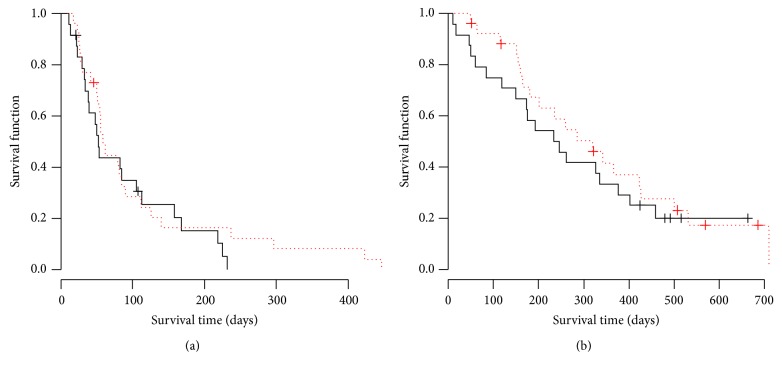
Figure 1
Figure 1
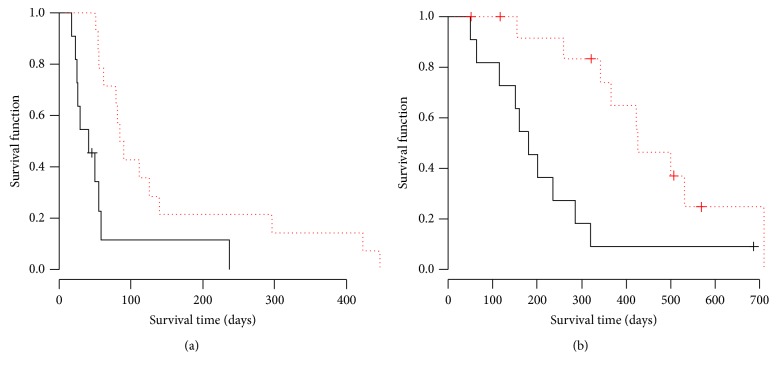
Survival curves of placebo and PPV arm. (a) Solid and dotted lines indicate the PFS curve by Kaplan-Meyer method in placebo and PPV arms, respectively. No significant difference was noted between both arms (p = 0.42, log-rank test). The median PFS in the placebo and PPV arm was 52 days and 59 days, respectively. Hazard ratio of PFS curve in PPV arm was 0.78 (95% CI 0.43–1.42). (b) Solid and dotted lines indicate the OS curve by Kaplan-Meyer method in placebo and PPV arms, respectively. No significant difference was noted between both arms (p = 0.49, log-rank test). The median PFS in the placebo and PPV arm was 233 days and 320 days, respectively. Hazard ratio of OS curve in PPV arm was 0.80 (95% CI 0.42–1.51).
Figure 2
Figure 2
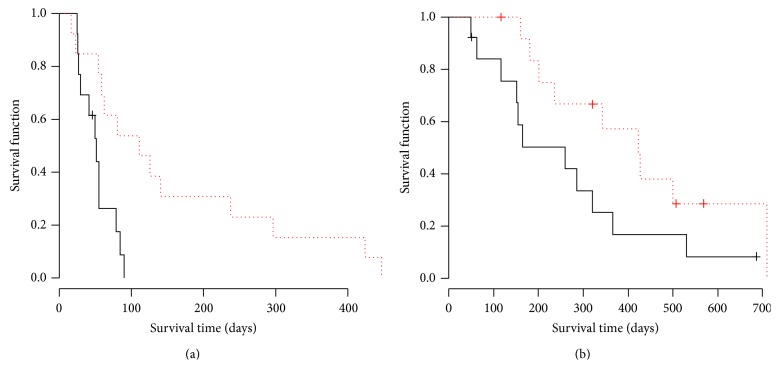
Survival curves of immunological responder and nonresponder in PPV arm. (a) Solid and dotted lines indicate the PFS curve by Kaplan-Meyer method in humoral immunological nonresponder and responder group of PPV arm, respectively. There was a significant difference between both arms (p = 0.0034, log-rank test). The median PFS in the nonresponder and responder was 41 days and 84 days, respectively. Hazard ratio of PFS curve in responder group was 0.28 (95% CI 0.11–0.69). (b) Solid and dotted lines indicate the OS curve by Kaplan-Meyer method in humoral immunological nonresponder and responder group of PPV arm, respectively. There was a significant difference between both arms (p = 0.0049, log-rank test). The median OS in the nonresponder and responder group was 181 days and 427 days, respectively. Hazard ratio of OS curve in responder group was 0.27 (95% CI 0.10–0.71).
Figure 3
Figure 3
Survival curves of the patients group with or without skin reaction in PPV arm. Dotted and solid lines indicate the PFS or OS curve by Kaplan-Meyer method of the patients group with or without skin reaction in PPV arm, respectively. (a) PFS curve. There was a significant difference between both arms (p = 0.005, log-rank test). The median PFS in the patients group with or without skin reaction was 51 days and 111 days, respectively. Hazard ratio of PFS curve in skin reaction group was 0.25 (95% CI 0.09–0.70). (b) OS curve. There was a marginal but not significant difference between both arms (p = 0.073, log-rank test). The median OS in the patients group with or without skin reaction was 259 days and 423 days, respectively. Hazard ratio of OS curve in the skin reaction group was 0.44 (95% CI 0.18–1.11).

References

    1. Schiller J. H., Harrington D., Belani C. P., et al. Comparison of four chemotherapy regimens for advanced non-small-cell lung cancer. The New England Journal of Medicine. 2002;346(2):92–98. doi: 10.1056/nejmoa011954. - DOI - PubMed
    1. Fossella F. V., DeVore R., Kerr R. N., et al. Randomized phase III trial of docetaxel versus vinorelbine or ifosfamide in patients with advanced non-small-cell lung cancer previously treated with platinum-containing chemotherapy regimens. Journal of Clinical Oncology. 2000;18(12):2354–2362. - PubMed
    1. Itoh K., Yamada A. Personalized peptide vaccines: a new therapeutic modality for cancer. Cancer Science. 2006;97(10):970–976. doi: 10.1111/j.1349-7006.2006.00272.x. - DOI - PMC - PubMed
    1. Hattori T., Mine T., Komatsu N., et al. Immunological evaluation of personalized peptide vaccination in combination with UFT and UZEL for metastatic colorectal carcinoma patients. Cancer Immunology, Immunotherapy. 2009;58(11):1843–1852. doi: 10.1007/s00262-009-0695-6. - DOI - PMC - PubMed
    1. Yanagimoto H., Shiomi H., Satoi S., et al. A phase II study of personalized peptide vaccination combined with gemcitabine for non-resectable pancreatic cancer patients. Oncology Reports. 2010;24(3):795–801. doi: 10.3892/or-00000923. - DOI - PubMed

Publication types

MeSH terms