


Guanylate binding protein 5: Impairing virion infectivity by targeting retroviral envelope glycoproteins
- PMID: 27275775
- PMCID: PMC5331900
- DOI: 10.1080/21541248.2016.1189990
Guanylate binding protein 5: Impairing virion infectivity by targeting retroviral envelope glycoproteins
Abstract
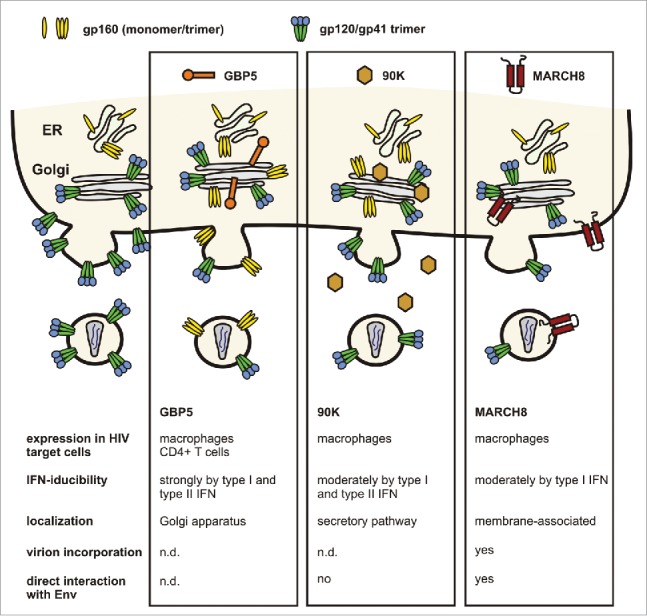
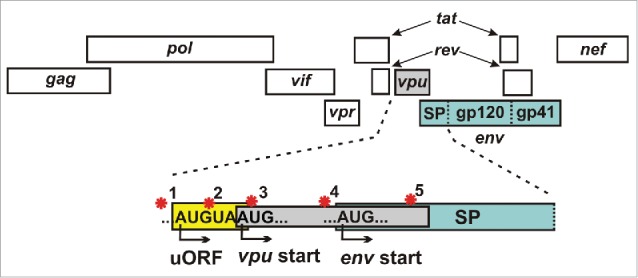
Guanylate binding proteins (GBPs) are interferon-inducible cellular factors that belong to the superfamily of guanosine triphosphatases (GTPases) and play important roles in the cell-intrinsic defense against bacteria, protozoa and viruses. In a recent report in Cell Host & Microbe, we identify GBP5 as novel restriction factor of HIV-1 that reduces the infectivity of progeny virions by interfering with processing and incorporation of the viral envelope (Env) glycoprotein. The inhibitory activity of GBP5 requires C-terminal isoprenylation, mediating Golgi-association, but not its GTPase function. Notably, GBP5 expression levels vary considerably in human macrophages and inversely correlate with infectious virus yield. We demonstrate that GBP5 can be evaded by an unusual tradeoff mechanism: Naturally occurring mutations in the start codon of the viral accessory gene vpu attenuate GBP5 inhibition by increasing Env expression at the cost of Vpu function. Whether direct counteraction mechanisms or more subtle changes balancing Vpu and Env expression also affect HIV-1 inhibition by GBP5 remains to be clarified. Other open questions are whether GBP5 restricts HIV-1 in CD4+ T cells and if other GBP family members also decrease infectivity of HIV and/or additional enveloped viruses.
Keywords: Env; GBP5; HIV-1; IFN; restriction factor; vpu.
Figures
Comment on
-
Immune evasion and counteraction of restriction factors by HIV-1 and other primate lentiviruses.Cell Host Microbe. 2010 Jul 22;8(1):55-67. doi: 10.1016/j.chom.2010.06.004. Cell Host Microbe. 2010. PMID: 20638642 Review.
References
-
- Doyle T, Goujon C, Malim MH. HIV-1 and interferons: who's interfering with whom? Nat Rev Micro 2015; 13:403-13; http://dx.doi.org/10.1038/nrmicro3449 - DOI - PMC - PubMed
-
- Kluge SF, Sauter D, Kirchhoff F. SnapShot: antiviral restriction factors. Cell 2015; 163:774-4.e1; PMID:26496613; http://dx.doi.org/10.1016/j.cell.2015.10.019 - DOI - PubMed
-
- Krupp A, McCarthy KR, Ooms M, Letko M, Morgan JS, Simon V, Johnson WE. APOBEC3G polymorphism as a selective barrier to cross-species transmission and emergence of pathogenic SIV and AIDS in a primate host. PLOS Pathog 2013; 9:e1003641; PMID:24098115; http://dx.doi.org/10.1371/journal.ppat.1003641 - DOI - PMC - PubMed
-
- Kirchhoff F. Immune evasion and counteraction of restriction factors by HIV-1 and other primate lentiviruses. Cell Host Microbe 2010; 8:55-67; PMID:20638642; http://dx.doi.org/10.1016/j.chom.2010.06.004 - DOI - PubMed
-
- Malim MH, Bieniasz PD. HIV restriction factors and mechanisms of evasion. Cold Spring Harb Perspect Med 2012; 2:a006940; PMID:22553496; http://dx.doi.org/10.1101/cshperspect.a006940 - DOI - PMC - PubMed
Publication types
MeSH terms
Substances
LinkOut - more resources
Full Text Sources
Other Literature Sources
Research Materials
