


Colorectal Cancer in Young African Americans: Is It Time to Revisit Guidelines and Prevention?
- PMID: 27278956
- PMCID: PMC5021553
- DOI: 10.1007/s10620-016-4207-1
Colorectal Cancer in Young African Americans: Is It Time to Revisit Guidelines and Prevention?
Abstract
Background & aims: Previous studies have suggested an increase in the incidence of colorectal cancer (CRC) in young adults (younger than 50 years). Among older people, African Americans have disproportionally higher CRC incidence and mortality. We assessed whether this CRC disparity also applies to CRC diagnosed among young people.
Methods: Using the Surveillance, Epidemiology, and End Results cancer registries, a population-based cancer registry covering 25.6 % of the United States' African American population, we identified patients diagnosed with CRC between the years of 2000-2012. The age-adjusted rates for non-Hispanic whites (NHW), African Americans, and Asian-Pacific Islanders (API) were calculated for the age categories 20-24, 25-29, 30-34, 35-39, and 40-44.
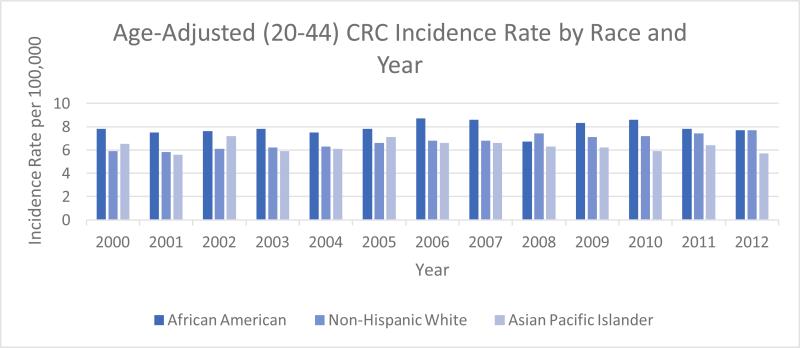
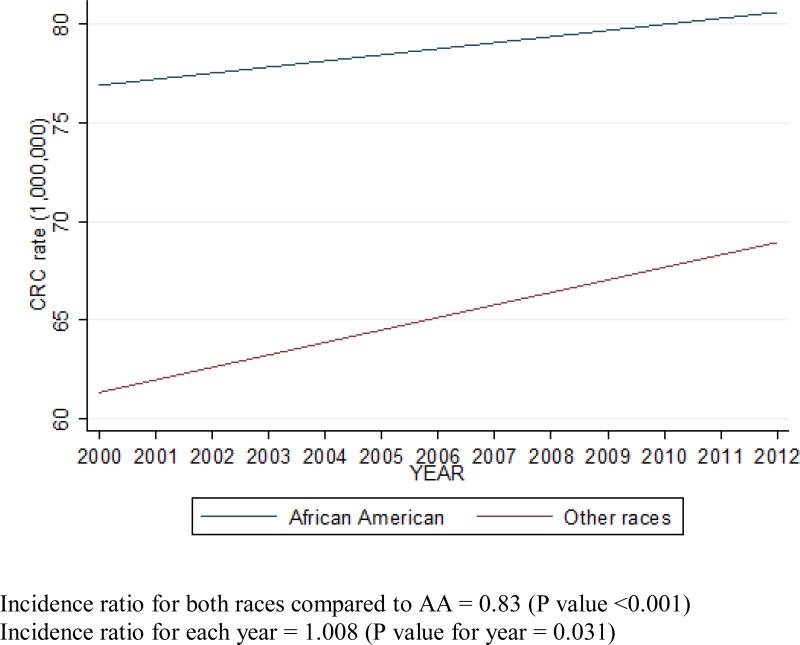
Results: CRC age-adjusted incidence is increasing among all three racial groups and was higher for African Americans compared to NHW and API across all years 2000-2012 (P < 0.001). Stage IV CRC was higher in African Americans compared with NHW, while there was higher stage III CRC in API compared with NHWs.
Conclusion: CRC incidence is increasing among the young in all racial groups under study. This increase in frequency of CRC is true among young African American adults who display highly advanced tumors in comparison with other races. While the present attention to screening seems to have decreased CRC prevalence in individuals older than 50, special attention needs to be addressed to young African American adults as well, to counter the observed trend, as they have the highest incidence of CRC among young population groups by race/ethnicity.
Keywords: Colorectal cancer; Race; SEER; Screening; Young adults.
Figures
Comment in
-
The Increasing Incidence of Colorectal Cancers Diagnosed in Subjects Under Age 50 Among Races: CRaCking the Conundrum.Dig Dis Sci. 2016 Oct;61(10):2767-2769. doi: 10.1007/s10620-016-4268-1. Dig Dis Sci. 2016. PMID: 27480086 No abstract available.
References
-
- American Cancer Society Colorectal Cancer Facts & Figures 2014-2016. 2014 Available at: http://www.cancer.org/acs/groups/content/documents/document/acspc-042280....
-
- Siegel RL, Jemal A, Ward EM. Increase in incidence of colorectal cancer among young men and women in the United States. Cancer epidemiology, biomarkers & prevention : a publication of the American Association for Cancer Research, cosponsored by the American Society of Preventive Oncology. 2009;18:1695–1698. - PubMed
-
- O'Connell JB, Maggard MA, Liu JH, Etzioni DA, Livingston EH, Ko CY. Rates of colon and rectal cancers are increasing in young adults. The American surgeon. 2003;69:866–872. - PubMed
MeSH terms
Grants and funding
LinkOut - more resources
Full Text Sources
Other Literature Sources
Medical
