


Use of Ultrasound Elastography in the Assessment of the Musculoskeletal System
- PMID: 27279926
- PMCID: PMC4880311
- DOI: 10.12659/PJR.896099
Use of Ultrasound Elastography in the Assessment of the Musculoskeletal System
Abstract
This article presents possible applications of ultrasound elastography in musculoskeletal imaging based on the available literature, as well as the possibility of extending indications for the use of elastography in the future. Ultrasound elastography (EUS) is a new method that shows structural changes in tissues following application of physical stress. Elastography techniques have been widely used to assess muscles and tendons in vitro since the early parts of the twentieth century. Only recently with the advent of new technology and creation of highly specialized ultrasound devices, has elastography gained widespread use in numerous applications. The authors performed a search of the Medline/PubMed databases for original research and reviewed publications on the application of ultrasound elastography for musculoskeletal imaging. All publications demonstrate possible uses of ultrasound elastography in examinations of the musculoskeletal system. The most widely studied areas include the muscles, tendons and rheumatic diseases. There are also reports on the employment in vessel imaging. The main limitation of elastography as a technique is above all the variability of applied pressure during imaging, which is operator-dependent. It would therefore be reasonable to provide clear guidelines on the technique applied, as well as clear indications for performing the test. It is important to develop methods for creating artifact-free, closed-loop, compression-decompression cycles. The main advantages include cost-effectiveness, short duration of the study, non-invasive nature of the procedure, as well as a potentially broader clinical availability. There are no clear guidelines with regard to indications as well as examination techniques. Ultrasound elastography is a new and still poorly researched method. We conclude, however, that it can be widely used in the examinations of musculoskeletal system. Therefore, it is necessary to conduct large, multi-center studies to determine the methodology, indications and technique of examination.
Keywords: Elasticity Imaging Techniques; Ultrasonography; Ultrasonography, Doppler, Color.
Figures
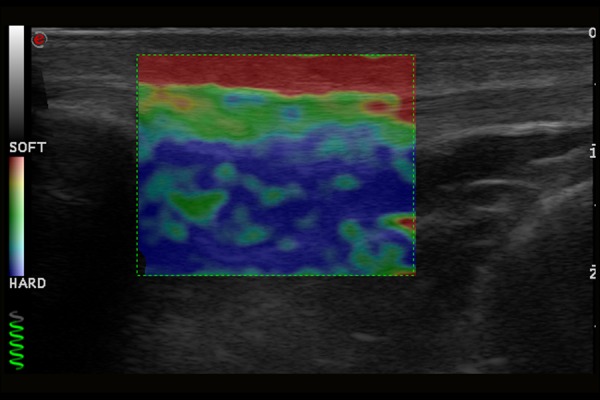
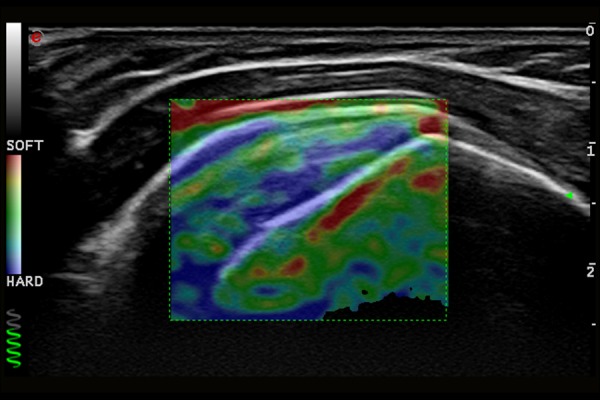
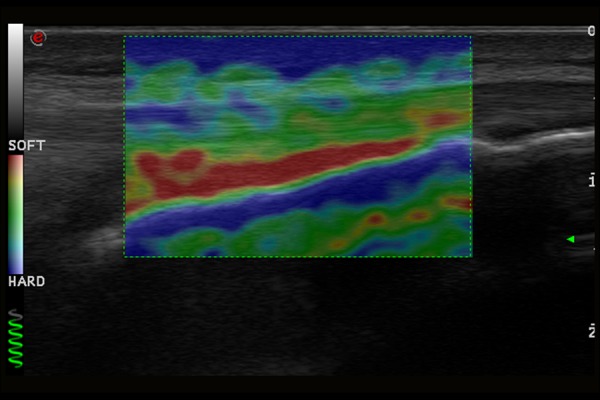
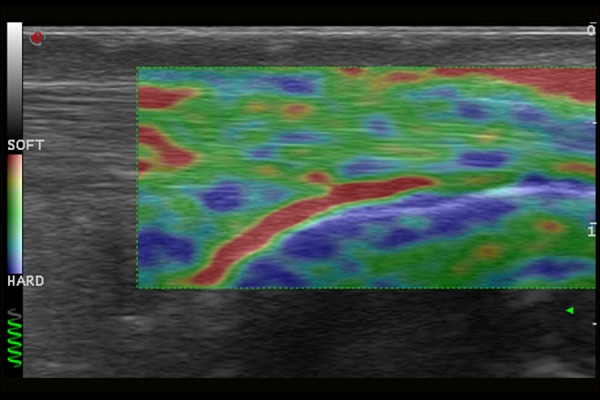
References
-
- Hall TJ. AAPM/RSNA physics tutorial for residents: topics in US: Beyond the basics: elasticity imaging with US. Radiographics. 2003;23:1657–71. - PubMed
-
- Garra BS. Imaging and estimation of tissue elasticity by ultrasound. Ultrasound Q. 2007;23:255–68. - PubMed
-
- Garra BS. Elastography: current status, future prospects, and making it work for you. Ultrasound Q. 2011;27:177–86. - PubMed
-
- Ophir J, Cespedes I, Ponnekanti H, et al. Elastography: a quantitative method for imaging the elasticity of biological tissues. Ultrason Imaging. 1991;13:111–34. - PubMed
-
- Lerner RM, Huang SR, Parker KJ. “Sonoelasticity” images derived from ultrasound signals in mechanically vibrated tissues. Ultrasound Med Biol. 1990;16:231–39. - PubMed
Publication types
LinkOut - more resources
Full Text Sources
Other Literature Sources
