. 2016 May 26;2(3):e80.
doi: 10.1212/NXG.0000000000000080. eCollection 2016 Jun.

Defining the spectrum of frontotemporal dementias associated with TARDBP mutations

Affiliations

Defining the spectrum of frontotemporal dementias associated with TARDBP mutations

Paola Caroppo et al. Neurol Genet. .

Abstract

Objectives: We describe the largest series of patients with TARDBP mutations presenting with frontotemporal dementia (FTD) and review the cases in the literature to precisely characterize FTD diseases associated with this genotype.

Methods: The phenotypic characteristics of 29 TARDBP patients, including 10 new French and Dutch cases and 19 reviewed from the literature, were evaluated.

Results: The most frequent phenotype was a behavioral variant frontotemporal dementia (bvFTD), but a significant proportion (40%) of our patients had semantic (svFTD) or nonfluent variants (nfvFTD) at onset; and svFTD was significantly more frequent in TARDBP carriers than in other FTD genotypes (p < 0.001). Remarkably, only a minority (40%) of our patients secondarily developed amyotrophic lateral sclerosis (ALS). Two patients carried a homozygous mutation but strikingly different phenotypes (bvFTD and ALS) indicating that homozygosity does not result in a specific phenotype. Earlier age at onset in children than parent's generations, mimicking an apparent "anticipation" (21.8 ± 9.3 years, p = 0.001), and possible reduced penetrance were present in most families.

Conclusions: This study enlarges the phenotypic spectrum of TARDBP and will have important clinical implications: (1) FTD can be the only clinical manifestation of TARDBP mutations; (2) Initial language or semantic disorders might be indicative of a specific genotype; (3) Mutations should be searched in all FTD phenotypes after exclusion of major genes, even in the absence of ALS in the proband or in family history; (4) reduced penetrance and clinical variability should be considered to deliver appropriate genetic counseling.


Figures
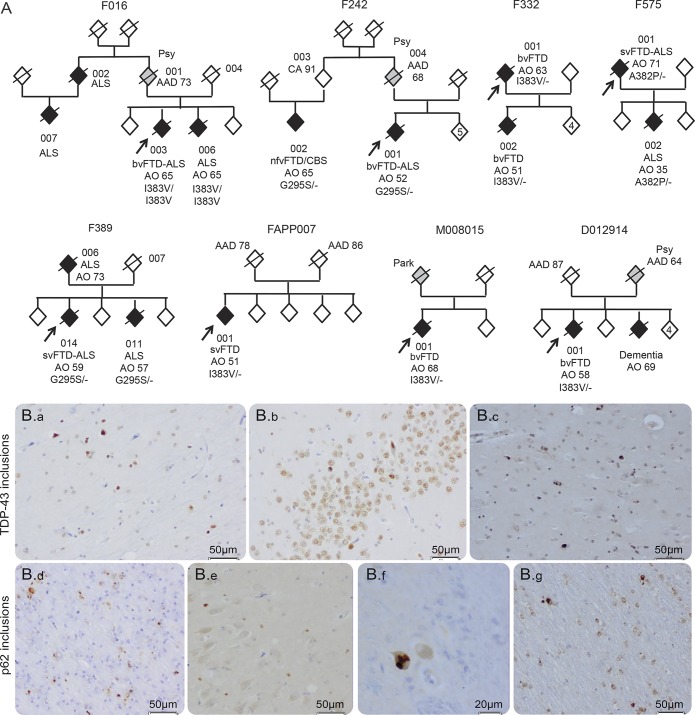
Figure 1
Figure 1. Pedigrees of the 8 families carrying TARDBP mutations (A) and pathologic examination of patient M008015-001 (B)
(A) Pedigrees of the 8 families carrying TARDBP mutations. Probands are indicated with an arrow. Individuals are represented by a diamond to preserve confidentiality. All affected members are represented in black. Individuals with an uncertain phenotype are represented in gray. AO = age at onset; AAD = age at death; CA = current age; the phenotypes are indicated for each affected individual. Genotypes are indicated for the individuals for whom DNA was available. Family F242: The obligate transmitter parent (004) died of suicide at age 68. Family 389: The mutation was not detected in 007, indicating that the transmitter was 006 who presented with isolated amyotrophic lateral sclerosis (ALS) at age 73 and died at age 74. One sibling (011) developed bulbar ALS without dementia at age 57. (B) Pathologic examination of patient M008015-001. Immunohistochemistry with TDP-43 and p62 antibodies showed TDP-43-positive neuronal inclusions in the hippocampus (a, b) and putamen (c); cytoplasmic p62-positive neuronal inclusions in the frontal cortex (d), hippocampus (e), medulla (f), and glial inclusions in the cerebellum (g).
Figure 2
Figure 2. Neuroimaging characteristics of TARDBP carriers
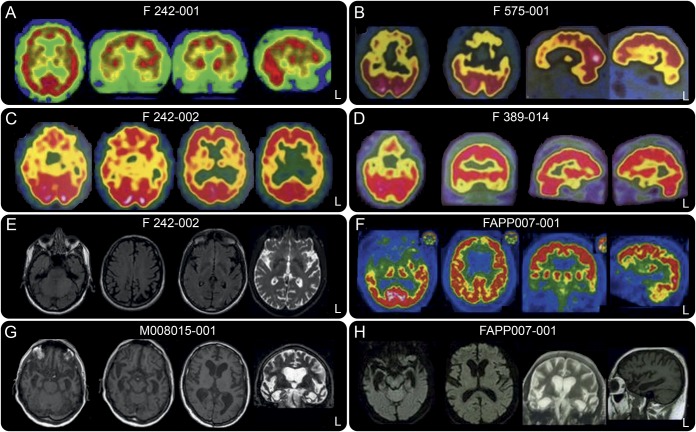
Brain 99mTc-ethylcysteinate dimer-SPECT, FDG-PET, and MRI of 6 patients: F242-001 (A), F575-001 (B), F242-002 (C and E), F389-014 (D), FAPP007-001 (F and H), and M008015-001 (G). Note the hypoperfusion and hypometabolism of the temporal pole in the 3 patients F575-001, F389-014, and FAPP007-001 presenting with semantic dementia.
Figure 3
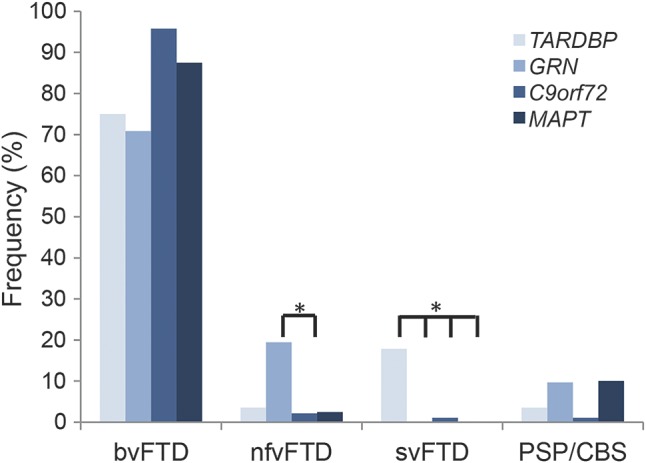
Figure 3. Frequencies of major FTD phenotypes according to the genotype in TARDBP, GRN, C9orf72, and MAPT carriers
The frequency of svFTD phenotype was higher in TARDBP carriers compared with GRN, C9orf72, and MAPT carriers (p < 0.001). The frequency of nfvFTD was not different in TARDBP carriers compared with others groups, but was higher in GRN carriers compared with C9orf72 carriers (p < 0.001). The frequencies of bvFTD and corticobasal syndrome (CBS) phenotypes were similar in the 4 groups. FTD = frontotemporal dementia; nfvFTD = nonfluent variant of frontotemporal dementia; svFTD = semantic variant of frontotemporal dementia.

References

    1. Gorno-Tempini ML, Hillis AE, Weintraub S, et al. Classification of primary progressive aphasia and its variants. Neurology 2011;76:1006–1014. - PMC - PubMed
    1. Rascovsky K, Hodges JR, Knopman D, et al. Sensitivity of revised diagnostic criteria for the behavioral variant of frontotemporal dementia. Brain 2011;134:2456–2477. - PMC - PubMed
    1. DeJesus-Hernandez M, Mackenzie IR, Boeve BF, et al. Expanded GGGGCC hexanucleotide repeat in noncoding region of C9ORF72 causes chromosome 9p-linked FTD and ALS. Neuron 2011;72:245–256. - PMC - PubMed
    1. Renton AE, Majounie E, Waite A, et al. A hexanucleotide repeat expansion in C9ORF72 is the cause of chromosome 9p21-linked ALS-FTD. Neuron 2011;72:257–268. - PMC - PubMed
    1. Lattante S, Rouleau GA, Kabashi E. TARDBP and FUS mutations associated with amyotrophic lateral sclerosis: summary and update. Hum Mutat 2013;34:812–826. - PubMed