Meta-Analysis
. 2016 Jun 9;11(6):e0157099.
doi: 10.1371/journal.pone.0157099. eCollection 2016.

Preclinical Studies of Mesenchymal Stem Cell (MSC) Administration in Chronic Obstructive Pulmonary Disease (COPD): A Systematic Review and Meta-Analysis

Affiliations
Meta-Analysis

Preclinical Studies of Mesenchymal Stem Cell (MSC) Administration in Chronic Obstructive Pulmonary Disease (COPD): A Systematic Review and Meta-Analysis

Xiangde Liu et al. PLoS One. .

Abstract

Background: In the last two decades, mesenchymal stem cells (MSCs) have been pre-clinically utilized in the treatment of a variety of kinds of diseases including chronic obstructive pulmonary disease (COPD). The aim of the current study was to systematically review and conduct a meta-analysis on the published pre-clinical studies of MSC administration in the treatment of COPD in animal models.

Methods and results: A systematic search of electronic databases was performed. Statistical analysis was performed using the Comprehensive Meta-Analysis software (Version 3). The pooled Hedges's g with 95% confidence intervals (95% CIs) was adopted to assess the effect size. Random effect model was used due to the heterogeneity between the studies. A total of 20 eligible studies were included in the current systematic review. The overall meta-analysis showed that MSC administration was significantly in favor of attenuating acute lung injury (Hedges's g = -2.325 ± 0.145 with 95% CI: -2.609 ~ -2.040, P < 0.001 for mean linear intercept, MLI; Hedges's g = -3.488 ± 0.504 with 95% CI: -4.476 ~ -2.501, P < 0.001 for TUNEL staining), stimulating lung tissue repair (Hedges's g = 3.249 ± 0.586 with 95% CI: 2.103~ 4.394, P < 0.001) and improving lung function (Hedges's g = 2.053 ± 0.408 with 95% CI: 1.253 ~ 2.854, P< 0.001). The mechanism of MSC therapy in COPD is through ameliorating airway inflammation (Hedges's g = -2.956 ± 0.371 with 95% CI: -3.683 ~ -2.229, P< 0.001) and stimulating cytokine synthesis that involves lung tissue repair (Hedges's g = 3.103 ± 0.734 with 95% CI: 1.664 ~ 4.541, P< 0.001).

Conclusion: This systematic review and meta-analysis suggest a promising role for MSCs in COPD treatment. Although the COPD models may not truly mimic COPD patients, these pre-clinical studies demonstrate that MSC hold promise in the treatment of chronic lung diseases including COPD. The mechanisms of MSCs role in preclinical COPD treatment may be associated with attenuating airway inflammation as well as stimulating lung tissue repair.


Conflict of interest statement

Competing Interests: The authors have declared that no competing interests exist.

Figures

Fig 1
Fig 1. Flow diagram of literature search and eligible publication selection.
Fig 2
Fig 2. Forest plot for the MSC effect on mean linear interception (MLI).
A random effect model was used due to significant heterogeneity of publications (I2 = 87.5, P < 0.01). Effect size was assessed by Hedges’s g and 95% CI, and the effect on MLI reduction was in favor of MSC treatment (Hedges’s g = -2.325 ± 0.145, 95% CI: -2.609~-2.040, P < 0.001) compared to control, which was the COPD model without MSC treatment.
Fig 3
Fig 3. Forest plot for the effect of MSCs on TUNEL positivity.
A random effect model was used due to significant heterogeneity of publications (I2 = 82.7, P < 0.01). Effect size was assessed by Hedges’s g and 95% CI, and the inhibitory effect on TUNEL positivity was in favor of MSC treatment (Hedges’s g = -3.488 ± 0.504, 95% CI: -4.478~-2.501, P < 0.001) compared to control group, which was the COPD model without MSC treatment.
Fig 4
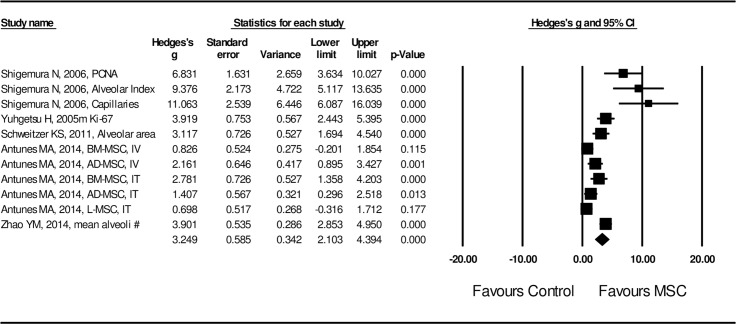
Fig 4. Forest plot for the effect of MSCs on lung tissue repair parameters.
A random effect model was used due to significant heterogeneity of publications was observed (I2 = 83.2, P <0.01). Effect size was assessed by Hedges’s g and 95% CI, and the stimulatory effect on lung tissue repair was in favor of MSC administration (Hedges’s g = 3.249 ± 0.586, 95% CI: 2.103~4.394, P < 0.001). Control group was the COPD model without MSC treatment.
Fig 5
Fig 5. Forest plot for the effect of MSCs on lung function in the COPD models.
A random effect model was used due to significant heterogeneity of publications (I2 = 80.1, P < 0.01). Effect size was assessed by Hedges’s g and 95% CI, and the effect on lung function improvement was in favor of MSC administration (Hedges’s g = 2.053 ± 0.408, 95% CI: 1.253~2.854, P < 0.001). Control group was the COPD model without MSC treatment.
Fig 6
Fig 6. Forest plot for the effect of MSCs on airway infiltration of inflammatory cells or release of pro-inflammatory cytokines in lung or blood.
A random effect model was used due to significant heterogeneity of publications (I2 = 84.8, P < 0.01). Effect size was assessed by Hedges’s g and 95% CI, and the inhibitory effect on airway inflammation and systemic inflammation was in favor of MSC administration (Hedges’s g = -2.956 ± 0.371, 95% CI: -3.683~-2.229, P < 0.001). Control group was the COPD model without MSC treatment.
Fig 7
Fig 7. Forest plot for the effect of MSCs on growth factors and anti-inflammatory cytokines.
A random effect model was used due to significant heterogeneity of publications (I2 = 88.0, P < 0.01). Effect size was assessed by Hedges’s g and 95% CI, and the stimulatory effect on growth factors and anti-inflammatory cytokines was in favor of MSC administration (Hedges’s g = 3.103 ± 0.734, 95% CI: 1.664~4.541, P < 0.001). Control group was the COPD model without MSC treatment.

References

    1. Armstrong L, Lako M, Buckley N, Lappin TR, Murphy MJ, Nolta JA, et al. Editorial: Our top 10 developments in stem cell biology over the last 30 years. Stem Cells. 2012;30(1):2–9. 10.1002/stem.1007 . - DOI - PubMed
    1. Caplan AI. Adult mesenchymal stem cells for tissue engineering versus regenerative medicine. J Cell Physiol. 2007;213(2):341–7. 10.1002/jcp.21200 . - DOI - PubMed
    1. Kern S, Eichler H, Stoeve J, Kluter H, Bieback K. Comparative analysis of mesenchymal stem cells from bone marrow, umbilical cord blood, or adipose tissue. Stem Cells. 2006;24(5):1294–301. 10.1634/stemcells.2005-0342 . - DOI - PubMed
    1. Minino AM. Death in the United States, 2009. NCHS Data Brief. 2011;(64):1–8. . - PubMed
    1. Kochanek KD, Xu J, Murphy SL, Minino AM, Kung HC. Deaths: preliminary data for 2009. Natl Vital Stat Rep. 2011;59(4):1–51. . - PubMed

MeSH terms