


Sleep Quality and Factors Influencing Self-Reported Sleep Duration and Quality in the General Internal Medicine Inpatient Population
- PMID: 27280292
- PMCID: PMC4900612
- DOI: 10.1371/journal.pone.0156735
Sleep Quality and Factors Influencing Self-Reported Sleep Duration and Quality in the General Internal Medicine Inpatient Population
Abstract
Background: Sleep quality in hospitalized Canadian General Internal Medicine patients is not well characterized. Our goals were to characterize hospital sleep quality in this population and identify potentially modifiable barriers to good sleep.
Methods: GIM inpatients at a quaternary centre in Edmonton, Canada completed a survey, including the Verran-Snyder Halpern (VSH) questionnaire, to characterize the previous night's sleep within 48 hours prior to discharge. A chart review was also completed to assess comorbidities, discharge diagnoses, and pharmaceutical sleep aid use.
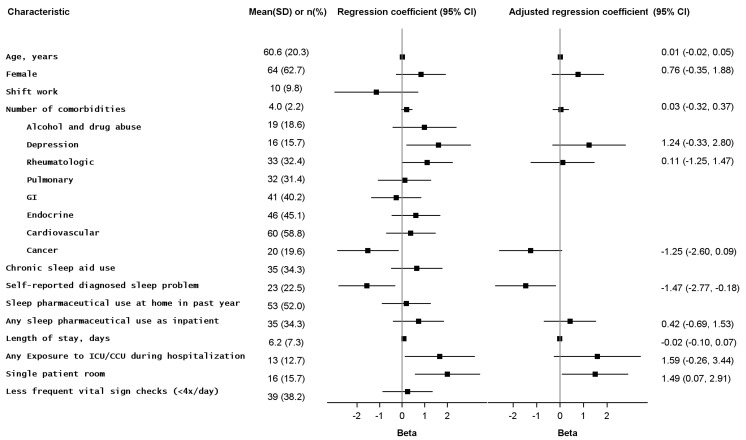
Results: Patients reported significantly worse nighttime sleep duration in hospital compared with home (mean 5.5 versus 7.0 hours per night, p < 0.0001). Sleep quality was poor, as measured by the VSH disturbance (mean 371), effectiveness (190), and supplementation (115) subscales. Variables independently associated with poorer sleep duration in multivariable regression include prior diagnosis of sleep disorder and multi-patient occupancy rooms. Age, sex, admitting diagnosis, length of stay, frequency of vital checks, and use of sleep pharmaceuticals during the index hospitalization were not associated with sleep duration. The most frequently reported reasons for poor sleep included noise (59%), nursing interruptions (30%), uncomfortable beds (18%), bright lights (16%), unfamiliar surroundings (14%), and pain (9%).
Conclusions: Sleep quality for GIM inpatients is significantly worse in hospital than at home. There is a need to test non-pharmacologic interventions to address the most frequently identified factors causing poor sleep hygiene for GIM inpatients.
Conflict of interest statement
Figures
References
-
- Ohayon MM. Epidemiology of insomnia: what we know and what we still need to learn. Sleep Med Rev. 2002;6;97–111. - PubMed
-
- Bonnet MH, Arand DL. Consequences of insomnia. Sleep Med Clin 2006;1;351–8.
-
- Knauert MP, Malik V, Kamdar BB. Sleep and sleep disordered breathing in hospitalized patients. Semin Resp Crit Care Med. 2014;35;582–92. - PubMed
-
- Kokras N, Kouzoupis A, Paparrigopoulos T,Ferentinos P, Karamanakos P, Kontoyannis DA, et al. Predicting insomnia in medical wards: the effect of anxiety, depression and admission diagnosis. Gen Hosp Psych. 2011;33;78–81. - PubMed
MeSH terms
LinkOut - more resources
Full Text Sources
Other Literature Sources
Medical
