Socioeconomic status, psychological resources, and inflammatory markers: Results from the MIDUS study
- PMID: 27280368
- PMCID: PMC5067959
- DOI: 10.1037/hea0000392
Socioeconomic status, psychological resources, and inflammatory markers: Results from the MIDUS study
Abstract
Objective: Our objective was to investigate interactions of psychological resources and socioeconomic status (SES)-as well as potential gender differences and the explanatory role of childhood and adult stress exposures, health behaviors, and negative and positive affect-in predicting markers of systemic inflammation.
Method: We utilized a sample of adults from the Midlife Development in the U.S. (MIDUS) study who provided biomarker data (N = 1,152). SES was operationalized as a composite of education, income, and occupational prestige, and the psychological resources construct was operationalized as a latent factor measured with optimism, perceived control, and self-esteem. Linear regression models examined these 2 factors and their interaction in predicting interleukin-6 (IL-6) and C-reactive protein (CRP) measured on average 2 years later, as well as 3-way interactions involving gender and the impact of covariate adjustment.
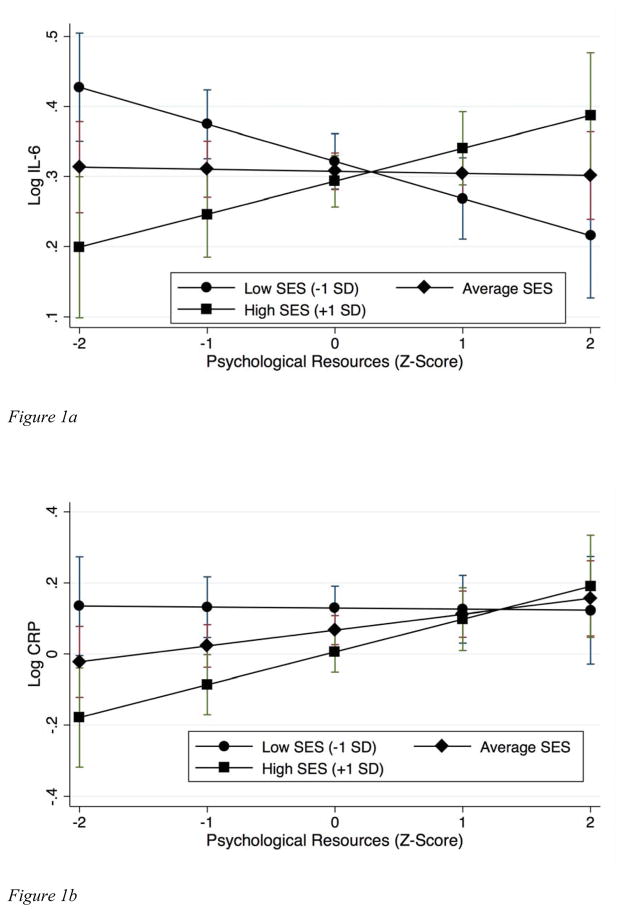
Results: Psychological resources interacted with SES in men (for IL-6: p < .001; for CRP: p = .04) but not in women. In men, greater psychological resources was associated with lower concentrations of IL-6 at lower levels of SES but higher concentrations of both markers at higher levels of SES. The inverse association between resources and IL-6 at low SES was moderately attenuated upon adjustment for negative affect.
Conclusion: Socioeconomic status might modulate the linkage between psychological resources and systemic inflammation in men. At lower levels of SES, resources may be related to lower inflammation in part through lower negative affect. Associations with higher inflammation at higher SES add to growing evidence suggesting that adaptive psychological characteristics may be associated with markers of poorer physiological function under certain conditions. (PsycINFO Database Record
(c) 2016 APA, all rights reserved).
Conflict of interest statement
Conflicts of Interest: None declared.
Figures
References
-
- Albus C. Psychological and social factors in coronary heart disease. Annals of Medicine. 2010;42(7):487–494. - PubMed
-
- Baum A, Garofalo JP, Yali A. Socioeconomic status and chronic stress: Does stress account for SES effects on health? Annals of the New York Academy of Sciences. 1999;896(1):131–144. - PubMed
-
- Bjarnason-Wehrens B, Grande G, Loewel H, Voller H, Mittag O. Gender-specific issues in cardiac rehabilitation: Do women with ischaemic heart disease need specially tailored programmes? European Journal of Cardiovascular Prevention and Rehabilitation. 2007;14(2):163–171. - PubMed
MeSH terms
Substances
Grants and funding
LinkOut - more resources
Full Text Sources
Other Literature Sources
Medical
Research Materials
Miscellaneous